
小鼠组织驻留性腹膜巨噬细胞在稳态、修复、感染和肿瘤转移中的作用。
Mouse Tissue-Resident Peritoneal Macrophages in Homeostasis, Repair, Infection, and Tumor Metastasis.
机构信息
Departamento de Inmunología y Oncología, Centro Nacional de Biotecnología/CSIC, Darwin 3, Madrid, 28049, Spain.
出版信息
Adv Sci (Weinh). 2023 Apr;10(11):e2206617. doi: 10.1002/advs.202206617. Epub 2023 Jan 19.
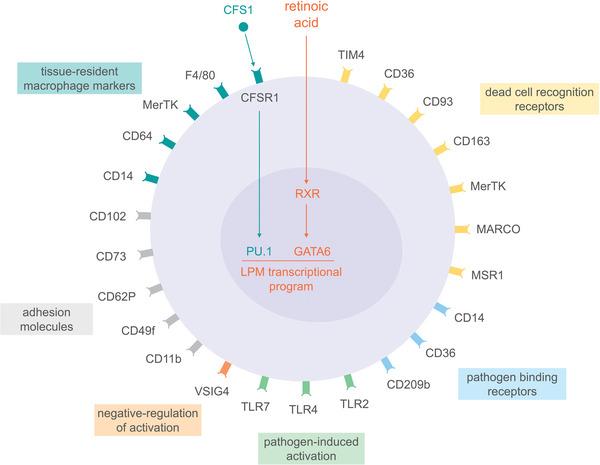
Large peritoneal macrophages (LPMs) are long-lived, tissue-resident macrophages, formed during embryonic life, developmentally and functionally confined to the peritoneal cavity. LPMs provide the first line of defense against life-threatening pathologies of the peritoneal cavity, such as abdominal sepsis, peritoneal metastatic tumor growth, or peritoneal injuries caused by trauma, or abdominal surgery. Apart from their primary phagocytic function, reminiscent of primitive defense mechanisms sustained by coelomocytes in the coelomic cavity of invertebrates, LPMs fulfill an essential homeostatic function by achieving an efficient clearance of apoptotic, that is crucial for the maintenance of self-tolerance. Research performed over the last few years, in mice, has unveiled the mechanisms by which LPMs fulfill a crucial role in repairing peritoneal injuries and controlling microbial and parasitic infections, reflecting that the GATA6-driven LPM transcriptional program can be modulated by extracellular signals associated with pathological conditions. In contrast, recent experimental evidence supports that peritoneal tumors can subvert LPM metabolism and function, leading to the acquisition of a tumor-promoting potential. The remarkable functional plasticity of LPMs can be nevertheless exploited to revert tumor-induced LPM protumor potential, providing the basis for the development of novel immunotherapeutic approaches against peritoneal tumor metastasis based on macrophage reprogramming.
大腹腔巨噬细胞(LPMs)是长寿命的组织驻留巨噬细胞,在胚胎发育过程中形成,在发育和功能上局限于腹腔。LPMs 为腹腔内危及生命的病理情况提供第一道防线,例如腹部败血症、腹膜转移性肿瘤生长或创伤或腹部手术引起的腹膜损伤。除了它们的主要吞噬功能外,类似于无脊椎动物体腔中的腔细胞维持的原始防御机制,LPMs 通过有效清除凋亡细胞来实现重要的稳态功能,这对于维持自身耐受至关重要。过去几年在小鼠中进行的研究揭示了 LPMs 发挥关键作用的机制,修复腹膜损伤和控制微生物和寄生虫感染,反映出 GATA6 驱动的 LPM 转录程序可以被与病理状况相关的细胞外信号调节。相比之下,最近的实验证据支持腹膜肿瘤可以颠覆 LPM 代谢和功能,导致获得促进肿瘤的潜力。然而,LPMs 的显著功能可塑性可以被利用来逆转肿瘤诱导的 LPM 促肿瘤潜力,为基于巨噬细胞重编程的新型免疫治疗方法开发提供了针对腹膜肿瘤转移的基础。


 Zotero 插件