
组氨酸桥:大自然的铜替代血红素?
The histidine brace: nature's copper alternative to haem?
机构信息
Department of Chemistry, University of York, UK.
出版信息
FEBS Lett. 2023 Feb;597(4):485-494. doi: 10.1002/1873-3468.14579. Epub 2023 Jan 29.
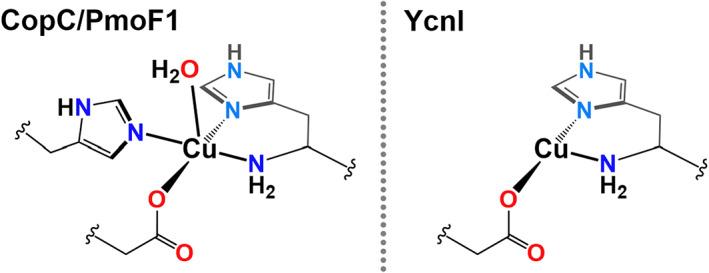
The copper histidine brace is a structural unit in metalloproteins (Proc Natl Acad Sci USA 2011, 108, 15079). It consists of a copper ion chelated by the NH and π-N atom of an N-terminal histidine, and the τ-N atom of a further histidine, in an overall T-shaped coordination geometry (Nat Catal 2018, 1, 571). Like haem-containing proteins, histidine-brace-containing proteins have peroxygenase and/or oxygenase activity, where the substrates are notable for resistance to oxidation, for example, lytic polysaccharide monooxygenases (LPMOs). Moreover, the histidine brace is an invariant unit around which different protein structures exert different activities. Given the similarities in the diversity of function of proteins that contain either the copper histidine brace or haem, the question arises as to whether the functions of histidine brace-containing proteins duplicate those containing haem groups.
铜组氨酸臂是金属蛋白酶中的一个结构单元(美国国家科学院院刊 2011 年,108 期,15079)。它由一个铜离子组成,由一个 N 端组氨酸的 NH 和π-N 原子以及另一个组氨酸的τ-N 原子螯合,形成一个整体的 T 型配位几何形状(自然催化 2018 年,1 期,571)。与含有血红素的蛋白质一样,含有组氨酸臂的蛋白质具有过氧化物酶和/或加氧酶活性,其底物的特点是对氧化具有抗性,例如溶菌多糖单加氧酶(LPMOs)。此外,组氨酸臂是一个不变的单元,不同的蛋白质结构围绕它发挥不同的活性。鉴于含有铜组氨酸臂或血红素的蛋白质在功能多样性上存在相似性,就出现了这样一个问题:是否含有组氨酸臂的蛋白质的功能与含有血红素基团的蛋白质的功能相同。


 Zotero 插件