
大麻纤维和抗冲改性剂在多相聚丙烯体系中的复杂作用
Complex Effects of Hemp Fibers and Impact Modifiers in Multiphase Polypropylene Systems.
作者信息
Panaitescu Denis Mihaela, Vuluga Zina, Frone Adriana Nicoleta, Gabor Augusta Raluca, Nicolae Cristian-Andi, Uşurelu Cătălina-Diana
机构信息
Polymer Department, National Institute for Research and Development in Chemistry and Petrochemistry ICECHIM, 202 Splaiul Independentei, 060021 Bucharest, Romania.
出版信息
Polymers (Basel). 2023 Jan 12;15(2):409. doi: 10.3390/polym15020409.
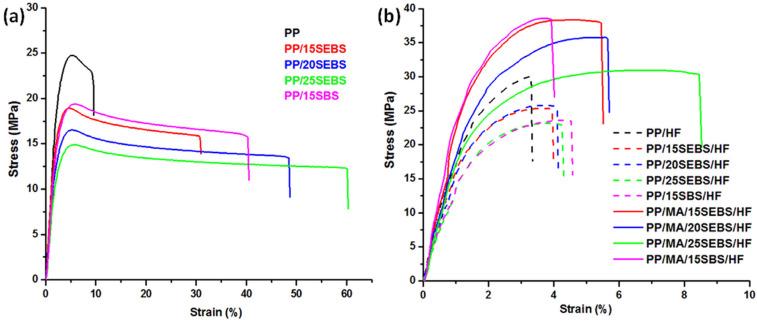
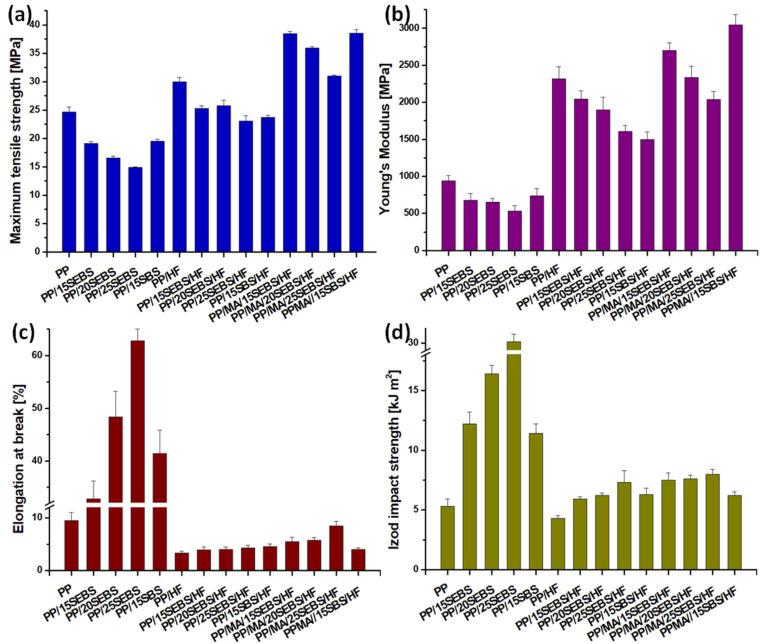
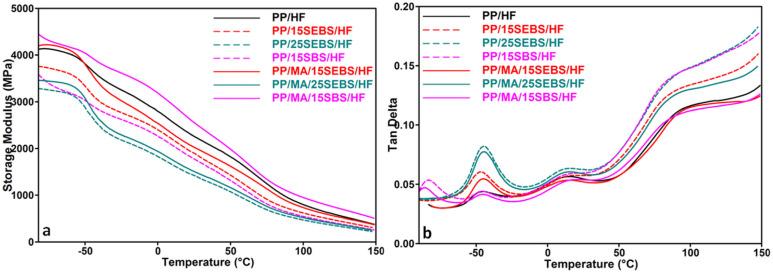
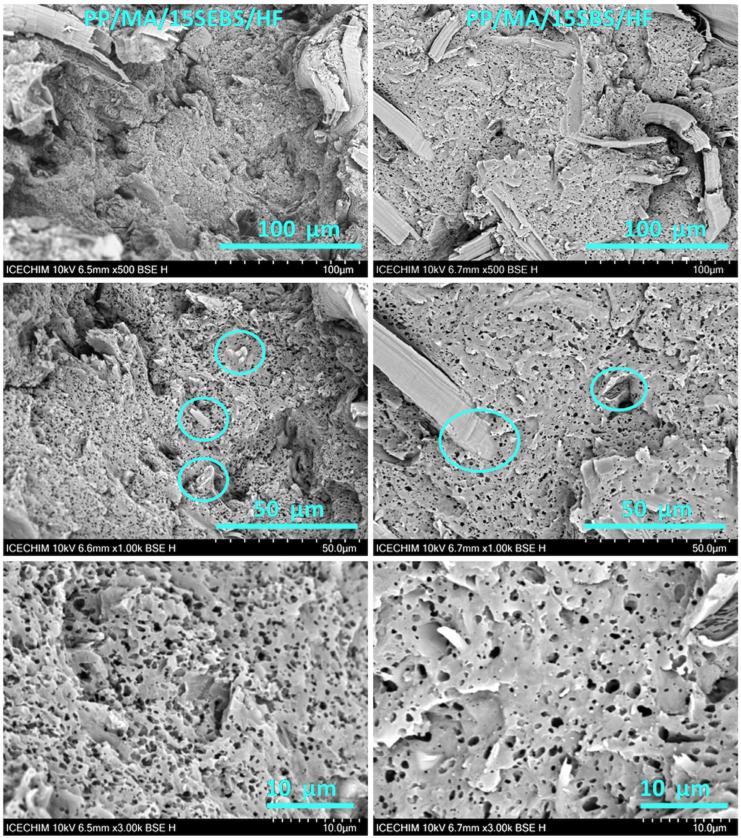
Natural fibers-reinforced polymer composites have progressed rapidly due to their undeniable advantages. Most of the commercial polypropylene (PP)-based materials are characterized by either high impact toughness or high stiffness, while the manufacture of PP composites with both good toughness and stiffness is challenging at present. In this work, poly[styrene--(ethylene-co-butylene)--styrene] (SEBS) and poly(styrene--butadiene--styrene) (SBS) copolymers were used in different amounts as modifiers in PP/hemp fibers (HF) composites, with the aim to use them for electrical vehicle parts. The interface in these multiphase systems was controlled by the addition of maleated polypropylene (MAPP). SEBS and SBS showed different effects on the elongation at break of the blends and the corresponding composites due to the HF that stiffened the multiphase systems. Similarly, a different action of MAPP was observed in the composites containing SEBS or SBS: higher Young's and storage moduli were obtained for the composite containing SBS, while greater elongation at break and impact strength values were recorded for the SEBS-containing system. In addition, a remarkable dispersion in the MAPP-containing composite and two times smaller average particle size were revealed by the SEM analysis for the SEBS particles compared to the SBS ones. The higher affinity of SEBS for PP compared to that for SBS and the different morphological characteristics of the systems containing SEBS and SBS may explain the different effects of these impact modifiers on the mechanical properties of the composites. The composites developed in this work were designed as substitutes for the fully synthetic polymeric materials or metal components used in the manufacturing of automotive parts.
天然纤维增强聚合物复合材料因其不可否认的优势而发展迅速。大多数商用聚丙烯(PP)基材料的特点是具有高冲击韧性或高刚度,而目前制造兼具良好韧性和刚度的PP复合材料具有挑战性。在这项工作中,聚[苯乙烯-(乙烯-共-丁烯)-苯乙烯](SEBS)和聚(苯乙烯-丁二烯-苯乙烯)(SBS)共聚物以不同用量用作PP/麻纤维(HF)复合材料的改性剂,旨在将其用于电动汽车部件。这些多相体系中的界面通过添加马来酸酐接枝聚丙烯(MAPP)来控制。由于HF使多相体系变硬,SEBS和SBS对共混物及相应复合材料的断裂伸长率表现出不同的影响。同样,在含有SEBS或SBS的复合材料中观察到MAPP的不同作用:含有SBS的复合材料获得了更高的杨氏模量和储能模量,而含有SEBS的体系记录到了更大的断裂伸长率和冲击强度值。此外,SEM分析显示,与SBS颗粒相比,含有MAPP的复合材料中SEBS颗粒具有显著的分散性,且平均粒径小两倍。与SBS相比,SEBS对PP具有更高的亲和力,以及含有SEBS和SBS的体系具有不同的形态特征,这可能解释了这些抗冲改性剂对复合材料力学性能的不同影响。这项工作中开发的复合材料被设计用作汽车零部件制造中使用的全合成聚合物材料或金属部件的替代品。



 Zotero 插件