
基于随机抗菌肽混合物的阻抗式细菌检测
Impedimetric Bacterial Detection Using Random Antimicrobial Peptide Mixtures.
机构信息
Institute of Biochemistry, Food Science and Nutrition, Robert H. Smith Faculty of Agriculture, Food and Environment, The Hebrew University of Jerusalem, Rehovot 76100, Israel.
Institute of Chemistry and the Center for Nanoscience and Nanotechnology, The Hebrew University of Jerusalem, Jerusalem 91904, Israel.
出版信息
Sensors (Basel). 2023 Jan 4;23(2):561. doi: 10.3390/s23020561.
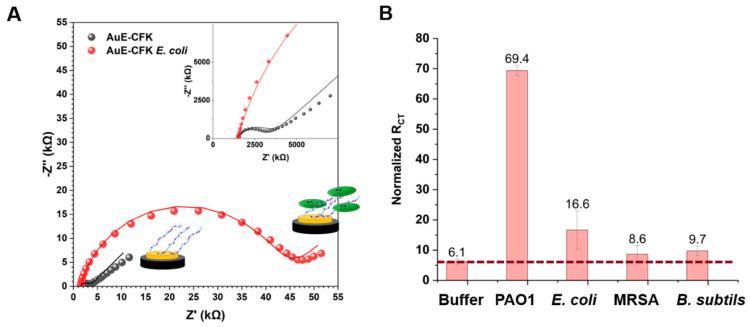
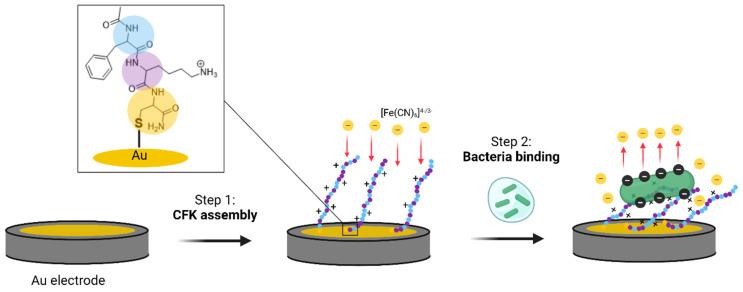
The biosensing of bacterial pathogens is of a high priority. Electrochemical biosensors are an important future tool for rapid bacteria detection. A monolayer of bacterial-binding peptides can serve as a recognition layer in such detection devices. Here, we explore the potential of random peptide mixtures (RPMs) composed of phenylalanine and lysine in random sequences and of controlled length, to form a monolayer that can be utilized for sensing. RPMs were found to assemble in a thin and diluted layer that attracts various bacteria. Faradaic electrochemical impedance spectroscopy was used with modified gold electrodes to measure the charge-transfer resistance (R) caused due to the binding of bacteria to RPMs. was found to cause the most prominent increase in R compared to other model bacteria. We show that the combination of highly accessible antimicrobial RPMs and electrochemical analysis can be used to generate a new promising line of bacterial biosensors.
细菌病原体的生物传感是当务之急。电化学生物传感器是快速细菌检测的重要未来工具。细菌结合肽的单层可以作为此类检测设备中的识别层。在这里,我们探索了由苯丙氨酸和赖氨酸组成的随机肽混合物(RPM)的潜力,这些混合物具有随机序列和受控长度,可形成可用于传感的单层。发现 RPM 组装成薄且稀释的层,可吸引各种细菌。使用修饰的金电极进行的法拉第电化学阻抗光谱法用于测量由于细菌与 RPM 结合而引起的电荷转移电阻(R)。与其他模式细菌相比, 被发现导致 R 明显增加。我们表明,高可及性的抗微生物 RPM 与电化学分析的结合可用于生成新的有前途的细菌生物传感器系列。



 Zotero 插件