
伤口愈合过程中巨噬细胞极化的表观遗传调控
Epigenetic regulation of macrophage polarization in wound healing.
作者信息
Chen Cheng, Liu Tengfei, Tang Yuanyang, Luo Gaoxing, Liang Guangping, He Weifeng
机构信息
State Key Laboratory of Trauma, Burn and Combined Injury, Institute of Burn Research, Southwest Hospital, Third Military Medical University (Army Medical University), Chongqing 400038, China.
Chongqing Key Laboratory for Disease Proteomics, Chongqing 400038, China.
出版信息
Burns Trauma. 2023 Jan 17;11:tkac057. doi: 10.1093/burnst/tkac057. eCollection 2023.
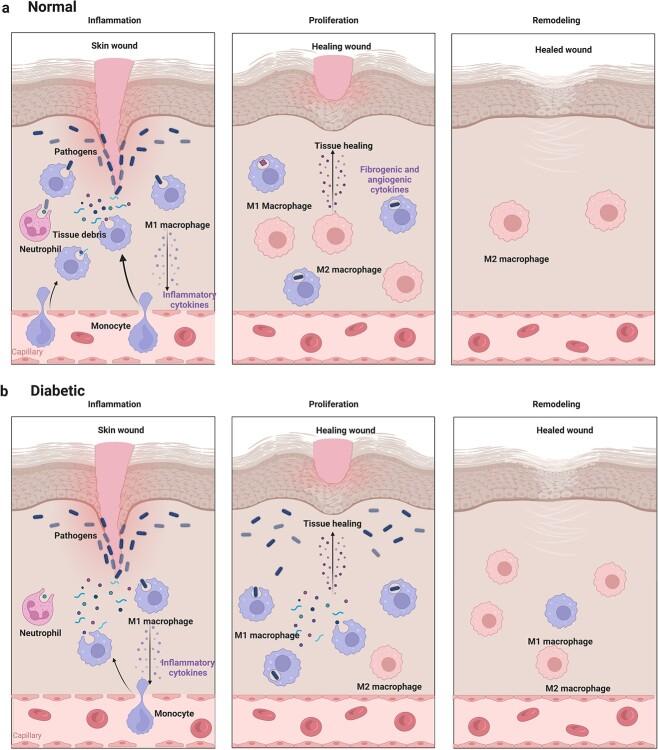
The immune microenvironment plays a critical role in regulating skin wound healing. Macrophages, the main component of infiltrating inflammatory cells, play a pivotal role in shaping the immune microenvironment in the process of skin wound healing. Macrophages comprise the classic proinflammatory M1 subtype and anti-inflammatory M2 population. In the early inflammatory phase of skin wound closure, M1-like macrophages initiate and amplify the local inflammatory response to disinfect the injured tissue. In the late tissue-repairing phase, M2 macrophages are predominant in wound tissue and limit local inflammation to promote tissue repair. The biological function of macrophages is tightly linked with epigenomic organization. Transcription factors are essential for macrophage polarization. Epigenetic modification of transcription factors determines the heterogeneity of macrophages. In contrast, transcription factors also regulate the expression of epigenetic enzymes. Both transcription factors and epigenetic enzymes form a complex network that regulates the plasticity of macrophages. Here, we describe the latest knowledge concerning the potential epigenetic mechanisms that precisely regulate the biological function of macrophages and their effects on skin wound healing.
免疫微环境在调节皮肤伤口愈合中起着关键作用。巨噬细胞是浸润性炎症细胞的主要成分,在皮肤伤口愈合过程中塑造免疫微环境方面发挥着关键作用。巨噬细胞包括经典的促炎性M1亚型和抗炎性M2群体。在皮肤伤口闭合的早期炎症阶段,M1样巨噬细胞启动并放大局部炎症反应以对受损组织进行消毒。在后期组织修复阶段,M2巨噬细胞在伤口组织中占主导地位,并限制局部炎症以促进组织修复。巨噬细胞的生物学功能与表观基因组组织紧密相连。转录因子对巨噬细胞极化至关重要。转录因子的表观遗传修饰决定了巨噬细胞的异质性。相反,转录因子也调节表观遗传酶的表达。转录因子和表观遗传酶都形成一个复杂的网络,调节巨噬细胞的可塑性。在此,我们描述了有关精确调节巨噬细胞生物学功能及其对皮肤伤口愈合影响的潜在表观遗传机制的最新知识。


 Zotero 插件