
肝细胞癌中的代谢组学:从生物标志物发现到精准医学。
Metabolomics in hepatocellular carcinoma: From biomarker discovery to precision medicine.
作者信息
Wu Xingyun, Wang Zihao, Luo Li, Shu Dan, Wang Kui
机构信息
West China School of Basic Medical Science & Forensic Medicine, Sichuan University, Chengdu, China.
Department of Gastrointestinal Surgery, West China Hospital, Sichuan University, Chengdu, China.
出版信息
Front Med Technol. 2023 Jan 4;4:1065506. doi: 10.3389/fmedt.2022.1065506. eCollection 2022.
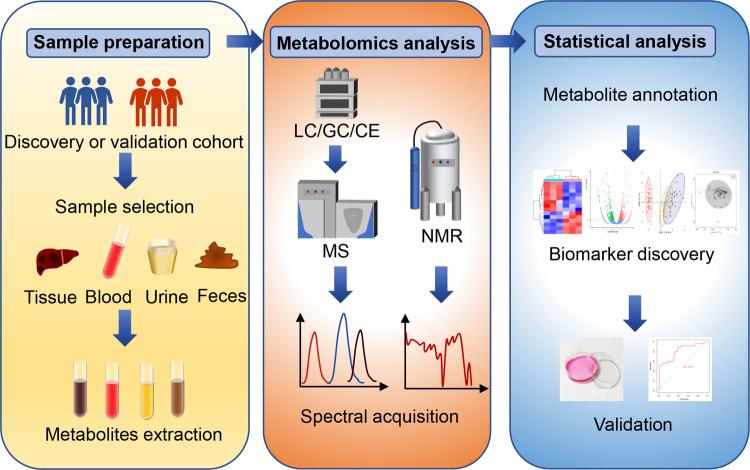
Hepatocellular carcinoma (HCC) remains a global health burden, and is mostly diagnosed at late and advanced stages. Currently, limited and insensitive diagnostic modalities continue to be the bottleneck of effective and tailored therapy for HCC patients. Moreover, the complex reprogramming of metabolic patterns during HCC initiation and progression has been obstructing the precision medicine in clinical practice. As a noninvasive and global screening approach, metabolomics serves as a powerful tool to dynamically monitor metabolic patterns and identify promising metabolite biomarkers, therefore holds a great potential for the development of tailored therapy for HCC patients. In this review, we summarize the recent advances in HCC metabolomics studies, including metabolic alterations associated with HCC progression, as well as novel metabolite biomarkers for HCC diagnosis, monitor, and prognostic evaluation. Moreover, we highlight the application of multi-omics strategies containing metabolomics in biomarker discovery for HCC. Notably, we also discuss the opportunities and challenges of metabolomics in nowadays HCC precision medicine. As technologies improving and metabolite biomarkers discovering, metabolomics has made a major step toward more timely and effective precision medicine for HCC patients.
肝细胞癌(HCC)仍然是一个全球性的健康负担,并且大多在晚期和进展期被诊断出来。目前,有限且不敏感的诊断方式仍然是肝癌患者有效和精准治疗的瓶颈。此外,在肝癌发生和发展过程中代谢模式的复杂重编程一直阻碍着临床实践中的精准医学。作为一种非侵入性的全局筛查方法,代谢组学是动态监测代谢模式和识别有前景的代谢物生物标志物的有力工具,因此在开发针对肝癌患者的精准治疗方面具有巨大潜力。在这篇综述中,我们总结了肝癌代谢组学研究的最新进展,包括与肝癌进展相关的代谢改变,以及用于肝癌诊断、监测和预后评估的新型代谢物生物标志物。此外,我们强调了包含代谢组学的多组学策略在肝癌生物标志物发现中的应用。值得注意的是,我们还讨论了代谢组学在当今肝癌精准医学中的机遇和挑战。随着技术的进步和代谢物生物标志物的发现,代谢组学在为肝癌患者提供更及时有效的精准医学方面迈出了重要一步。

 Zotero 插件