
白蛋白紫杉醇联合吉西他滨对比 mFOLFIRINOX 一线治疗转移性胰腺癌的疗效和安全性:一项回顾性研究。
The efficacy and safety of Nab-paclitaxel plus gemcitabine versus mFOLFIRINOX in the first-line treatment of metastatic pancreatic cancer: a retrospective study.
机构信息
Hubei Cancer Clinical Study Center, Hubei Key Laboratory of Tumor Biological Behaviors, Zhongnan Hospital, Wuhan University, Wuhan, China.
Department of Radiation Oncology & Medical Oncology, Zhongnan Hospital, Wuhan University, No 169 Donghu Road, Wuchang District, Hubei, Wuhan 430071, China.
出版信息
World J Surg Oncol. 2023 Jan 23;21(1):19. doi: 10.1186/s12957-023-02896-z.
BACKGROUND
Nab-paclitaxel plus gemcitabine (AG) and modified FOLFIRINOX (FFX) are two systemic therapies that have been widely used as standard first-line chemotherapy regimens in metastatic pancreatic cancer. However, since there is no clinical trial to directly compare the efficacy and safety of the two regimens, it is not clear which regimen is more effective. In this study, we aim to examine and compare the efficacy and safety of AG and FFX as first-line chemotherapy regimens in Chinese patients with metastatic pancreatic cancer in a real-world setting.
METHODS
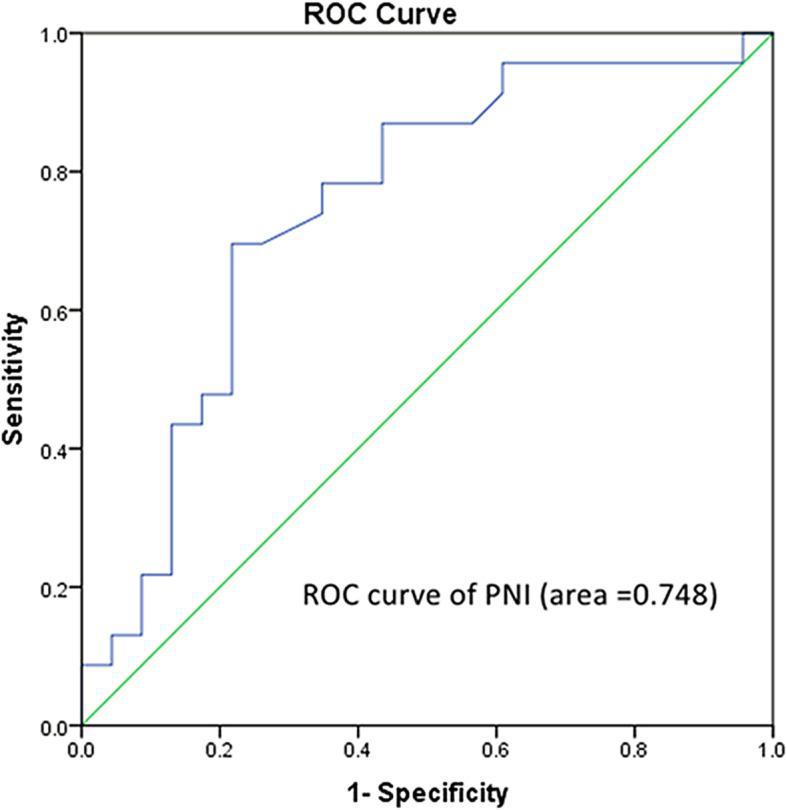
We retrospectively evaluated the outcomes of 44 patients who were diagnosed with metastatic pancreatic cancer and were treated with either AG (n = 24) or FFX (n = 20) as first-line chemotherapy between March 2017 and February 2022 at Zhongnan Hospital of Wuhan University. Prognostic nutrition index (PNI) was calculated based on the serum albumin level and peripheral lymphocyte count. According to the optimal cutoff value of PNI, patients were divided into low PNI group (PNI < 43.70) and high PNI group (PNI ≥ 43.70).
RESULTS
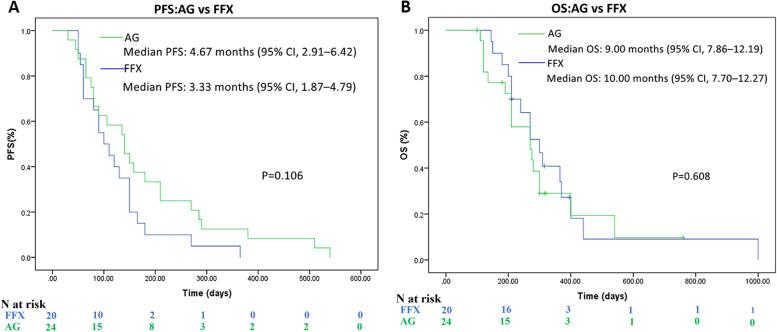
Of 44 patients in this study, 24 were treated with AG, and 20 were treated with FFX as first-line chemotherapy. No significant differences in baseline characteristics were found between the two groups. The objective response rate (ORR) was 16.7% in the AG group and 20.0% in the FFX group. The disease control rate (DCR) was 70.8% in the AG group and 60.0% in the FFX group. There was no significant difference in PFS or OS between the AG group and the FFX group. The median progression-free survival (PFS) was 4.67 months (95% confidence interval [CI], 2.91-6.42) in the AG group and 3.33 months (95% CI, 1.87-4.79, p = 0.106) in the FFX group. The median overall survival (OS) was 9.00 months (95% CI, 7.86-12.19) in the AG group and 10.00 months (95% CI, 7.70-12.27, p = 0.608) in the FFX group. The second-line treatment rate was 62.5% in the AG group and 55.0% in the FFX group. Immune checkpoint inhibitors (ICIs) based regimens are common second-line treatment options whether in AG or FFX group. Significantly more grade 3-4 peripheral neuropathy occurred in the AG than FFX groups (4 (20.8%) vs 0 (0.0%), p = 0.030*). The patients in the PNI (Prognostic nutrition index) ≥ 43.7 group had a significant longer median OS (PNI ≥ 43.7 vs PNI < 43.7: 10.33 vs 8.00 months, p = 0.019).
CONCLUSION
AG and FFX showed comparable efficacy outcomes in patients with metastatic pancreatic cancer. Pancreatic cancer patients receiving first-line chemotherapy with good nutritional status are likely to have a better prognosis.
背景
纳布紫杉醇联合吉西他滨(AG)和改良 FOLFIRINOX(FFX)是两种已广泛用于转移性胰腺癌的标准一线化疗方案的系统疗法。然而,由于没有临床试验直接比较这两种方案的疗效和安全性,因此尚不清楚哪种方案更有效。在这项研究中,我们旨在检查和比较 AG 和 FFX 作为中国转移性胰腺癌患者一线化疗方案的疗效和安全性。
方法
我们回顾性评估了 2017 年 3 月至 2022 年 2 月在武汉大学中南医院接受 AG(n=24)或 FFX(n=20)作为一线化疗的 44 例转移性胰腺癌患者的结局。预后营养指数(PNI)是根据血清白蛋白水平和外周淋巴细胞计数计算得出的。根据 PNI 的最佳截断值,患者被分为低 PNI 组(PNI<43.70)和高 PNI 组(PNI≥43.70)。
结果
本研究中 44 例患者中,24 例接受 AG 治疗,20 例接受 FFX 作为一线化疗。两组患者的基线特征无显著差异。AG 组的客观缓解率(ORR)为 16.7%,FFX 组为 20.0%。AG 组疾病控制率(DCR)为 70.8%,FFX 组为 60.0%。AG 组和 FFX 组的无进展生存期(PFS)或总生存期(OS)无显著差异。AG 组中位 PFS 为 4.67 个月(95%CI,2.91-6.42),FFX 组为 3.33 个月(95%CI,1.87-4.79,p=0.106)。AG 组中位 OS 为 9.00 个月(95%CI,7.86-12.19),FFX 组为 10.00 个月(95%CI,7.70-12.27,p=0.608)。AG 组二线治疗率为 62.5%,FFX 组为 55.0%。AG 组和 FFX 组常见的二线治疗方案均为免疫检查点抑制剂(ICIs)。AG 组 3-4 级周围神经病变的发生率明显高于 FFX 组(4[20.8%]vs 0[0.0%],p=0.030*)。PNI(预后营养指数)≥43.7 组的中位 OS 显著延长(PNI≥43.7 vs PNI<43.7:10.33 vs 8.00 个月,p=0.019)。
结论
AG 和 FFX 在转移性胰腺癌患者中的疗效结果相当。接受一线化疗的胰腺癌患者营养状况良好,预后可能更好。

 Zotero 插件