
MSI2 缺陷可通过影响肠道微生物群来减弱 ILC3 对 DSS 诱导的结肠炎的作用。
MSI2 deficiency in ILC3s attenuates DSS-induced colitis by affecting the intestinal microbiota.
机构信息
Department of Organ Transplantation, Xiang'an Hospital, Xiamen University, Xiamen, Fujian, China.
Fujian Provincial Key Laboratory of Organ and Tissue Regeneration, Organ Transplantation Institute of Xiamen University, School of Medicine, Xiamen University, Xiamen, Fujian, China.
出版信息
Front Immunol. 2023 Jan 12;13:963379. doi: 10.3389/fimmu.2022.963379. eCollection 2022.
BACKGROUND
The etiology and pathogenesis of inflammatory bowel disease (IBD), including ulcerative colitis (UC) and Crohn's disease (CD), are generally believed to be related to immune dysfunction and intestinal microbiota disorder. However, the exact mechanism is not yet fully understood. The pathological changes associated with dextran sodium sulfate (DSS)-induced colitis are similar to those in human UC. As a subgroup of the innate immune system, group 3 innate lymphoid cells (ILC3s) are widely distributed in the lamina propria of the intestinal mucosa, and their function can be regulated by a variety of molecules. Musashi2 (MSI2) is a type of evolutionarily conserved RNA-binding protein that maintains the function of various tissue stem cells and is essential for postintestinal epithelial regeneration. The effect of MSI2 deficiency in ILC3s on IBD has not been reported. Thus, mice with conditional MSI2 knockout in ILC3s were used to construct a DSS-induced colitis model and explore its effects on the pathogenesis of IBD and the species, quantity and function of the intestinal microbiota.
METHODS
mice ( ) and mice ( ) were induced by DSS to establish the IBD model. The severity of colitis was evaluated by five measurements: body weight percentage, disease activity index, colon shortening degree, histopathological score and routine blood examination. The species, quantity and function of the intestinal microbiota were characterized by high-throughput 16S rRNA gene sequencing of DNA extracted from fecal samples.
RESULTS
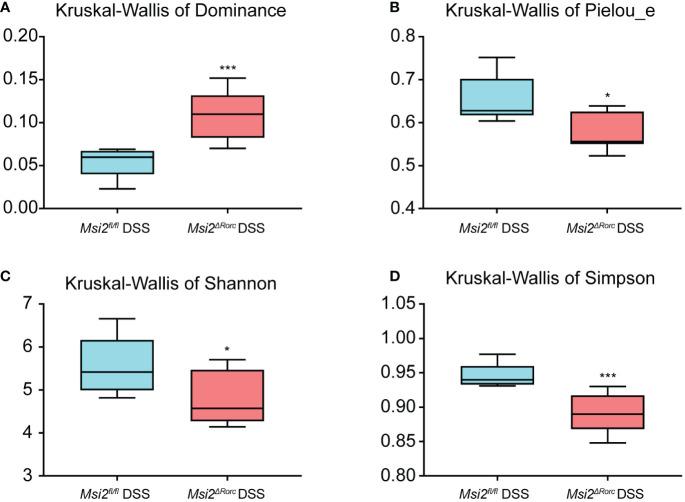
MSI2 was knocked out in the ILC3s of mice. The mice exhibited reductions in body weight loss, the disease activity index, degree of colon shortening, tissue histopathological score and immune cells in the peripheral blood compared to those of mice after DSS administration. The 16S rRNA sequencing results showed that the diversity of the intestinal microbiota in DSS-treated mice changed, with the abundance of Firmicutes increasing and that of Bacteroidetes decreasing. The linear discriminant analysis effect size (LEfSe) approach revealed that Lactobacillaceae could be the key bacteria in the mouse during the improvement of colitis. Using PICRUST2 to predict the function of the intestinal microbiota, it was found that the functions of differential bacteria inferred by modeling were mainly enriched in infectious diseases, immune system and metabolic functions.
CONCLUSIONS
MSI2 deficiency in ILC3s attenuated DSS-induced colonic inflammation in mice and affected intestinal microbiota diversity, composition, and function, with Lactobacillaceae belonging to the phylum Firmicutes possibly representing the key bacteria. This finding could contribute to our understanding of the pathogenesis of IBD and provide new insights for its clinical diagnosis and treatment.
背景
炎症性肠病(IBD)的病因和发病机制,包括溃疡性结肠炎(UC)和克罗恩病(CD),一般认为与免疫功能障碍和肠道微生物群紊乱有关。然而,其确切机制尚未完全阐明。葡聚糖硫酸钠(DSS)诱导的结肠炎相关的病理变化与人类 UC 相似。作为固有免疫系统的一个亚群,第三组固有淋巴细胞(ILC3)广泛分布在肠黏膜固有层,其功能可受多种分子调节。Musashi2(MSI2)是一种进化上保守的 RNA 结合蛋白,维持各种组织干细胞的功能,对肠道上皮细胞再生至关重要。MSI2 缺陷对 ILC3 中 IBD 的影响尚未报道。因此,使用条件性 MSI2 在 ILC3 中敲除的小鼠构建 DSS 诱导的结肠炎模型,探讨其对 IBD 发病机制以及肠道微生物群落的种类、数量和功能的影响。
方法
用 DSS 诱导 小鼠和 小鼠建立 IBD 模型。通过五项指标评估结肠炎的严重程度:体重百分比、疾病活动指数、结肠缩短程度、组织病理评分和常规血液检查。通过从粪便样本中提取的 DNA 进行高通量 16S rRNA 基因测序,描述肠道微生物群落的种类、数量和功能。
结果
在 小鼠的 ILC3 中敲除了 MSI2。与 小鼠相比,DSS 给药后, 小鼠的体重减轻、疾病活动指数、结肠缩短程度、组织病理评分和外周血免疫细胞减少。16S rRNA 测序结果显示,DSS 处理的 小鼠肠道微生物群落的多样性发生变化,厚壁菌门的丰度增加,拟杆菌门的丰度减少。线性判别分析效应量(LEfSe)方法显示,乳杆菌科可能是 小鼠在改善结肠炎过程中的关键细菌。使用 PICRUST2 预测肠道微生物群落的功能,发现通过建模推断的差异细菌的功能主要富集在传染病、免疫系统和代谢功能中。
结论
ILC3 中 MSI2 的缺失减轻了 DSS 诱导的小鼠结肠炎症,并影响了肠道微生物群落的多样性、组成和功能,厚壁菌门的乳杆菌科可能代表关键细菌。这一发现有助于我们了解 IBD 的发病机制,并为其临床诊断和治疗提供新的见解。




 Zotero 插件