
血浆代谢组学、脂质组学和细胞因子组学分析可预测接受肝切除的转移性结直肠癌患者的疾病复发情况。
Plasma metabolomics, lipidomics and cytokinomics profiling predict disease recurrence in metastatic colorectal cancer patients undergoing liver resection.
作者信息
Costantini Susan, Di Gennaro Elena, Capone Francesca, De Stefano Alfonso, Nasti Guglielmo, Vitagliano Carlo, Setola Sergio Venanzio, Tatangelo Fabiana, Delrio Paolo, Izzo Francesco, Avallone Antonio, Budillon Alfredo
机构信息
Experimental Pharmacology Unit, Istituto Nazionale Tumori - IRCCS - Fondazione G. Pascale, Napoli, Italy.
Experimental Clinical Abdominal Oncology Unit, Istituto Nazionale Tumori - IRCCS - Fondazione G. Pascale, Napoli, Italy.
出版信息
Front Oncol. 2023 Jan 11;12:1110104. doi: 10.3389/fonc.2022.1110104. eCollection 2022.
PURPOSE
In metastatic colorectal cancer (mCRC) patients (pts), treatment strategies integrating liver resection with induction chemotherapy offer better 5-year survival rates than chemotherapy alone. However, liver resection is a complex and costly procedure, and recurrence occurs in almost 2/3rds of pts, suggesting the need to identify those at higher risk. The aim of this work was to evaluate whether the integration of plasma metabolomics and lipidomics combined with the multiplex analysis of a large panel of plasma cytokines can be used to predict the risk of relapse and other patient outcomes after liver surgery, beyond or in combination with clinical morphovolumetric criteria.
EXPERIMENTAL DESIGN
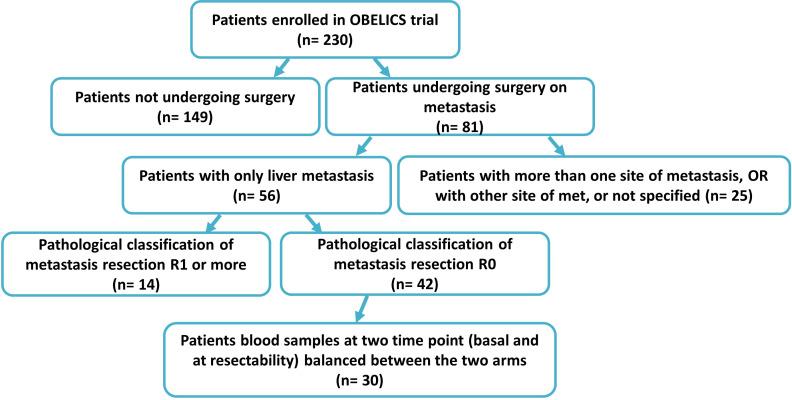
Peripheral blood metabolomics and lipidomics were performed by 600 MHz NMR spectroscopy on plasma from 30 unresectable mCRC pts treated with bevacizumab plus oxaliplatin-based regimens within the Obelics trial (NCT01718873) and subdivided into responder (R) and non-R (NR) according to 1-year disease-free survival (DFS): ≥ 1-year (R, n = 12) and < 1-year (NR, n = 18). A large panel of cytokines, chemokines, and growth factors was evaluated on the same plasma using Luminex xMAP-based multiplex bead-based immunoassay technology. A multiple biomarkers model was built using a support vector machine (SVM) classifier.
RESULTS
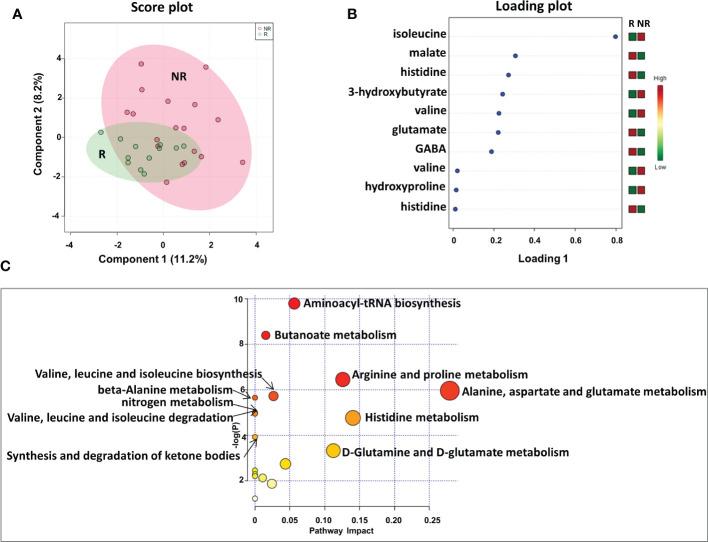
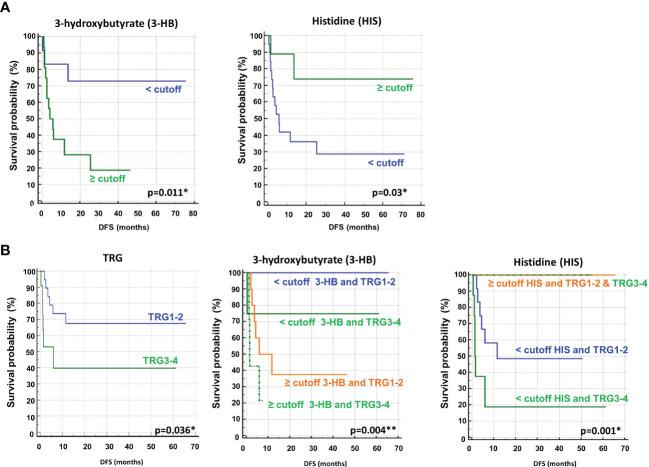
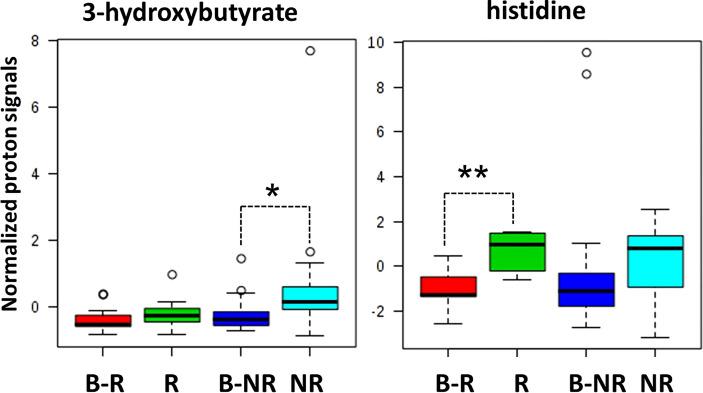
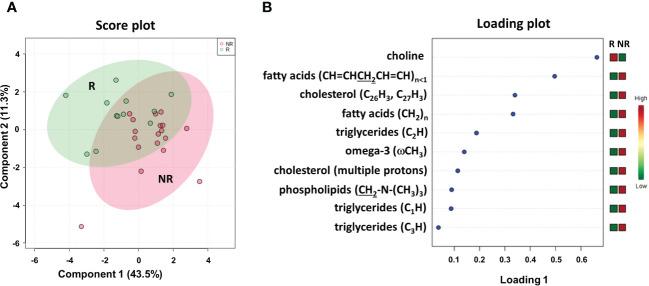
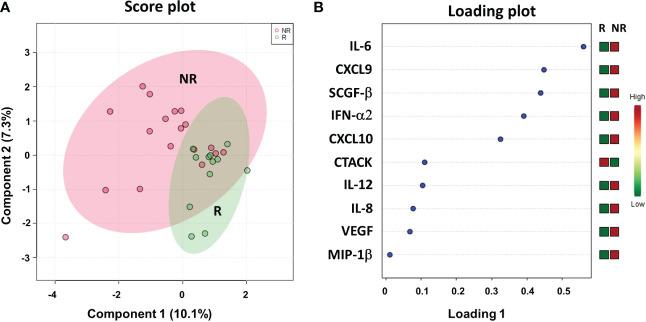
Sparse partial least squares discriminant analysis (sPLS-DA) and loading plots obtained by analyzing metabolomics profiles of samples collected at the time of response evaluation when resectability was established showed significantly different levels of metabolites between the two groups. Two metabolites, 3-hydroxybutyrate and histidine, significantly predicted DFS and overall survival. Lipidomics analysis confirmed clear differences between the R and NR pts, indicating a statistically significant increase in lipids (cholesterol, triglycerides and phospholipids) in NR pts, reflecting a nonspecific inflammatory response. Indeed, a significant increase in proinflammatory cytokines was demonstrated in NR pts plasma. Finally, a multiple biomarkers model based on the combination of presurgery plasma levels of 3-hydroxybutyrate, cholesterol, phospholipids, triglycerides and IL-6 was able to correctly classify patients by their DFS with good accuracy.
CONCLUSION
Overall, this exploratory study suggests the potential of these combined biomarker approaches to predict outcomes in mCRC patients who are candidates for liver metastasis resection after induction treatment for defining personalized management and treatment strategies.
目的
在转移性结直肠癌(mCRC)患者中,将肝切除与诱导化疗相结合的治疗策略比单纯化疗具有更高的5年生存率。然而,肝切除是一个复杂且成本高昂的手术,几乎三分之二的患者会复发,这表明需要识别出复发风险较高的患者。本研究的目的是评估血浆代谢组学和脂质组学与大量血浆细胞因子多重分析相结合,能否用于预测肝切除术后复发风险及其他患者预后,超越或结合临床形态学体积标准。
实验设计
在Obelics试验(NCT01718873)中,对30例接受贝伐单抗加奥沙利铂方案治疗的不可切除mCRC患者的血浆进行600 MHz核磁共振波谱分析,以进行外周血代谢组学和脂质组学研究。根据1年无病生存期(DFS)将患者分为缓解者(R,n = 12)和非缓解者(NR,n = 18):DFS≥1年(R组)和DFS<1年(NR组)。使用基于Luminex xMAP的多重微珠免疫测定技术,对同一血浆中的大量细胞因子、趋化因子和生长因子进行评估。使用支持向量机(SVM)分类器建立多生物标志物模型。
结果
通过分析在确定可切除性时进行反应评估时采集的样本的代谢组学谱获得的稀疏偏最小二乘判别分析(sPLS-DA)和载荷图显示,两组之间代谢物水平存在显著差异。两种代谢物,3-羟基丁酸和组氨酸,显著预测了DFS和总生存期。脂质组学分析证实了R组和NR组之间存在明显差异,表明NR组中脂质(胆固醇、甘油三酯和磷脂)有统计学意义的增加,反映了非特异性炎症反应。事实上,NR组患者血浆中促炎细胞因子显著增加。最后,基于术前血浆中3-羟基丁酸、胆固醇、磷脂、甘油三酯和IL-6水平组合的多生物标志物模型能够以良好的准确性根据DFS正确分类患者。
结论
总体而言,这项探索性研究表明,这些联合生物标志物方法有潜力预测诱导治疗后可能进行肝转移切除的mCRC患者的预后,以确定个性化管理和治疗策略。




 Zotero 插件