
评估胰腺癌患者中癌症易感性基因的种系突变:一项单中心研究。
Evaluation of inherited germline mutations in cancer susceptibility genes among pancreatic cancer patients: a single-center study.
机构信息
Division of Gastroenterology, Fondazione "Casa Sollievo della Sofferenza" IRCCS Hospital, Viale Cappuccini 1, FG, 71013, San Giovanni Rotondo, Italy.
Unit of Biostatistics, Fondazione "Casa Sollievo della Sofferenza" IRCCS Hospital, Viale Cappuccini 1, FG, 71013, San Giovanni Rotondo, Italy.
出版信息
Mol Med. 2023 Jan 30;29(1):14. doi: 10.1186/s10020-023-00600-1.
BACKGROUND
Germline mutations in cancer susceptibility genes were identified in pancreatic cancer (PanC) patients with a sporadic disease and in those unselected for family cancer history.
METHODS
With the aim to determine the prevalence of germline predisposition genes mutations in PanC, and to evaluate whether they were associated with the presence of PanC, we profiled a custom AmpliSeq panel of 27 cancer susceptibility genes in 47 PanC patients and 51 control subjects by using the Ion Torrent PGM system.
RESULTS
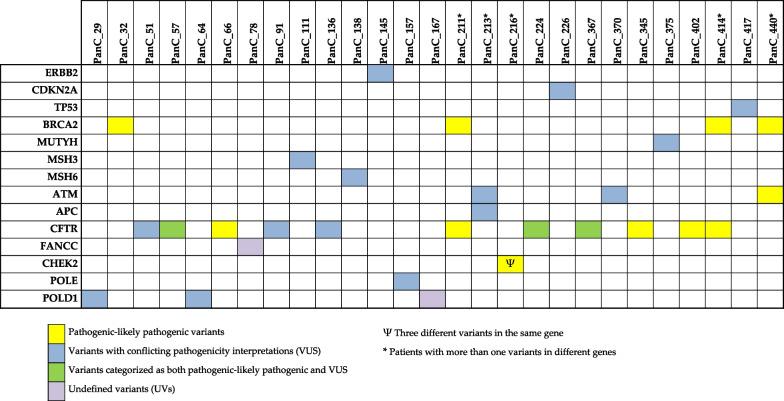
Multigene panel testing identified a total of 31 variants in 27 PanC (57.4%), including variants with pathogenic/likely pathogenic effect, those of uncertain significance, and variants whose clinical significance remains currently undefined. Five patients carried more than one variant in the same gene or in different genes. Eight patients (17.0%) had at least one pathogenic/likely pathogenic variant in four main genes: CFTR (10.6%), BRCA2 (8.5%), ATM and CHEK2 (2.1%). Pathogenic/likely pathogenic mutation were identified in patients with positive PanC family history (20%) or in patients without first-degree relatives affected by PanC (13.6%). All the BRCA2 mutation carriers were unselected PanC patients. The presence of mutations in BRCA2 was significantly associated with an increased occurrence of PanC and with positive family history for endometrial cancer (p = 0.018).
CONCLUSIONS
This study confirmed the potential remarkable contribution of BRCA2 in assessing the presence of PanC. Overall our findings supported the recommendation of offering the germline testing to all the PanC patients with the intent to reduce the number of underdiagnosed carriers of mutations in predisposition genes, and not to preclude their relatives from the opportunity to benefit from surveillance programs.
背景
在散发性疾病的胰腺癌(PanC)患者和未选择家族癌症病史的患者中,已经鉴定出癌症易感性基因的种系突变。
方法
为了确定 PanC 中种系易感性基因突变的流行率,并评估它们是否与 PanC 的存在相关,我们使用 Ion Torrent PGM 系统对 47 名 PanC 患者和 51 名对照者的 27 种癌症易感性基因的定制 AmpliSeq 面板进行了分析。
结果
多基因面板检测总共在 27 个 PanC 中鉴定出 31 个变体,包括具有致病性/可能致病性影响的变体、意义不确定的变体和其临床意义目前尚未确定的变体。五名患者在同一基因或不同基因中携带一种以上的变体。八名患者(17.0%)在四个主要基因中至少有一个致病性/可能致病性变体:CFTR(10.6%)、BRCA2(8.5%)、ATM 和 CHEK2(2.1%)。在有阳性 PanC 家族史的患者(20%)或没有一级亲属受 PanC 影响的患者(13.6%)中发现了致病性/可能致病性突变。所有 BRCA2 突变携带者均为未选择的 PanC 患者。BRCA2 突变的存在与 PanC 的发生增加和子宫内膜癌的阳性家族史显著相关(p=0.018)。
结论
本研究证实了 BRCA2 在评估 PanC 存在方面的潜在重要贡献。总体而言,我们的研究结果支持向所有 PanC 患者提供种系检测的建议,目的是减少易感性基因中突变的未确诊携带者数量,并使他们的亲属有机会从监测计划中受益。
 Zotero 插件