
脂肪组织巨噬细胞及其在肥胖相关胰岛素抵抗中的作用:作用机制的概述。
Adipose tissue macrophages and their role in obesity-associated insulin resistance: an overview of the complex dynamics at play.
机构信息
Endocrinology & Metabolism Laboratory, Department of Zoology, Siksha Bhavana (Institute of Science), Visva-Bharati (A Central University), Santiniketan 731235, West Bengal, India.
出版信息
Biosci Rep. 2023 Mar 31;43(3). doi: 10.1042/BSR20220200.
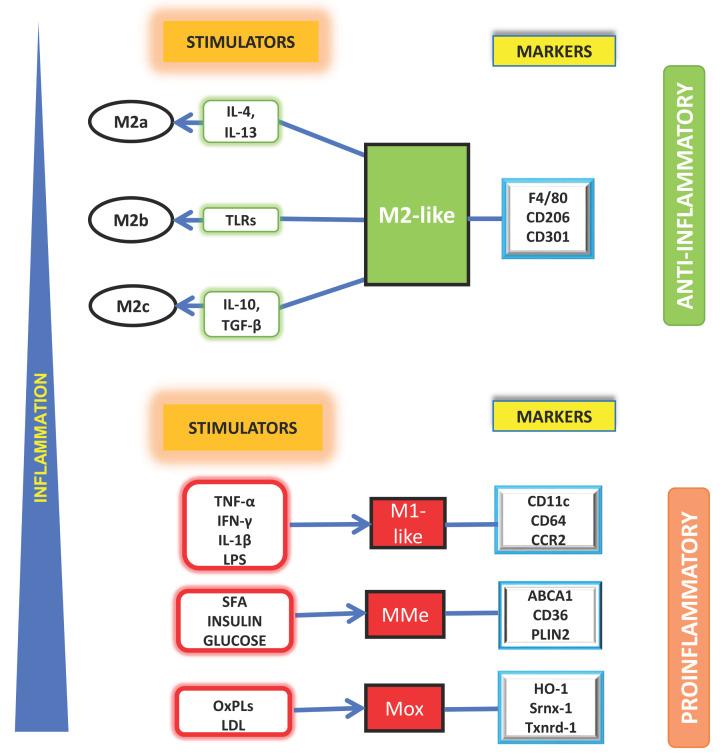
Obesity, a major global health concern, is characterized by serious imbalance between energy intake and expenditure leading to excess accumulation of fat in adipose tissue (AT). A state of chronic low-grade AT inflammation is prevalent during obesity. The adipose tissue macrophages (ATM) with astounding heterogeneity and complex regulation play a decisive role in mediating obesity-induced insulin resistance. Adipose-derived macrophages were broadly classified as proinflammatory M1 and anti-inflammatory M2 subtypes but recent reports have proclaimed several novel and intermediate profiles, which are crucial in understanding the dynamics of macrophage phenotypes during development of obesity. Lipid-laden hypertrophic adipocytes release various chemotactic signals that aggravate macrophage infiltration into AT skewing toward mostly proinflammatory status. The ratio of M1-like to M2-like macrophages is increased substantially resulting in copious secretion of proinflammatory mediators such as TNFα, IL-6, IL-1β, MCP-1, fetuin-A (FetA), etc. further worsening insulin resistance. Several AT-derived factors could influence ATM content and activation. Apart from being detrimental, ATM exerts beneficial effects during obesity. Recent studies have highlighted the prime role of AT-resident macrophage subpopulations in not only effective clearance of excess fat and dying adipocytes but also in controlling vascular integrity, adipocyte secretions, and fibrosis within obese AT. The role of ATM subpopulations as friend or foe is determined by an intricate interplay of such factors arising within hyperlipidemic microenvironment of obese AT. The present review article highlights some of the key research advances in ATM function and regulation, and appreciates the complex dynamics of ATM in the pathophysiologic scenario of obesity-associated insulin resistance.
肥胖是一个全球性的健康问题,其特征是能量摄入和支出之间严重失衡,导致脂肪在脂肪组织(AT)中过度积累。肥胖时,慢性低度 AT 炎症状态普遍存在。具有惊人异质性和复杂调节作用的脂肪组织巨噬细胞(ATM)在介导肥胖诱导的胰岛素抵抗中起着决定性作用。脂肪来源的巨噬细胞被广泛分为促炎 M1 和抗炎 M2 亚型,但最近的报道已经宣布了几种新的和中间的表型,这对于理解巨噬细胞表型在肥胖发展过程中的动态至关重要。富含脂质的肥大脂肪细胞释放各种趋化信号,加剧巨噬细胞浸润 AT,使其向主要促炎状态倾斜。M1 样与 M2 样巨噬细胞的比例显著增加,导致大量促炎介质如 TNFα、IL-6、IL-1β、MCP-1、胎球蛋白-A(FetA)等的分泌增加,进一步加重胰岛素抵抗。几种 AT 衍生的因子可以影响 ATM 的含量和激活。除了有害作用外,ATM 在肥胖中也具有有益作用。最近的研究强调了 AT 驻留的巨噬细胞亚群在有效清除多余脂肪和死亡脂肪细胞以及控制肥胖 AT 中的血管完整性、脂肪细胞分泌和纤维化方面的主要作用。ATM 亚群是敌是友的角色取决于肥胖 AT 高脂血症微环境中出现的多种因素的复杂相互作用。本文综述了一些关于 ATM 功能和调节的关键研究进展,并赞赏了 ATM 在肥胖相关胰岛素抵抗的病理生理情况下的复杂动态。

 Zotero 插件