
哺乳动物社会组织和寿命的相关性进化。
Correlated evolution of social organization and lifespan in mammals.
机构信息
CAS Key Laboratory of Animal Ecology and Conservation Biology, Institute of Zoology, Beijing, 100101, China.
University of Chinese Academy of Sciences, Beijing, 100049, China.
出版信息
Nat Commun. 2023 Jan 31;14(1):372. doi: 10.1038/s41467-023-35869-7.
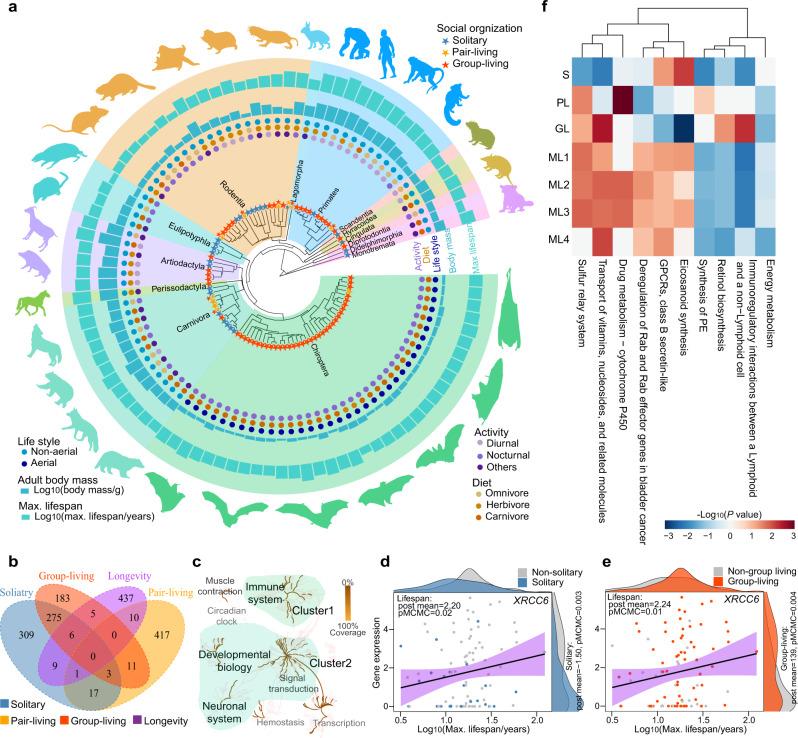
Discerning the relationship between sociality and longevity would permit a deeper understanding of how animal life history evolved. Here, we perform a phylogenetic comparative analysis of ~1000 mammalian species on three states of social organization (solitary, pair-living, and group-living) and longevity. We show that group-living species generally live longer than solitary species, and that the transition rate from a short-lived state to a long-lived state is higher in group-living than non-group-living species, altogether supporting the correlated evolution of social organization and longevity. The comparative brain transcriptomes of 94 mammalian species identify 31 genes, hormones and immunity-related pathways broadly involved in the association between social organization and longevity. Further selection features reveal twenty overlapping pathways under selection for both social organization and longevity. These results underscore a molecular basis for the influence of the social organization on longevity.
辨别社会性与长寿之间的关系,可以让我们更深入地了解动物的生活史是如何进化的。在这里,我们对约 1000 种哺乳动物的三种社会组织状态(独居、成对生活和群体生活)和寿命进行了系统发育比较分析。结果表明,群体生活的物种通常比独居物种寿命更长,而且从短寿状态向长寿状态的转变速度在群体生活物种中比非群体生活物种更高,这总体上支持了社会组织和寿命的相关性进化。对 94 种哺乳动物的比较脑转录组分析确定了 31 个基因、激素和免疫相关途径,这些途径广泛涉及社会组织和寿命之间的关联。进一步的选择特征揭示了 20 个重叠的途径,这些途径同时受到社会组织和寿命的选择。这些结果强调了社会组织对寿命的影响的分子基础。


 Zotero 插件