
不同族裔人群的补体系统生物标志物的差异及其与黑非裔和白欧裔男性代谢健康的关联。
Ethnic differences in complement system biomarkers and their association with metabolic health in men of Black African and White European ethnicity.
机构信息
Department of Nutritional Sciences, School of Population & Life Course Sciences, Faculty of Life Sciences & Medicine, King's College London, London, UK.
Dementia Research Institute Cardiff, School of Medicine, Cardiff University, Cardiff, UK.
出版信息
Clin Exp Immunol. 2023 Apr 7;212(1):52-60. doi: 10.1093/cei/uxad011.
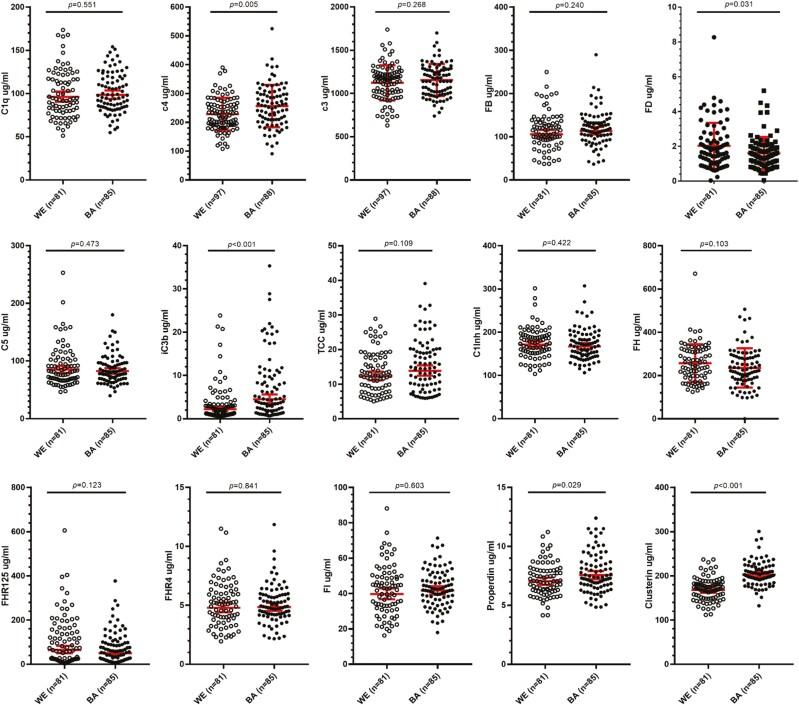
Inflammation plays a fundamental role in the development of several metabolic diseases, including obesity and type 2 diabetes (T2D); the complement system has been implicated in their development. People of Black African (BA) ethnicity are disproportionately affected by T2D and other metabolic diseases but the impact of ethnicity on the complement system has not been explored. We investigated ethnic differences in complement biomarkers and activation status between men of BA and White European (WE) ethnicity and explored their association with parameters of metabolic health. We measured a panel of 15 complement components, regulators, and activation products in fasting plasma from 89 BA and 96 WE men. Ethnic differences were statistically validated. Association of complement biomarkers with metabolic health indices (BMI, waist circumference, insulin resistance, and HbA1c) were assessed in the groups. Plasma levels of the key complement components C3 and C4, the regulators clusterin and properdin and the activation marker iC3b were significantly higher in BA compared to WE men after age adjustment, while FD levels were significantly lower. C3 and C4 levels positively correlated with some or all markers of metabolic dysfunction in both ethnic groups while FD was inversely associated with HbA1c in both groups, and clusterin and properdin were inversely associated with some markers of metabolic dysfunction only in the WE group. Our findings of increased levels of complement components and activation products in BA compared to WE men suggest differences in complement regulation that may impact susceptibility to poor metabolic health.
炎症在多种代谢疾病的发展中起着至关重要的作用,包括肥胖症和 2 型糖尿病(T2D);补体系统被认为与它们的发展有关。黑非洲(BA)人群中 T2D 和其他代谢疾病的发病率不成比例,但种族对补体系统的影响尚未得到探索。我们研究了 BA 和白种欧洲(WE)人群中男性的补体生物标志物和激活状态的种族差异,并探讨了它们与代谢健康参数的关联。我们测量了 89 名 BA 和 96 名 WE 男性空腹血浆中的 15 种补体成分、调节剂和激活产物。对种族差异进行了统计学验证。在这两个群体中,评估了补体生物标志物与代谢健康指数(BMI、腰围、胰岛素抵抗和 HbA1c)的相关性。在年龄调整后,BA 男性的关键补体成分 C3 和 C4、调节剂 clusterin 和 properdin 以及激活标志物 iC3b 的血浆水平明显高于 WE 男性,而 FD 水平明显较低。C3 和 C4 水平与两个群体中代谢功能障碍的一些或所有标志物呈正相关,而 FD 在两个群体中与 HbA1c 呈负相关,clusterin 和 properdin 仅在 WE 群体中与一些代谢功能障碍标志物呈负相关。与 WE 男性相比,BA 男性补体成分和激活产物水平升高,这表明补体调节存在差异,可能影响代谢健康不良的易感性。

 Zotero 插件