
亚太地区的自我采集宫颈筛查:实施证据的范围综述。
Self-Collection Cervical Screening in the Asia-Pacific Region: A Scoping Review of Implementation Evidence.
机构信息
Centre for Health Policy, Melbourne School of Population and Global Health, The University of Melbourne, Melbourne, Victoria, Australia.
Community Health Department, Christian Medical College, Vellore, Tamil Nadu, India.
出版信息
JCO Glob Oncol. 2023 Jan;9:e2200297. doi: 10.1200/GO.22.00297.
PURPOSE
Although cervical cancer is a disease of inequity, it can be eliminated as a public health problem through vaccination, screening, and treatment. Human papillomavirus vaginal self-collection cervical screening is a high-performance test that can increase reach of screening. This review describes the different contexts and models of care used to pilot or implement self-collection within the Asia-Pacific, measures the extent that implementation outcome measures are reported and, where available, summarizes key implementation findings.
METHODS
A scoping review was conducted by searching five databases of the peer-reviewed literature on June 20, 2022. Two researchers assessed eligibility and extracted data independently to the model of care used and the Conceptual Framework for Implementation Outcomes. A mixed-method consolidation of findings (quantitative: count and frequencies; qualitative: content analysis) was undertaken to narratively report findings.
RESULTS
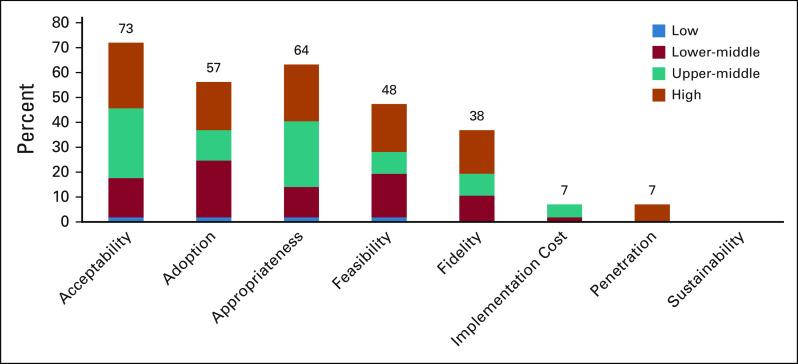
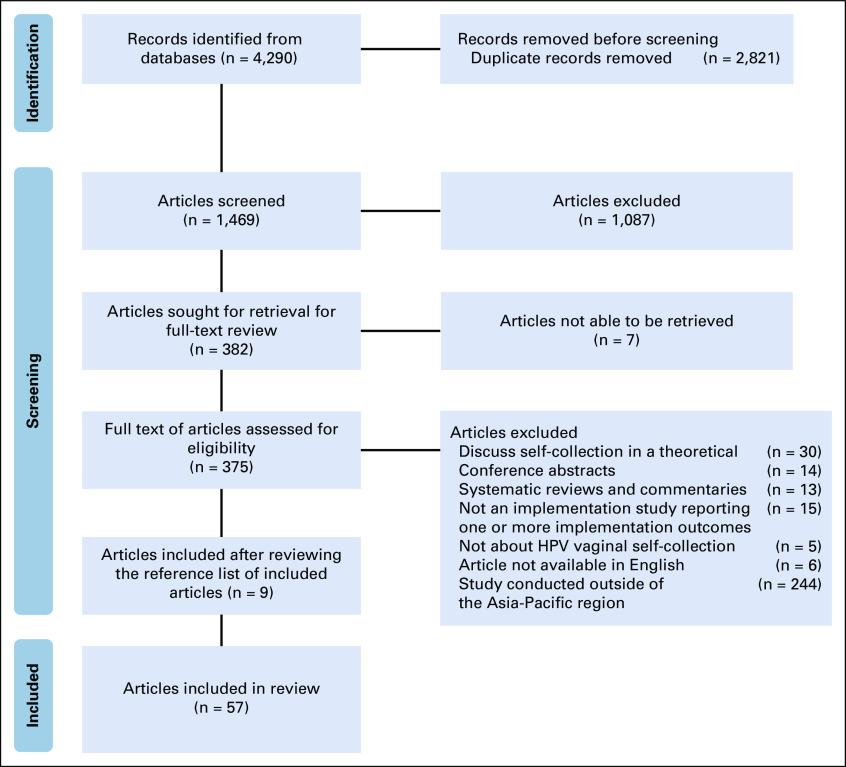
Fifty-seven articles, comprising 50 unique studies from 11 countries and two special autonomous regions, were included; 82% were conducted in trials. The implementation of self-collection was conducted in low- (2%), lower-middle- (32%), upper-middle- (32%), and high-income (35%) settings, with 10 different delivery models used; 80% delivered through practitioner-supported models with diversity in how samples were processed, and treatment was offered. Acceptability (73%) and appropriateness (64%) measures were most reported, followed by adoption (57%), feasibility (48%), and fidelity (38%). Only 7% of articles reported implementation cost or penetration measures. No articles reported sustainability measures.
CONCLUSION
The literature confirms that self-collection cervical screening has been implemented within the Asia-Pacific region, with evidence demonstrating that it is acceptable and appropriate from the user's perspective. Well-designed, high-quality implementation trials and real-world evaluations of self-collection that report the breadth of implementation outcomes can support the progression toward the elimination of cervical cancer.
目的
尽管宫颈癌是一种不平等的疾病,但通过疫苗接种、筛查和治疗,它可以被消除为一个公共卫生问题。人乳头瘤病毒阴道自我采集宫颈筛查是一种高性能的检测方法,可以增加筛查的覆盖面。本综述描述了在亚太地区试点或实施自我采集的不同背景和护理模式,衡量了实施结果测量的报告程度,并在可用时总结了关键的实施发现。
方法
通过 2022 年 6 月 20 日在五个同行评审文献数据库中搜索,进行了范围综述。两名研究人员独立评估合格性并提取数据,以用于护理模式和实施结果概念框架。采用混合方法对发现进行综合(定量:计数和频率;定性:内容分析),以叙述性报告发现。
结果
纳入了 57 篇文章,包括来自 11 个国家和两个特别自治区的 50 项独特研究;82%的研究是在试验中进行的。自我采集的实施在低收入(2%)、中下收入(32%)、中上收入(32%)和高收入(35%)国家进行,使用了 10 种不同的交付模式;80%通过从业者支持的模式进行,在这些模式中,样本的处理和治疗方式各不相同。最常报告的是可接受性(73%)和适宜性(64%)措施,其次是采用(57%)、可行性(48%)和忠实度(38%)。只有 7%的文章报告了实施成本或渗透率措施。没有文章报告可持续性措施。
结论
文献证实,自我采集宫颈筛查已在亚太地区实施,有证据表明,从用户的角度来看,它是可接受和合适的。精心设计、高质量的自我采集实施试验和真实世界评估,报告实施结果的广度,可以支持消除宫颈癌的进展。
 Zotero 插件