
禁食状态下女性在进行60分钟中等强度运动前进食的代谢影响。
Metabolic impact of feeding prior to a 60-min bout of moderate-intensity exercise in females in a fasted state.
作者信息
Ratliff Kayla M, Kerksick Chad M, Moon Jessica M, Hagele Anthony M, Boring Johnathan L, Walden Kylie, Gaige Connor J, Stecker Richard A, Sunderland Kyle L, Mumford Petey W
机构信息
Exercise and Performance Nutrition Laboratory, Kinesiology Department, College of Science, Technology, and Health, Lindenwood University, St. Charles, MO, United States.
出版信息
Front Sports Act Living. 2023 Jan 16;4:1070477. doi: 10.3389/fspor.2022.1070477. eCollection 2022.
BACKGROUND
The metabolic impact of pre-exercise feeding of protein or carbohydrate on fat oxidation and energy expenditure rates, especially, in females, is poorly understood.
METHODS
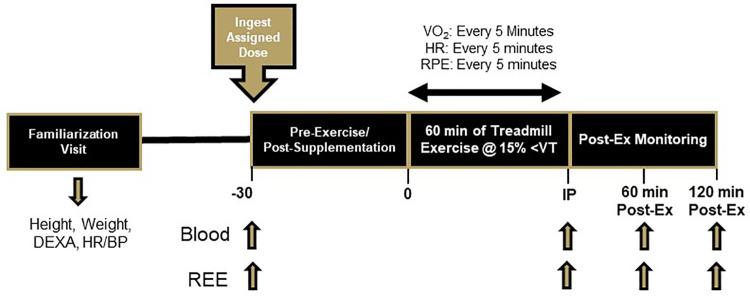
Recreationally active females ( = 15, 32 ± 10 years, 164.8 ± 5.6 cm, 63.5 ± 9.3 kg, 23.4 ± 3.2 kg/m) completed four testing sessions in a randomized, double-blind, crossover fashion after fasting overnight. Participants ingested isovolumetric and isoenergetic solutions containing either 25 g of whey protein, casein protein, carbohydrate (CHO), or a non-caloric placebo (PLA). Participants then completed 60 min of treadmill exercise at 15% below ventilatory threshold 30 min after ingestion. Respiratory exchange ratio (RER) was evaluated throughout exercise and resting energy expenditure (REE) was assessed pre-exercise, and 0-, 60-, and 120-min post-exercise.
RESULTS
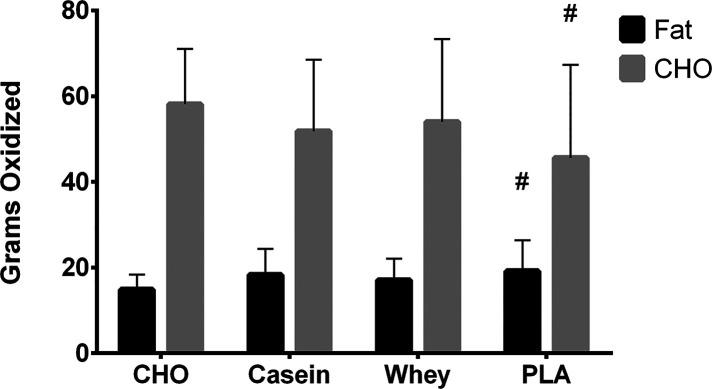
A significant condition x time interaction was observed for RER ( = 0.008) during exercise, with CHO exhibiting higher RER values (vs. PLA) at four time points. A significant main effect for condition was observed for carbohydrate ( = 0.001) and fat ( = 0.02) oxidation rates during exercise, with fat oxidation rates being higher in PLA vs. CHO ( = 0.01). When total fat oxidized was calculated across the entire exercise bout, a significant main effect for condition was observed ( = 0.01), with PLA being greater than CHO ( = 0.04). A significant condition x time interaction ( = 0.02) was found for both absolute and normalized REE, with casein and whey protein having significantly higher values than CHO ( < 0.05) immediately post-exercise.
CONCLUSION
When compared to a fasted control (PLA), consuming CHO, but not protein, decreased total fat oxidation prior to a 60-min bout of moderate-intensity exercise in females.
背景
运动前摄入蛋白质或碳水化合物对脂肪氧化和能量消耗率的代谢影响,尤其是在女性中,目前了解甚少。
方法
有运动习惯的女性(n = 15,32±10岁,164.8±5.6厘米,63.5±9.3千克,23.4±3.2千克/米²)在禁食过夜后,以随机、双盲、交叉方式完成四次测试。参与者摄入等体积、等能量的溶液,其中分别含有25克乳清蛋白、酪蛋白、碳水化合物(CHO)或无热量安慰剂(PLA)。参与者在摄入后30分钟以低于通气阈值15%的强度在跑步机上运动60分钟。在整个运动过程中评估呼吸交换率(RER),并在运动前、运动后0、60和120分钟评估静息能量消耗(REE)。
结果
运动期间RER(P = 0.008)观察到显著的条件×时间交互作用,CHO在四个时间点的RER值高于PLA。运动期间碳水化合物(P = 0.001)和脂肪(P = 0.02)氧化率观察到显著的条件主效应,PLA组的脂肪氧化率高于CHO组(P = 0.01)。当计算整个运动过程中氧化的总脂肪量时,观察到显著的条件主效应(P = 0.01),PLA组大于CHO组(P = 0.04)。绝对和标准化REE均发现显著的条件×时间交互作用(P = 0.02),运动后立即酪蛋白和乳清蛋白的值显著高于CHO组(P < 0.05)。
结论
与禁食对照(PLA)相比,女性在进行60分钟中等强度运动前摄入CHO而非蛋白质会降低总脂肪氧化。

 Zotero 插件