
移动医疗干预对改善慢性疼痛患者疼痛、生活质量和功能障碍的系统评价。
mHealth Intervention for Improving Pain, Quality of Life, and Functional Disability in Patients With Chronic Pain: Systematic Review.
机构信息
Preventive Medicine and Public Health Area, Department of Biomedicine, Biotechnology and Public Health, University of Cádiz, Cádiz, Spain.
Observatory of Pain, University of Cádiz, Cádiz, Spain.
出版信息
JMIR Mhealth Uhealth. 2023 Feb 2;11:e40844. doi: 10.2196/40844.
BACKGROUND
Chronic pain (CP) is 1 of the leading causes of disability worldwide and represents a significant burden on individual, social, and economic aspects. Potential tools, such as mobile health (mHealth) systems, are emerging for the self-management of patients with CP.
OBJECTIVE
A systematic review was conducted to analyze the effects of mHealth interventions on CP management, based on pain intensity, quality of life (QoL), and functional disability assessment, compared to conventional treatment or nonintervention.
METHODS
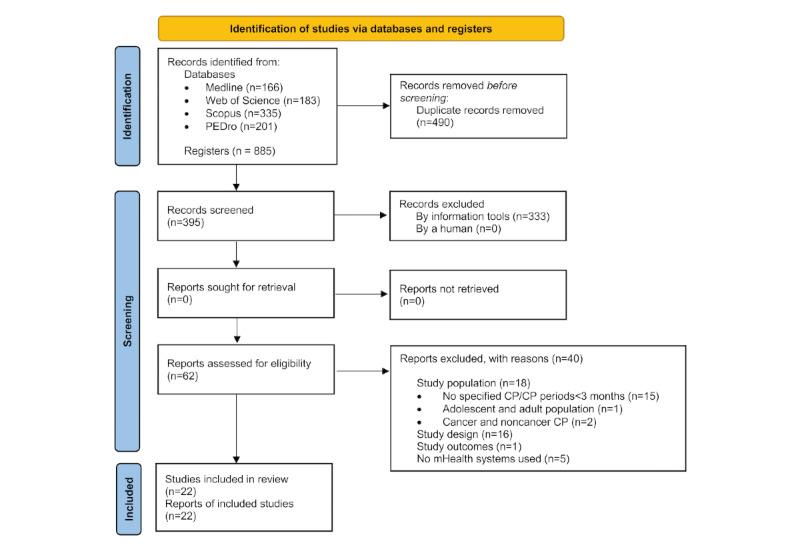
PRISMA (Preferred Reporting Items for Systematic Reviews and Meta-Analysis) guidelines were followed to conduct a systematic review of randomized controlled trials (RCTs) published in PubMed, Web of Science, Scopus, and Physiotherapy Evidence Database (PEDro) databases from February to March 2022. No filters were used. The eligibility criteria were RCTs of adults (≥18 years old) with CP, intervened with mHealth systems based on mobile apps for monitoring pain and health-related outcomes, for pain and behavioral self-management, and for performing therapeutic approaches, compared to conventional treatments (physical, occupational, and psychological therapies; usual medical care; and education) or nonintervention, reporting pain intensity, QoL, and functional disability. The methodological quality and risk of bias (RoB) were assessed using the Checklist for Measuring Quality, the Oxford Centre for Evidence-Based Medicine Levels of Evidence, and the Cochrane RoB 2.0 tool.
RESULTS
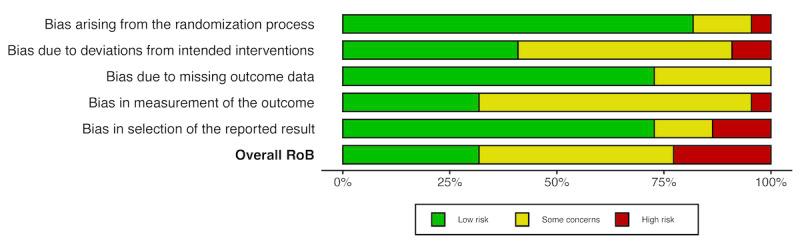
In total, 22 RCTs, involving 2641 patients with different CP conditions listed in the International Classification of Diseases 11th Revision (ICD-11), including chronic low back pain (CLBP), chronic musculoskeletal pain (CMSP), chronic neck pain (CNP), unspecified CP, chronic pelvic pain (CPP), fibromyalgia (FM), interstitial cystitis/bladder pain syndrome (IC/BPS), irritable bowel syndrome (IBS), and osteoarthritis (OA). A total of 23 mHealth systems were used to conduct a variety of CP self-management strategies, among which monitoring pain and symptoms and home-based exercise programs were the most used. Beneficial effects of the use of mHealth systems in reducing pain intensity (CNP, FM, IC/BPS, and OA), QoL (CLBP, CNP, IBS, and OA), and functional disability (CLBP, CMSP, CNP, and OA) were found. Most of the included studies (18/22, 82%) reported medium methodological quality and were considered as highly recommendable; in addition, 7/22 (32%) studies had a low RoB, 10/22 (45%) had some concerns, and 5/22 (23%) had a high RoB.
CONCLUSIONS
The use of mHealth systems indicated positive effects for pain intensity in CNP, FM, IC/BPS, and OA; for QoL in CLBP, CNP, IBS, and OA; and for functional disability in CLBP, CMSP, CNP, and OA. Thus, mHealth seems to be an alternative to improving pain-related outcomes and QoL and could be part of multimodal strategies for CP self-management. High-quality studies are needed to merge the evidence and recommendations of the use of mHealth systems for CP management.
TRIAL REGISTRATION
PROSPERO International Prospective Register of Systematic Reviews CRD42022315808; https://www.crd.york.ac.uk/prospero/display_record.php?RecordID=315808.
背景
慢性疼痛(CP)是全球导致残疾的主要原因之一,给个人、社会和经济方面带来了巨大负担。移动健康(mHealth)系统等潜在工具正在出现,用于 CP 患者的自我管理。
目的
系统评价旨在分析 mHealth 干预措施对 CP 管理的影响,基于疼痛强度、生活质量(QoL)和功能障碍评估,与常规治疗或非干预相比。
方法
遵循 PRISMA(系统评价和荟萃分析的首选报告项目)指南,于 2022 年 2 月至 3 月在 PubMed、Web of Science、Scopus 和物理治疗证据数据库(PEDro)数据库中对发表的随机对照试验(RCT)进行系统评价。未使用过滤器。纳入标准为针对 CP 成年人(≥18 岁)的 RCT,干预措施为基于移动应用程序的 mHealth 系统,用于监测疼痛和健康相关结果、疼痛和行为自我管理以及执行治疗方法,与常规治疗(物理、职业和心理疗法;常规医疗护理;和教育)或非干预相比,报告疼痛强度、QoL 和功能障碍。使用清单评估方法质量和偏倚风险(RoB),牛津循证医学中心证据水平和 Cochrane RoB 2.0 工具。
结果
共有 22 项 RCT,涉及国际疾病分类第 11 版(ICD-11)列出的 2641 名患有不同 CP 病症的患者,包括慢性下背痛(CLBP)、慢性肌肉骨骼疼痛(CMSP)、慢性颈部疼痛(CNP)、未指定 CP、慢性盆腔疼痛(CPP)、纤维肌痛(FM)、间质性膀胱炎/膀胱疼痛综合征(IC/BPS)、肠易激综合征(IBS)和骨关节炎(OA)。共有 23 种 mHealth 系统用于进行各种 CP 自我管理策略,其中监测疼痛和症状以及家庭锻炼计划是最常用的。使用 mHealth 系统在减轻疼痛强度(CNP、FM、IC/BPS 和 OA)、QoL(CLBP、CNP、IBS 和 OA)和功能障碍(CLBP、CMSP、CNP 和 OA)方面具有有益效果。大多数纳入的研究(22 项中的 18 项,82%)报告了中等方法质量,并被认为是高度推荐的;此外,7/22(32%)的研究存在低 RoB,10/22(45%)存在一些关注,5/22(23%)存在高 RoB。
结论
mHealth 系统的使用在 CNP、FM、IC/BPS 和 OA 中对疼痛强度、CLBP、CNP、IBS 和 OA 中的 QoL 以及 CLBP、CMSP、CNP 和 OA 中的功能障碍均有积极影响。因此,mHealth 似乎是改善疼痛相关结果和 QoL 的一种替代方法,并且可以作为 CP 自我管理的多模式策略的一部分。需要高质量的研究来合并 mHealth 系统用于 CP 管理的证据和建议。
试验注册
PROSPERO 国际前瞻性系统评价注册中心 CRD42022315808;https://www.crd.york.ac.uk/prospero/display_record.php?RecordID=315808。

 Zotero 插件