
术后循环肿瘤 DNA 可改善可切除肺癌的风险分层:多中心研究结果。
Postoperative circulating tumor DNA can refine risk stratification in resectable lung cancer: results from a multicenter study.
机构信息
Guangdong Lung Cancer Institute, Guangdong Provincial Key Laboratory of Translational Medicine in Lung Cancer, Guangdong Provincial People's Hospital (Guangdong Academy of Medical Sciences), Southern Medical University, Guangzhou, China.
School of Medicine, South China University of Technology, Guangzhou, China.
出版信息
Mol Oncol. 2023 May;17(5):825-838. doi: 10.1002/1878-0261.13387. Epub 2023 Feb 24.
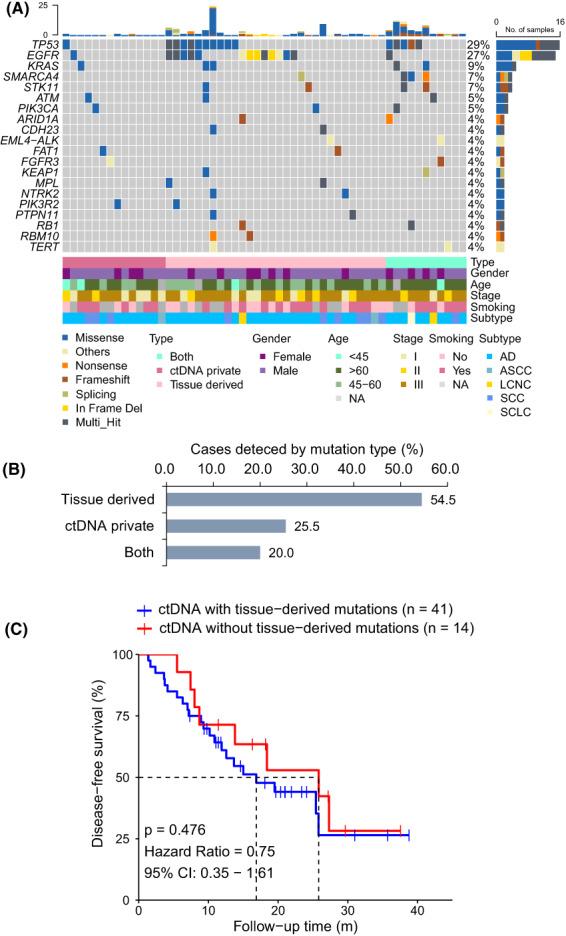
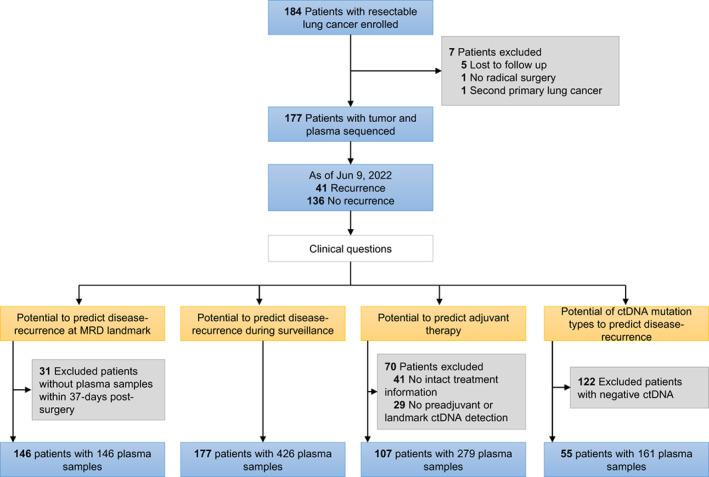
Circulating tumor DNA (ctDNA) has potential as a promising biomarker for molecular residual disease (MRD) detection in lung cancer. As the next-generation sequencing standardized panel for ctDNA detection emerges, its clinical utility needs to be validated. We prospectively recruited 184 resectable lung cancer patients from four medical centers. Serial postoperative ctDNAs were analyzed by a standardized panel. A total of 427 postoperative plasma samples from 177 eligible patients were enrolled. ctDNA positivity after surgery was an independent predictor for disease recurrence and preceded radiological recurrence by a median of 6.6 months (range, 0.7-27.0 months). ctDNA-positive or -negative patients with tumors of any stage had similar disease-free survival (DFS). Patients who received targeted therapy had significantly improved DFS than those not receiving adjuvant therapy or receiving chemotherapy, regardless of baseline/preadjuvant ctDNA status. According to whether the ctDNA variants were detected in its matched tissue, they were classified into tissue derived and non-tissue derived. Patients with detectable postoperative ctDNA with tissue-derived mutations had comparable DFS with those with non-tissue-derived mutations. Collectively, we demonstrated that postoperative ctDNA has the potential to stratify prognosis and optimize tumor stage in resectable lung cancer. ctDNA variants not identified in tissue samples should be considered in MRD test.
循环肿瘤 DNA(ctDNA)作为一种有前途的分子残留疾病(MRD)检测生物标志物,在肺癌中有一定的应用潜力。随着用于 ctDNA 检测的下一代测序标准化面板的出现,其临床应用价值需要得到验证。我们前瞻性地从四家医疗中心招募了 184 名可切除的肺癌患者。通过标准化面板对术后的 ctDNA 进行了分析。总共从 177 名合格患者中采集了 427 个术后血浆样本。术后 ctDNA 阳性是疾病复发的独立预测因素,且比影像学复发提前中位数 6.6 个月(范围:0.7-27.0 个月)。肿瘤分期为任何阶段的 ctDNA 阳性或阴性患者的无病生存期(DFS)相似。无论基线/术前 ctDNA 状态如何,接受靶向治疗的患者的 DFS 明显优于未接受辅助治疗或接受化疗的患者。根据 ctDNA 变异是否在其匹配的组织中检测到,将其分为组织来源和非组织来源。可检测到术后具有组织衍生突变的 ctDNA 的患者与具有非组织衍生突变的患者具有相似的 DFS。总的来说,我们证明了术后 ctDNA 具有分层预后和优化可切除肺癌肿瘤分期的潜力。未在组织样本中鉴定到的 ctDNA 变体应考虑用于 MRD 检测。


 Zotero 插件