
一种基于生理的[镓]镓-(HA-)多柔比星的药代动力学模型,用于预测GEP-NET患者的全身分布和肿瘤摄取效应。
A physiologically based pharmacokinetic model for [Ga]Ga-(HA-)DOTATATE to predict whole-body distribution and tumor sink effects in GEP-NET patients.
作者信息
Siebinga Hinke, de Wit-van der Veen Berlinda J, Beijnen Jos H, Dorlo Thomas P C, Huitema Alwin D R, Hendrikx Jeroen J M A
机构信息
Department of Pharmacy and Pharmacology, The Netherlands Cancer Institute, Amsterdam, The Netherlands.
Department of Nuclear Medicine, The Netherlands Cancer Institute, Amsterdam, The Netherlands.
出版信息
EJNMMI Res. 2023 Feb 3;13(1):8. doi: 10.1186/s13550-023-00958-7.
BACKGROUND
Little is known about parameters that have a relevant impact on (dis)similarities in biodistribution between various Ga-labeled somatostatin analogues. Additionally, the effect of tumor burden on organ uptake remains unclear. Therefore, the aim of this study was to describe and compare organ and tumor distribution of [Ga]Ga-DOTATATE and [Ga]Ga-HA-DOTATATE using a physiologically based pharmacokinetic (PBPK) model and to identify factors that might cause biodistribution and tumor uptake differences between both peptides. In addition, the effect of tumor burden on peptide biodistribution in gastroenteropancreatic (GEP) neuroendocrine tumor (NET) patients was assessed.
METHODS
A PBPK model was developed for [Ga]Ga-(HA-)DOTATATE in GEP-NET patients. Three tumor compartments were added, representing primary tumor, liver metastases and other metastases. Furthermore, reactions describing receptor binding, internalization and recycling, renal clearance and intracellular degradation were added to the model. Scan data from GEP-NET patients were used for evaluation of model predictions. Simulations with increasing tumor volumes were performed to assess the tumor sink effect.
RESULTS
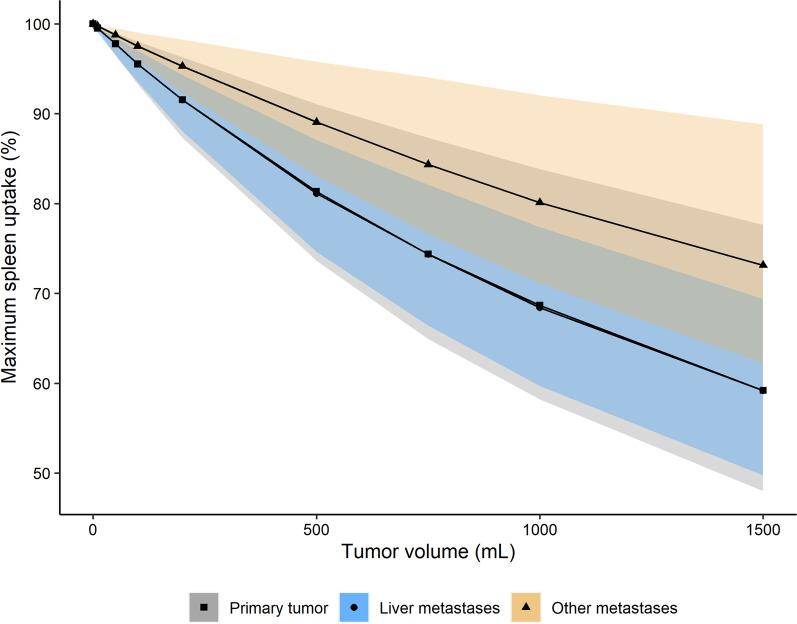
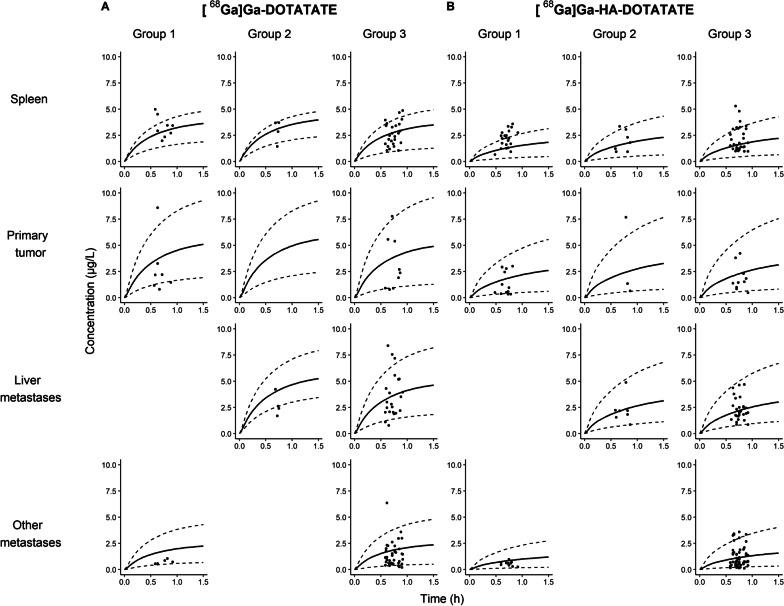
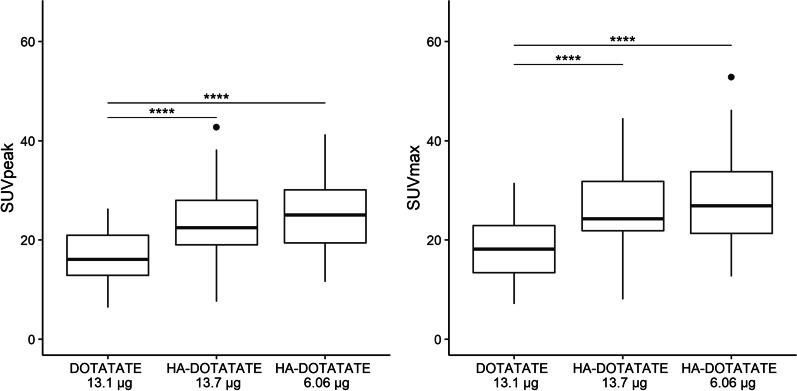
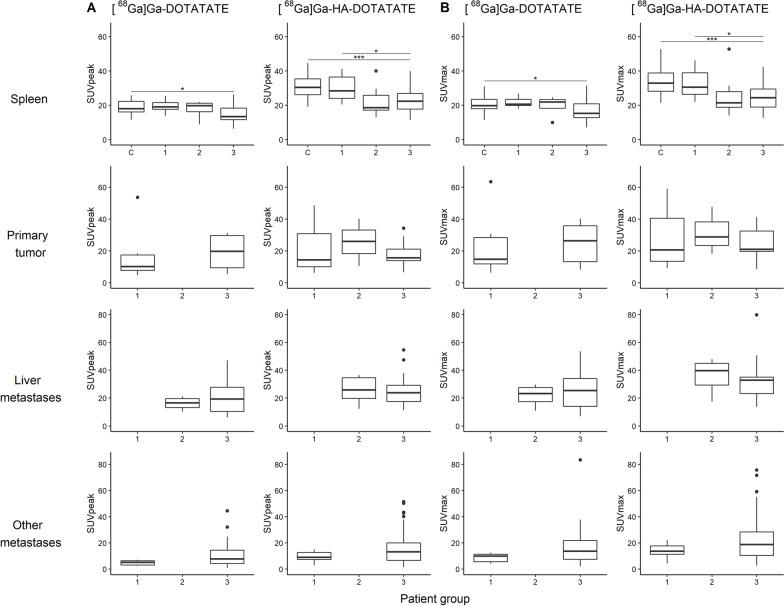
Data of 39 and 59 patients receiving [Ga]Ga-DOTATATE and [Ga]Ga-HA-DOTATATE, respectively, were included. Evaluations showed that the model adequately described image-based patient data and that different receptor affinities caused organ uptake dissimilarities between both peptides. Sensitivity analysis indicated that tumor blood flow and blood volume impacted tumor distribution most. Tumor sink predictions showed a decrease in spleen uptake with increasing tumor volume, which seemed clinically relevant for patients with total tumor volumes higher than ~ 550 mL.
CONCLUSION
The developed PBPK model adequately predicted tumor and organ uptake for this GEP-NET population. Relevant organ uptake differences between [Ga]Ga-DOTATATE and [Ga]Ga-HA-DOTATATE were caused by different affinity profiles, while tumor uptake was mainly affected by tumor blood flow and blood volume. Furthermore, tumor sink predictions showed that for the majority of patients a tumor sink effect is not expected to be clinically relevant.
背景
对于对各种镓标记的生长抑素类似物生物分布的(不)相似性有相关影响的参数了解甚少。此外,肿瘤负荷对器官摄取的影响仍不清楚。因此,本研究的目的是使用基于生理的药代动力学(PBPK)模型描述和比较[镓]镓-多柔比星和[镓]镓-透明质酸-多柔比星的器官和肿瘤分布,并确定可能导致两种肽生物分布和肿瘤摄取差异的因素。此外,评估了肿瘤负荷对胃肠胰(GEP)神经内分泌肿瘤(NET)患者肽生物分布的影响。
方法
为GEP-NET患者开发了[镓]镓-(透明质酸-)多柔比星的PBPK模型。添加了三个肿瘤隔室,分别代表原发性肿瘤、肝转移和其他转移。此外,将描述受体结合、内化和再循环、肾清除和细胞内降解的反应添加到模型中。来自GEP-NET患者的扫描数据用于评估模型预测。进行了肿瘤体积增加的模拟以评估肿瘤汇效应。
结果
分别纳入了39例接受[镓]镓-多柔比星和59例接受[镓]镓-透明质酸-多柔比星的患者的数据。评估表明,该模型充分描述了基于图像的患者数据,并且不同的受体亲和力导致两种肽之间的器官摄取差异。敏感性分析表明,肿瘤血流和血容量对肿瘤分布影响最大。肿瘤汇预测显示,随着肿瘤体积增加,脾脏摄取减少,这对于总肿瘤体积高于约550 mL的患者似乎具有临床相关性。
结论
所开发的PBPK模型充分预测了该GEP-NET人群的肿瘤和器官摄取。[镓]镓-多柔比星和[镓]镓-透明质酸-多柔比星之间相关的器官摄取差异是由不同的亲和力特征引起的,而肿瘤摄取主要受肿瘤血流和血容量影响。此外,肿瘤汇预测表明,对于大多数患者,肿瘤汇效应预计在临床上不相关。

 Zotero 插件