
在临床前动物模型中通过ACE2受体诱饵预防和治疗SARS-CoV-2感染
Prophylaxis and treatment of SARS-CoV-2 infection by an ACE2 receptor decoy in a preclinical animal model.
作者信息
Tada Takuya, Dcosta Belinda M, Zhou Hao, Landau Nathaniel R
机构信息
Department of Microbiology, NYU Grossman School of Medicine, 430 East 29th Street, Alexandria West Building, Rm 509, New York, NY 10016, USA.
出版信息
iScience. 2023 Feb 17;26(2):106092. doi: 10.1016/j.isci.2023.106092. Epub 2023 Jan 31.
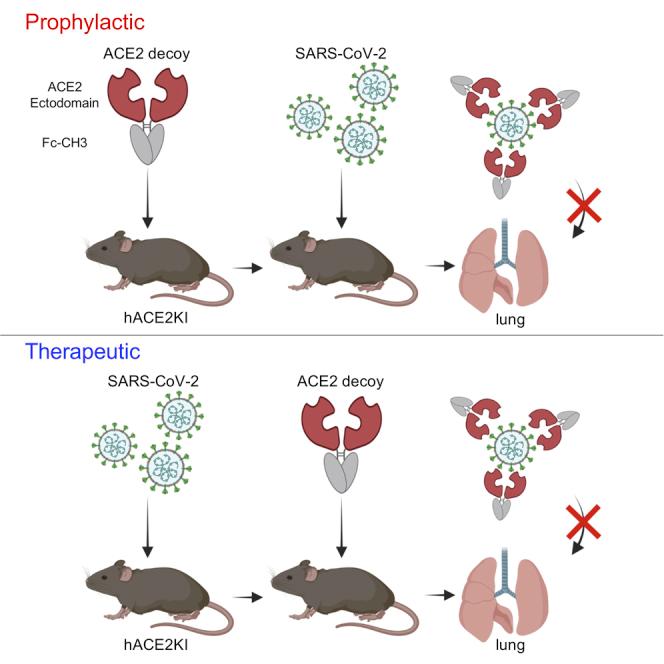
The emergence of SARS-CoV-2 variants with highly mutated spike proteins has presented an obstacle to the use of monoclonal antibodies for the prevention and treatment of SARS-CoV-2 infection. We show that a high-affinity receptor decoy protein in which a modified ACE2 ectodomain is fused to a single domain of an immunoglobulin heavy chain Fc region dramatically suppressed virus loads in mice upon challenge with a high dose of parental SARS-CoV-2 or Omicron variants. The decoy also potently suppressed virus replication when administered shortly post-infection. The decoy approach offers protection against the current viral variants and, potentially, against SARS-CoV-2 variants that may emerge with the continued evolution of the spike protein or novel viruses that use ACE2 for virus entry.
具有高度突变刺突蛋白的严重急性呼吸综合征冠状病毒2(SARS-CoV-2)变体的出现,给单克隆抗体用于预防和治疗SARS-CoV-2感染带来了障碍。我们发现,一种高亲和力受体诱饵蛋白,其中修饰的血管紧张素转换酶2(ACE2)胞外域与免疫球蛋白重链Fc区域的单个结构域融合,在用高剂量的亲本SARS-CoV-2或奥密克戎变体攻击小鼠后,能显著抑制病毒载量。该诱饵在感染后不久给药时,也能有效抑制病毒复制。这种诱饵方法可为当前的病毒变体提供保护,并有可能为随着刺突蛋白持续进化可能出现的SARS-CoV-2变体或使用ACE2进入细胞的新型病毒提供保护。


 Zotero 插件