
常见镇痛药与卵巢癌生存:卵巢癌预后与生活方式(OPAL)研究。
Common analgesics and ovarian cancer survival: the Ovarian cancer Prognosis And Lifestyle (OPAL) Study.
机构信息
Population Health Program, QIMR Berghofer Medical Research Institute, Brisbane, QLD, Australia.
School of Public Health, Faculty of Medicine, University of Queensland, Brisbane, QLD, Australia.
出版信息
J Natl Cancer Inst. 2023 May 8;115(5):570-577. doi: 10.1093/jnci/djac239.
BACKGROUND
Most women with ovarian cancer (OC) are diagnosed with advanced disease. They often experience recurrence after primary treatment, and their subsequent prognosis is poor. Our goal was to evaluate the association between use of nonsteroidal antiinflammatory drugs (NSAIDs), including regular and low-dose aspirin, and 5-year cancer-specific survival after an OC diagnosis.
METHODS
The Ovarian cancer Prognosis And Lifestyle study is a prospective population-based cohort of 958 Australian women with OC. Information was gathered through self-completed questionnaires. We classified NSAID use during the year prediagnosis and postdiagnosis as none or occasional (<1 d/wk), infrequent (1-3 d/wk), and frequent (≥4 d/wk) use. We measured survival from the start of primary treatment: surgery or neoadjuvant chemotherapy for analyses of prediagnosis use, or 12 months after starting treatment (postdiagnosis use) until the earliest of date of death from OC (other deaths were censored) or last follow-up to 5 years. We used Cox proportional hazards regression to estimate adjusted hazard ratios (HRs) and 95% confidence intervals (CIs) and applied inverse-probability of treatment weighting to minimize confounding. We also calculated restricted mean survival times.
RESULTS
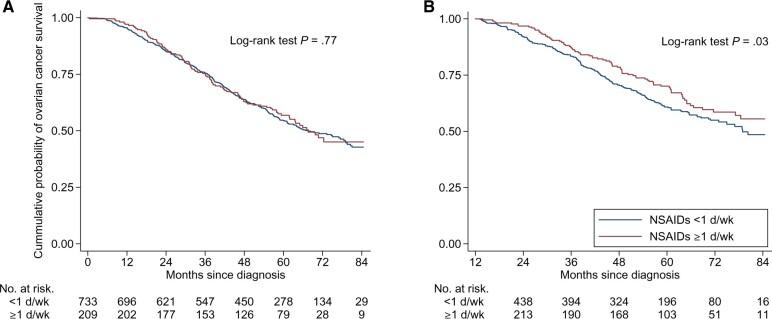
Compared with nonusers and infrequent users, we observed better survival associated with frequent NSAID use prediagnosis (HR = 0.73, 95% CI = 0.55 to 0.97) or postdiagnosis (HR = 0.65, 95% CI = 0.45 to 0.94). Estimates were similar for aspirin and nonaspirin NSAIDs, new and continuous users and in weighted models. These differences would translate to a 2.5-month increase in mean survival by 5 years postdiagnosis. There was no association with acetaminophen.
CONCLUSIONS
Our findings confirm a previous study suggesting NSAID use might improve OC survival.
背景
大多数卵巢癌 (OC) 患者被诊断为晚期疾病。她们在初次治疗后经常复发,后续预后较差。我们的目标是评估非甾体抗炎药 (NSAIDs) 的使用与 OC 诊断后 5 年癌症特异性生存之间的关系,包括常规和低剂量阿司匹林。
方法
卵巢癌预后和生活方式研究是一项针对 958 名澳大利亚 OC 女性的前瞻性基于人群的队列研究。通过自填问卷收集信息。我们将诊断前和诊断后一年内的 NSAID 使用情况分为不使用或偶尔使用(<1 天/周)、不频繁使用(1-3 天/周)和频繁使用(≥4 天/周)。我们从初次治疗开始测量生存:手术或新辅助化疗用于分析诊断前使用情况,或从开始治疗后 12 个月(诊断后使用)开始,直至 OC 死亡(其他死亡为删失)或最后随访至 5 年。我们使用 Cox 比例风险回归估计调整后的风险比 (HR) 和 95%置信区间 (CI),并应用治疗反概率加权以最小化混杂。我们还计算了受限平均生存时间。
结果
与不使用者和不频繁使用者相比,我们观察到频繁使用 NSAIDs 与诊断前(HR=0.73,95%CI=0.55-0.97)或诊断后(HR=0.65,95%CI=0.45-0.94)生存相关。阿司匹林和非阿司匹林 NSAIDs、新使用者和连续使用者以及加权模型的估计值相似。这些差异将导致诊断后 5 年平均生存时间增加 2.5 个月。与醋氨酚无关。
结论
我们的研究结果证实了先前的一项研究,表明 NSAID 的使用可能改善 OC 的生存。


 Zotero 插件