
基于社区的在线同伴支持脊髓损伤自我管理干预的可行性:一项试点等待名单随机试验方案
Feasibility of a Community-Based, Online, Peer-Supported Spinal Cord Injury Self-management Intervention: Protocol for a Pilot Wait-Listed Randomized Trial.
作者信息
Newman Susan Dunreath, Toatley Sherwood, Rodgers Marka Danielle, Qanungo Suparna, Mueller Martina, Denny Brian, Rodriguez Angela
机构信息
College of Nursing, Medical University of South Carolina, Charleston, SC, United States.
South Carolina Spinal Cord Injury Association, Columbia, SC, United States.
出版信息
JMIR Res Protoc. 2023 Feb 7;12:e42688. doi: 10.2196/42688.
BACKGROUND
People with spinal cord injury (SCI) report feeling unprepared to manage their disability upon discharge to the community. This situation is exacerbated when they return to settings where self-management support and resources are sparse, thus increasing the risk of costly secondary conditions and rehospitalizations. These factors make a compelling case for implementing innovative community-based SCI self-management programs that empower and engage individuals with SCI. Using a community-engaged research (CEnR) approach, we developed a peer-supported SCI self-management intervention, known as PHOENIX (Peer-supported Health Outreach, Education, and Information Exchange), which integrates online educational content and support from peer navigators (PNs) through telehealth, to promote health and community participation after SCI.
OBJECTIVE
The objective of this pilot study is to evaluate the feasibility and acceptability of PHOENIX and the study design, and to obtain estimates of the variability of relevant outcome measures.
METHODS
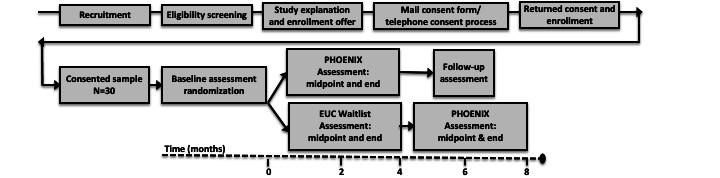
We conducted a pilot randomized waitlist-controlled trial (n=30) in collaboration with the South Carolina Spinal Cord Injury Association (SCSCIA), our long-standing community-based nonprofit organization research partner. We recruited 4 PNs through our SCSCIA collaboration using its existing network of trained peer mentors. Our study design supported comparison of the following 2 randomly assigned groups: PHOENIX intervention group and waitlist enhanced usual care (EUC) group. The PHOENIX intervention was administered online by PNs over 16 weeks through scheduled "video visits." The EUC group participated in the study for 16 weeks with usual community services and no navigation, and received 4 monthly newsletters from the SCSCIA on a variety of SCI-relevant topics. At the end of the waitlist period, the waitlist EUC group received the full PHOENIX intervention. Measures of feasibility included PN and participant recruitment and retention, PN workload, protocol adherence, and incidence of technical issues. We conducted qualitative interviews with participants and PNs to evaluate the acceptability of PHOENIX and the study design. Outcome measures, including community participation, quality of life, and the occurrence and subjective impact of medically serious secondary conditions and rehospitalizations, were assessed at baseline after randomization and at subsequent time points to allow between-group comparisons.
RESULTS
PN hiring and training were completed in August 2018. Recruitment began in November 2018. A total of 30 participants were recruited across South Carolina, and 28 participants completed follow-up by August 2020. An analysis of the results is being finalized, and the results are expected to be published in 2023.
CONCLUSIONS
This study will provide valuable information to guide future research seeking to address unmet self-management needs and improve outcomes in individuals with SCI. Feasibility findings of this study will provide evidence from CEnR guided by people with SCI and SCI service providers to inform further development, testing, and dissemination of effective and scalable self-management strategies for people with SCI.
INTERNATIONAL REGISTERED REPORT IDENTIFIER (IRRID): RR1-10.2196/42688.
背景
脊髓损伤(SCI)患者表示,出院回到社区后,他们感觉自己没有做好管理残疾状况的准备。当他们回到自我管理支持和资源匮乏的环境中时,这种情况会更加严重,从而增加了出现代价高昂的继发疾病和再次住院的风险。这些因素有力地证明了实施创新的基于社区的SCI自我管理项目的必要性,该项目能够增强SCI患者的能力并促使他们积极参与。我们采用社区参与式研究(CEnR)方法,开发了一种同伴支持的SCI自我管理干预措施,称为PHOENIX(同伴支持的健康外展、教育和信息交流),该措施通过远程医疗整合在线教育内容和同伴导航员(PN)的支持,以促进SCI后的健康和社区参与。
目的
本试点研究的目的是评估PHOENIX的可行性和可接受性以及研究设计,并获取相关结局指标变异性的估计值。
方法
我们与南卡罗来纳州脊髓损伤协会(SCSCIA)合作开展了一项试点随机等待列表对照试验(n = 30),SCSCIA是我们长期合作的基于社区的非营利组织研究伙伴。我们通过与SCSCIA合作,利用其现有的经过培训的同伴导师网络招募了4名PN。我们的研究设计支持对以下两个随机分配的组进行比较:PHOENIX干预组和等待列表强化常规护理(EUC)组。PHOENIX干预由PN通过预定的“视频访视”在16周内在线实施。EUC组在16周内参与常规社区服务且无导航,并每月收到4份SCSCIA关于各种SCI相关主题的时事通讯。在等待列表期结束时,等待列表EUC组接受完整的PHOENIX干预。可行性指标包括PN和参与者的招募与保留、PN工作量、方案依从性以及技术问题的发生率。我们对参与者和PN进行了定性访谈,以评估PHOENIX和研究设计的可接受性。在随机化后的基线以及随后的时间点评估结局指标,包括社区参与、生活质量以及严重医学继发疾病和再次住院的发生情况及其主观影响,以便进行组间比较。
结果
PN的招聘和培训于2018年8月完成。招募工作于2018年11月开始。南卡罗来纳州共招募了30名参与者,截至2020年8月,28名参与者完成了随访。结果分析正在定稿,预计结果将于2023年发表。
结论
本研究将提供有价值的信息,以指导未来旨在满足未满足的自我管理需求并改善SCI患者结局的研究。本研究的可行性结果将提供来自以SCI患者和SCI服务提供者为指导的CEnR的证据,为SCI患者有效且可扩展的自我管理策略的进一步开发、测试和传播提供信息。
国际注册报告标识符(IRRID):RR1-10.2196/42688。


 Zotero 插件