
DRAGON-数据:一个用于整合大型精神科队列中基因组和表型数据的平台及协议。
DRAGON-Data: a platform and protocol for integrating genomic and phenotypic data across large psychiatric cohorts.
作者信息
Lynham Amy J, Knott Sarah, Underwood Jack F G, Hubbard Leon, Agha Sharifah S, Bisson Jonathan I, van den Bree Marianne B M, Chawner Samuel J R A, Craddock Nicholas, O'Donovan Michael, Jones Ian R, Kirov George, Langley Kate, Martin Joanna, Rice Frances, Roberts Neil P, Thapar Anita, Anney Richard, Owen Michael J, Hall Jeremy, Pardiñas Antonio F, Walters James T R
机构信息
MRC Centre for Neuropsychiatric Genetics and Genomics, Division of Psychological Medicine and Clinical Neurosciences, School of Medicine, Cardiff University, UK.
MRC Centre for Neuropsychiatric Genetics and Genomics, Division of Psychological Medicine and Clinical Neurosciences, School of Medicine, Cardiff University, UK; and School of Psychology, Cardiff University, UK.
出版信息
BJPsych Open. 2023 Feb 8;9(2):e32. doi: 10.1192/bjo.2022.636.
BACKGROUND
Current psychiatric diagnoses, although heritable, have not been clearly mapped onto distinct underlying pathogenic processes. The same symptoms often occur in multiple disorders, and a substantial proportion of both genetic and environmental risk factors are shared across disorders. However, the relationship between shared symptoms and shared genetic liability is still poorly understood.
AIMS
Well-characterised, cross-disorder samples are needed to investigate this matter, but few currently exist. Our aim is to develop procedures to purposely curate and aggregate genotypic and phenotypic data in psychiatric research.
METHOD
As part of the Cardiff MRC Mental Health Data Pathfinder initiative, we have curated and harmonised phenotypic and genetic information from 15 studies to create a new data repository, DRAGON-Data. To date, DRAGON-Data includes over 45 000 individuals: adults and children with neurodevelopmental or psychiatric diagnoses, affected probands within collected families and individuals who carry a known neurodevelopmental risk copy number variant.
RESULTS
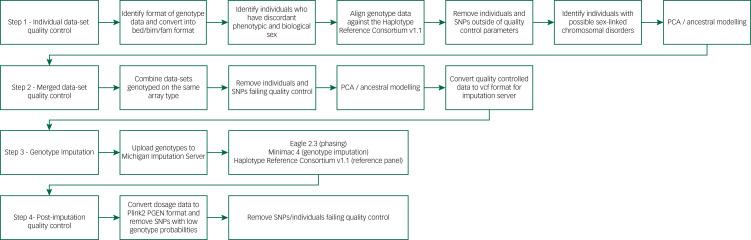
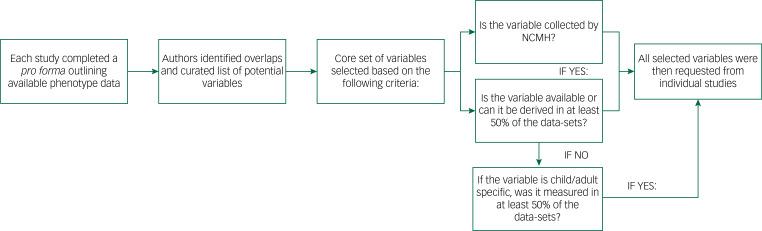
We have processed the available phenotype information to derive core variables that can be reliably analysed across groups. In addition, all data-sets with genotype information have undergone rigorous quality control, imputation, copy number variant calling and polygenic score generation.
CONCLUSIONS
DRAGON-Data combines genetic and non-genetic information, and is available as a resource for research across traditional psychiatric diagnostic categories. Algorithms and pipelines used for data harmonisation are currently publicly available for the scientific community, and an appropriate data-sharing protocol will be developed as part of ongoing projects (DATAMIND) in partnership with Health Data Research UK.
背景
目前的精神疾病诊断虽然具有遗传性,但尚未明确映射到不同的潜在致病过程。相同的症状常出现在多种疾病中,并且相当一部分遗传和环境风险因素在不同疾病之间是共享的。然而,共享症状与共享遗传易感性之间的关系仍知之甚少。
目的
需要特征明确的跨疾病样本对此进行研究,但目前此类样本很少。我们的目标是开发程序,以便在精神疾病研究中有目的地整理和汇总基因型和表型数据。
方法
作为卡迪夫医学研究委员会心理健康数据探索者计划的一部分,我们整理并统一了来自15项研究的表型和遗传信息,以创建一个新的数据存储库DRAGON-Data。截至目前,DRAGON-Data包含超过45000名个体:患有神经发育或精神疾病诊断的成人和儿童、所收集家庭中的患病先证者以及携带已知神经发育风险拷贝数变异的个体。
结果
我们已处理可用的表型信息,以得出可在各组间进行可靠分析的核心变量。此外,所有具有基因型信息的数据集都经过了严格的质量控制、插补、拷贝数变异检测和多基因评分生成。
结论
DRAGON-Data结合了遗传和非遗传信息,可作为跨传统精神疾病诊断类别的研究资源。用于数据统一的算法和流程目前已向科学界公开,并且将作为与英国健康数据研究合作的正在进行的项目(DATAMIND)的一部分制定适当的数据共享协议。
 Zotero 插件