
免疫原性细胞死亡:溶瘤病毒免疫治疗的基石。
Immunogenic cell death: The cornerstone of oncolytic viro-immunotherapy.
机构信息
International Ph.D. Program in Medicine, College of Medicine, Taipei Medical University, Taipei, Taiwan.
Department of Microbiology and Immunology, School of Medicine, College of Medicine, Taipei Medical University, Taipei, Taiwan.
出版信息
Front Immunol. 2023 Jan 23;13:1038226. doi: 10.3389/fimmu.2022.1038226. eCollection 2022.
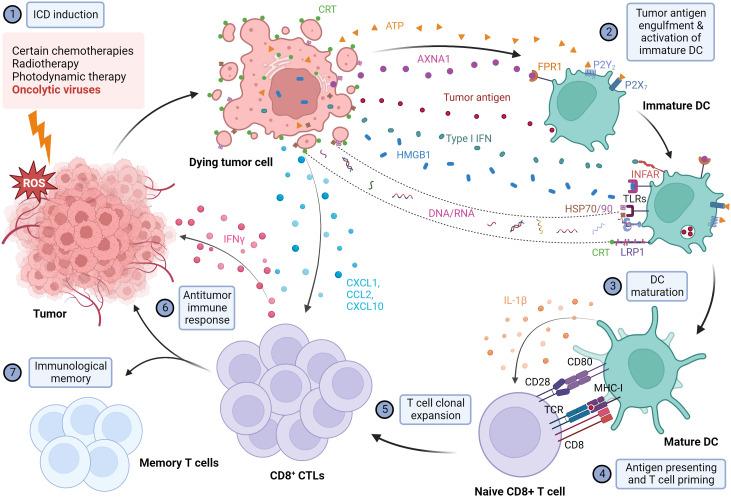
According to the World Health Organization, cancer is one of the leading global health concerns, causing nearly 10 million deaths in 2020. While classical chemotherapeutics produce strong cytotoxicity on cancer cells, they carry limitations of drug resistance and off-target effects and sometimes fail to elicit adequate antitumor protection against tumor relapse. Additionally, most cancer cells have developed various ways to escape immune surveillance. Nevertheless, novel anticancer strategies such as oncolytic viro-immunotherapy can trigger immunogenic cell death (ICD), which can quickly grasp the attention of the host defense machinery, resulting in an ensuing antitumor immune response. Specifically, oncolytic viruses (OVs) can infect and destroy targeted cancer cells and stimulate the immune system by exposing pathogen-associated molecular patterns (PAMPs) and damage-associated molecular patterns (DAMPs) to promote inflammatory reactions, and concomitantly prime and induce antitumor immunity by the release of neoantigens from the damaged cancer cells. Thus, OVs can serve as a novel system to sensitize tumor cells for promising immunotherapies. This review discusses the concept of ICD in cancer, centralizing ICD-associated danger signals and their consequence in antitumor responses and ICD induced by OVs. We also shed light on the potential strategies to enhance the immunogenicity of OVs, including the use of genetically modified OVs and their combination with ICD-enhancing agents, which are helpful as forthcoming anticancer regimens.
根据世界卫生组织的数据,癌症是全球主要健康问题之一,2020 年导致近 1000 万人死亡。虽然经典的化疗药物对癌细胞具有很强的细胞毒性,但它们存在耐药性和脱靶效应的限制,有时无法对肿瘤复发产生足够的抗肿瘤保护作用。此外,大多数癌细胞已经发展出各种逃避免疫监视的方法。然而,新型抗癌策略,如溶瘤病毒免疫治疗,可以触发免疫原性细胞死亡(ICD),这可以迅速引起宿主防御机制的注意,导致随后的抗肿瘤免疫反应。具体来说,溶瘤病毒(OVs)可以感染和破坏靶向癌细胞,并通过暴露病原体相关分子模式(PAMPs)和损伤相关分子模式(DAMPs)来刺激免疫系统,从而促进炎症反应,同时通过受损癌细胞释放新抗原来启动和诱导抗肿瘤免疫。因此,OVs 可以作为一种新的系统,使肿瘤细胞对有前途的免疫疗法敏感。本综述讨论了癌症中 ICD 的概念,集中讨论了 ICD 相关危险信号及其在抗肿瘤反应中的作用,以及 OVs 诱导的 ICD。我们还探讨了增强 OVs 免疫原性的潜在策略,包括使用基因修饰的 OVs 及其与 ICD 增强剂的联合应用,这些策略有助于作为即将出现的抗癌方案。

 Zotero 插件