
吡唑啉酮类化合物(第二部分):抗氧化潜力评估;构效关系
Pyrazolone-type compounds (part II): and evaluation of antioxidant potential; structure-activity relationship.
作者信息
Branković Jovica, Milovanović Vesna M, Petrović Zorica D, Simijonović Dušica, Petrović Vladimir P
机构信息
University of Kragujevac, Faculty of Science, Department of Chemistry R. Domanovića 12 34000 Kragujevac Serbia
University of Kragujevac, Faculty of Agronomy, Department of Chemistry and Chemical Engineering Cara Dušana 34 32000 Čačak Serbia.
出版信息
RSC Adv. 2023 Jan 18;13(5):2884-2895. doi: 10.1039/d2ra08280b.
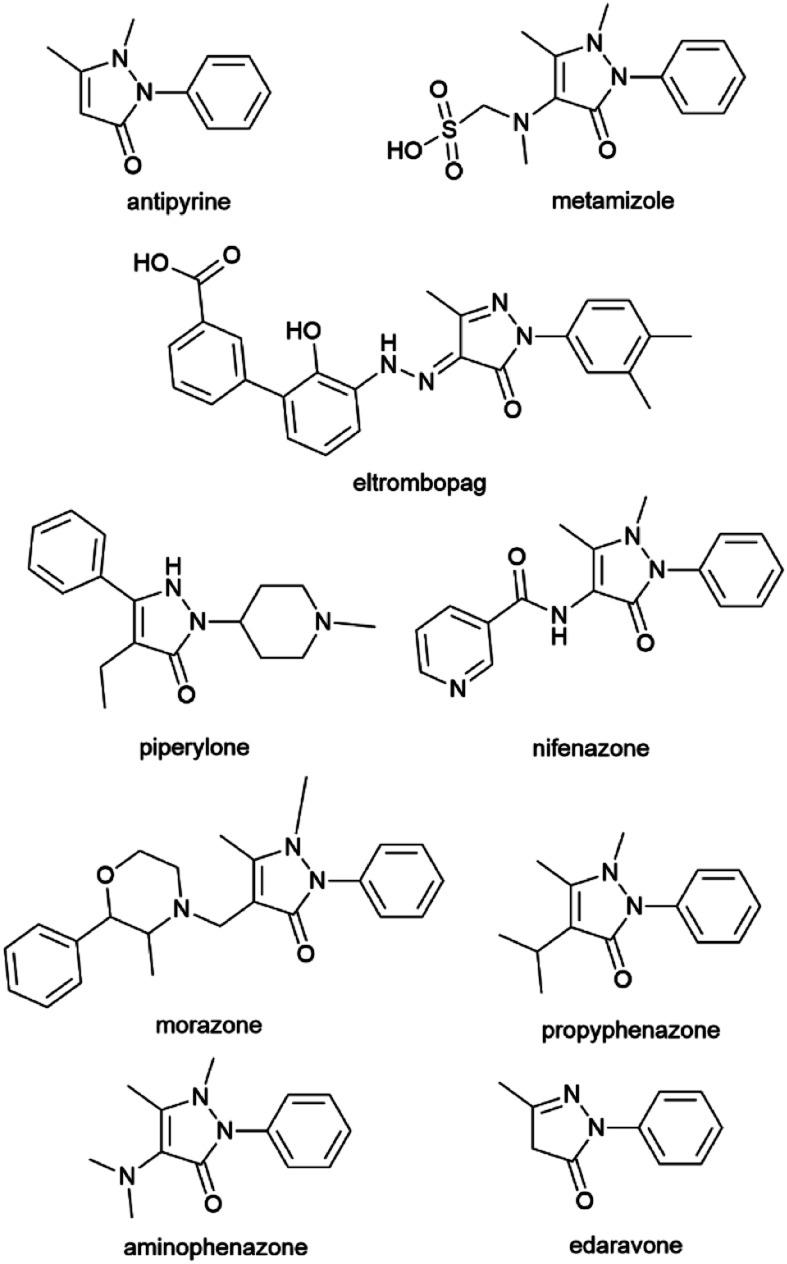
The pyrazolone class comprises a variety of hybrid compounds displaying diverse biological actions. Although studied for decades, these compounds are still of interest due to their facile chemical transformations. In our previous work, we presented the synthetic route of functionalised pyrazolone derivatives. The presence of pyrazolone structural motif in many drugs, such as edaravone, prompted us to investigate the antioxidant features of the selected compounds. In this paper, we provide an extensive and description of the antioxidant properties of selected pyrazolone analogues. The obtained results revealed their great antiradical potency against the DPPH radical (IC values in the 2.6-7.8 μM range), where the best results were obtained for analogues bearing a catechol moiety. Density functional theory (DFT) was used to assess their antioxidant capacity from the thermodynamic aspect. Here, good agreement with results was achieved. DFT was employed for the prediction of the most preferable radical scavenging pathway, also. In polar solvents, the SPLET mechanism is a favourable scavenging route, whereas in nonpolar solvents the HAT is slightly predominant. Furthermore, antioxidant mechanisms were studied in the presence of relevant reactive oxygen species. The obtained values of the reaction enthalpies with the selected radicals revealed that HAT is slightly prevailing in polar solvents, while the SPLET mechanism is dominant in nonpolar solvents. Regarding the well-known antioxidant features of the drug edaravone, these findings represent valuable data for this pyrazolone class and could be used as the basis for further investigations.
吡唑啉酮类包含多种具有不同生物活性的杂化化合物。尽管已研究了数十年,但由于其易于进行化学转化,这些化合物仍然备受关注。在我们之前的工作中,我们展示了功能化吡唑啉酮衍生物的合成路线。许多药物(如依达拉奉)中存在吡唑啉酮结构基序,这促使我们研究所选化合物的抗氧化特性。在本文中,我们对所选吡唑啉酮类似物的抗氧化性能进行了广泛的描述。所得结果表明它们对DPPH自由基具有很强的抗自由基能力(IC值在2.6 - 7.8 μM范围内),其中带有儿茶酚部分的类似物表现出最佳结果。密度泛函理论(DFT)用于从热力学角度评估它们的抗氧化能力。在此,与实验结果取得了良好的一致性。DFT还用于预测最优选的自由基清除途径。在极性溶剂中,SPLET机制是一种有利的清除途径,而在非极性溶剂中,HAT机制略占主导。此外,在存在相关活性氧物种的情况下研究了抗氧化机制。与所选自由基反应的反应焓值表明,在极性溶剂中HAT机制略占优势,而在非极性溶剂中SPLET机制占主导。鉴于药物依达拉奉众所周知的抗氧化特性,这些发现为该吡唑啉酮类提供了有价值的数据,可作为进一步研究的基础。

 Zotero 插件