
神经元兴奋性作为回路重构的调节因子。
Neuronal excitability as a regulator of circuit remodeling.
机构信息
Department of Molecular Cell Biology, Weizmann Institute of Science, 7610001 Rehovot, Israel.
Department of Molecular Cell Biology, Weizmann Institute of Science, 7610001 Rehovot, Israel; Department of Molecular Neuroscience, Weizmann Institute of Science, 7610001 Rehovot, Israel.
出版信息
Curr Biol. 2023 Mar 13;33(5):981-989.e3. doi: 10.1016/j.cub.2023.01.032. Epub 2023 Feb 8.
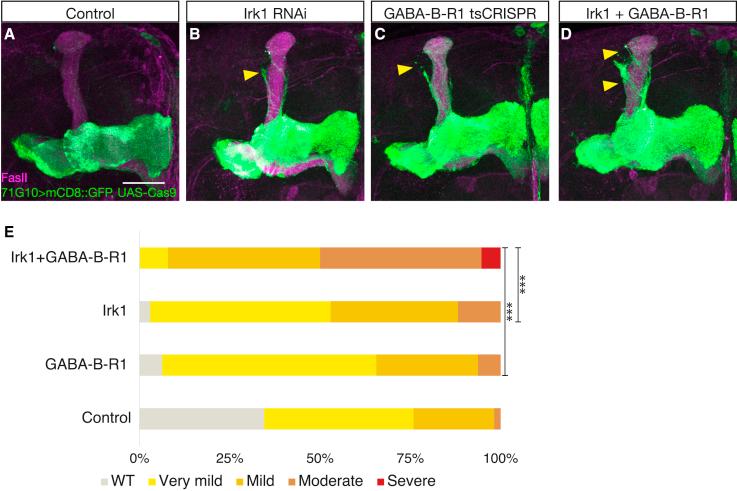
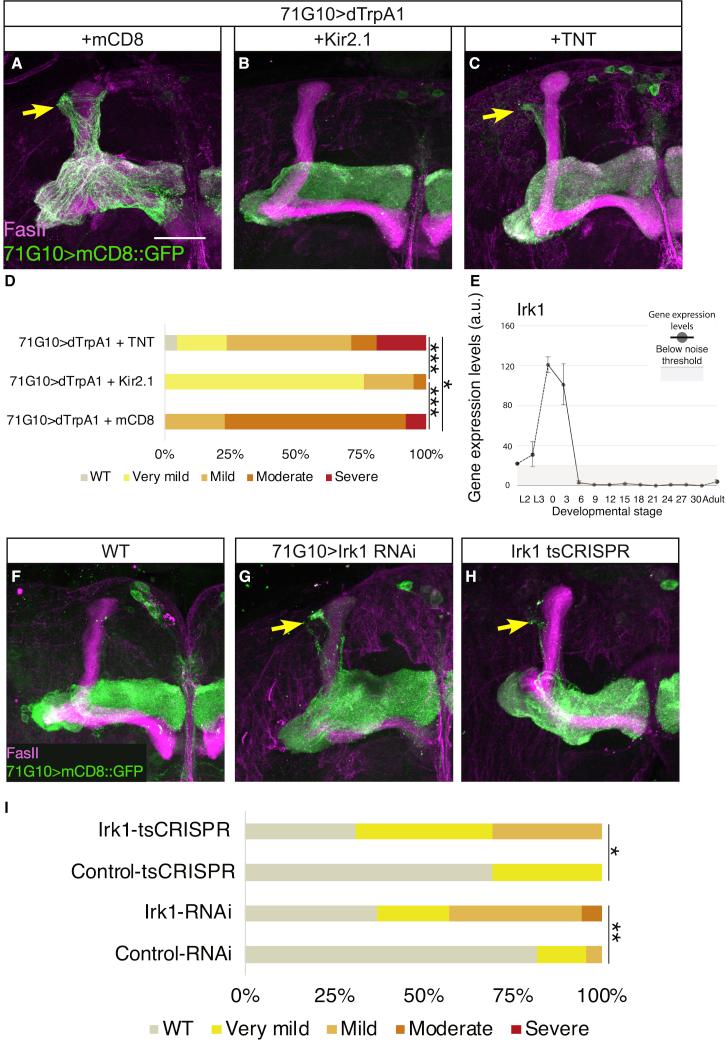
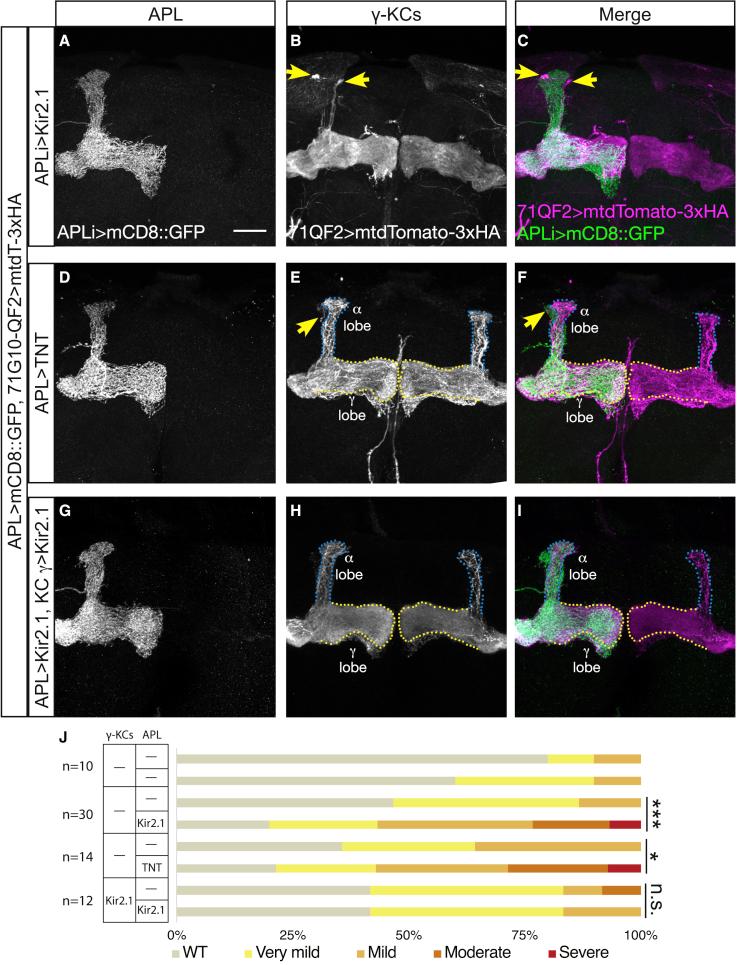
Postnatal remodeling of neuronal connectivity shapes mature nervous systems. The pruning of exuberant connections involves cell-autonomous and non-cell-autonomous mechanisms, such as neuronal activity. Indeed, experience-dependent competition sculpts various excitatory neuronal circuits. Moreover, activity has been shown to regulate growth cone motility and the stability of neurites and synaptic connections. However, whether inhibitory activity influences the remodeling of neuronal connectivity or how activity influences remodeling in systems in which competition is not clearly apparent is not fully understood. Here, we use the Drosophila mushroom body (MB) as a model to examine the role of neuronal activity in the developmental axon pruning of γ-Kenyon cells. The MB is a neuronal structure in insects, implicated in associative learning and memory, which receives mostly olfactory input from the antennal lobe. The MB circuit includes intrinsic neurons, called Kenyon cells (KCs), which receive inhibitory input from the GABAergic anterior paired lateral (APL) neuron among other inputs. The γ-KCs undergo stereotypic, steroid-hormone-dependent remodeling that involves the pruning of larval neurites followed by regrowth to form adult connections. We demonstrate that silencing neuronal activity is required for γ-KC pruning. Furthermore, we show that this is mechanistically achieved by cell-autonomous expression of the inward rectifying potassium channel 1 (irk1) combined with inhibition by APL neuron activity likely via GABA-B-R1 signaling. These results support the Hebbian-like rule "use it or lose it," where inhibition can destabilize connectivity and promote pruning while excitability stabilizes existing connections.
神经元连接的产后重塑塑造了成熟的神经系统。过多连接的修剪涉及细胞自主和非细胞自主机制,如神经元活动。事实上,经验依赖的竞争塑造了各种兴奋性神经元回路。此外,活动已被证明可以调节生长锥的运动以及神经突和突触连接的稳定性。然而,抑制性活动是否会影响神经元连接的重塑,或者活动如何影响竞争不明显的系统中的重塑,目前还不完全清楚。在这里,我们使用果蝇蘑菇体(MB)作为模型,研究神经元活动在γ-Kenyon 细胞的发育性轴突修剪中的作用。MB 是昆虫中的一种神经元结构,参与联想学习和记忆,它主要从触角叶接收嗅觉输入。MB 回路包括内在神经元,称为 Kenyon 细胞(KC),它们从 GABA 能的前配对侧(APL)神经元接收抑制性输入,以及其他输入。γ-KC 经历了刻板的、类固醇激素依赖性的重塑,包括幼虫神经突的修剪,然后再生形成成年连接。我们证明,沉默神经元活动是γ-KC 修剪所必需的。此外,我们表明,这是通过细胞自主表达内向整流钾通道 1(irk1)与 APL 神经元活性的抑制相结合来实现的,可能通过 GABA-B-R1 信号传导。这些结果支持了类似赫布的规则“用进废退”,即抑制可以破坏连接并促进修剪,而兴奋性则稳定现有的连接。

 Zotero 插件