
滑膜肉瘤临床前建模:整合转基因小鼠模型和患者来源模型用于转化研究
Synovial Sarcoma Preclinical Modeling: Integrating Transgenic Mouse Models and Patient-Derived Models for Translational Research.
作者信息
Landuzzi Lorena, Ruzzi Francesca, Lollini Pier-Luigi, Scotlandi Katia
机构信息
Experimental Oncology Laboratory, IRCCS Istituto Ortopedico Rizzoli, 40136 Bologna, Italy.
Laboratory of Immunology and Biology of Metastasis, Department of Medical and Surgical Sciences (DIMEC), University of Bologna, 40126 Bologna, Italy.
出版信息
Cancers (Basel). 2023 Jan 18;15(3):588. doi: 10.3390/cancers15030588.
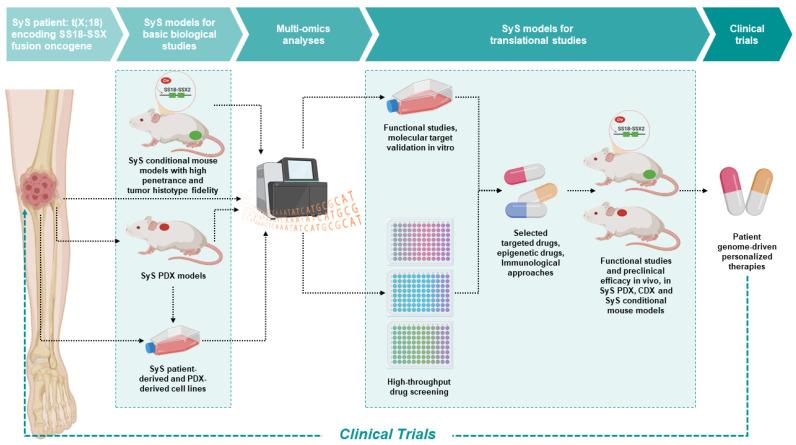
Synovial sarcomas (SyS) are rare malignant tumors predominantly affecting children, adolescents, and young adults. The genetic hallmark of SyS is the t(X;18) translocation encoding the SS18-SSX fusion gene. The fusion protein interacts with both the BAF enhancer and polycomb repressor complexes, and either activates or represses target gene transcription, resulting in genome-wide epigenetic perturbations and altered gene expression. Several experimental in in vivo models, including conditional transgenic mouse models expressing the SS18-SSX fusion protein and spontaneously developing SyS, are available. In addition, patient-derived xenografts have been estab-lished in immunodeficient mice, faithfully reproducing the complex clinical heterogeneity. This review focuses on the main molecular features of SyS and the related preclinical in vivo and in vitro models. We will analyze the different conditional SyS mouse models that, after combination with some of the few other recurrent alterations, such as gains in BCL2, Wnt-β-catenin signaling, FGFR family, or loss of PTEN and SMARCB1, have provided additional insight into the mechanisms of synovial sarcomagenesis. The recent advancements in the understanding of SyS biology and improvements in preclinical modeling pave the way to the development of new epigenetic drugs and immunotherapeutic approaches conducive to new treatment options.
滑膜肉瘤(SyS)是一种罕见的恶性肿瘤,主要影响儿童、青少年和年轻成年人。SyS的遗传学特征是t(X;18)易位,编码SS18-SSX融合基因。该融合蛋白与BAF增强子和多梳抑制复合物相互作用,激活或抑制靶基因转录,导致全基因组表观遗传扰动和基因表达改变。有几种体内实验模型可供使用,包括表达SS18-SSX融合蛋白并自发形成SyS的条件转基因小鼠模型。此外,已在免疫缺陷小鼠中建立了患者来源的异种移植物,忠实地再现了复杂的临床异质性。本综述重点关注SyS的主要分子特征以及相关的临床前体内和体外模型。我们将分析不同的条件性SyS小鼠模型,这些模型与其他一些少数复发改变(如BCL2扩增、Wnt-β-连环蛋白信号通路、FGFR家族改变或PTEN和SMARCB1缺失)相结合后,为滑膜肉瘤发生机制提供了更多见解。对SyS生物学理解的最新进展和临床前建模的改进为开发新的表观遗传药物和免疫治疗方法铺平了道路,这些方法有助于提供新的治疗选择。
 Zotero 插件