
肉鸡胴体上的小污染更多是质量问题而非食品安全问题。
Small Contaminations on Broiler Carcasses Are More a Quality Matter than a Food Safety Issue.
作者信息
Libera Kacper, Lipman Len, Berends Boyd R
机构信息
Institute for Risk Assessment Sciences (IRAS), Utrecht University, 3508 TD Utrecht, The Netherlands.
出版信息
Foods. 2023 Jan 24;12(3):522. doi: 10.3390/foods12030522.
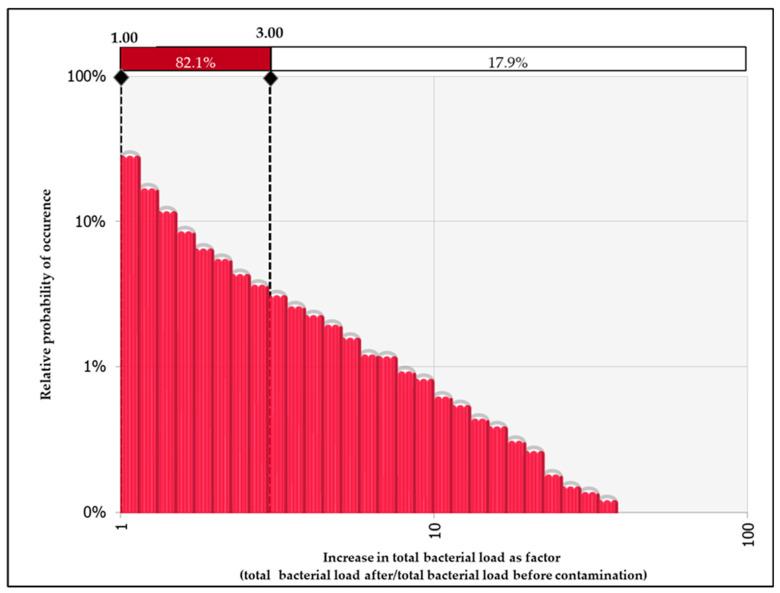
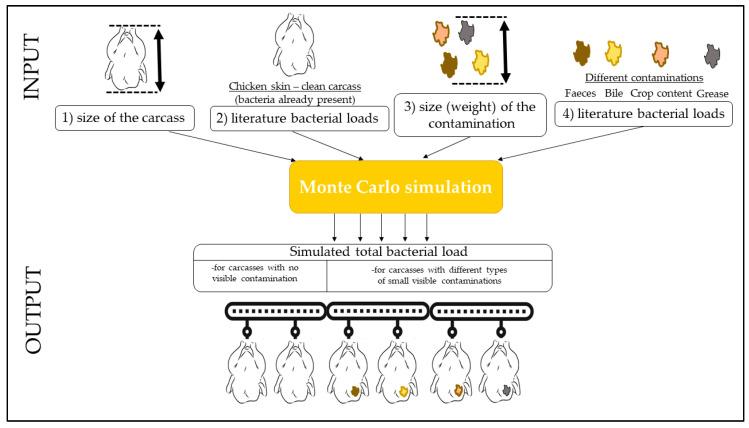
Depending on the interpretation of the European Union (EU) regulations, even marginally visibly contaminated poultry carcasses could be rejected for human consumption due to food safety concerns. However, it is not clear if small contaminations actually increase the already present bacterial load of carcasses to such an extent that the risk for the consumers is seriously elevated. Therefore, the additional contribution to the total microbial load on carcasses by a small but still visible contamination with feces, grains from the crop, and drops of bile and grease from the slaughter line was determined using a Monte Carlo simulation. The bacterial counts (total aerobic plate count, , , and spp.) were obtained from the literature and used as input for the Monte Carlo model with 50,000 iterations for each simulation. The Monte Carlo simulation revealed that the presence of minute spots of feces, bile, crop content, and slaughter line grease do not lead to a substantial increase of the already existing biological hazards present on the carcasses and should thus be considered a matter of quality rather than food safety.
根据欧盟法规的解释,出于食品安全考虑,即使只是稍有可见污染的家禽胴体也可能被拒绝供人类食用。然而,尚不清楚小面积污染是否真的会将胴体中已有的细菌负荷增加到严重提高消费者风险的程度。因此,通过蒙特卡洛模拟确定了粪便、嗉囊谷物以及屠宰线的胆汁和油脂造成的小面积但仍可见的污染对胴体总微生物负荷的额外贡献。细菌计数(总需氧平板计数、[此处原文缺失具体菌名]、[此处原文缺失具体菌名]和[此处原文缺失具体菌名]菌属)取自文献,并用作蒙特卡洛模型的输入,每次模拟进行50,000次迭代。蒙特卡洛模拟表明,粪便、胆汁、嗉囊内容物和屠宰线油脂的微小斑点的存在不会导致胴体上已有的生物危害大幅增加,因此应将其视为质量问题而非食品安全问题。
 Zotero 插件