
SCARA5通过使STAT3和PI3K/AKT信号通路失活来抑制口腔鳞状细胞癌。
SCARA5 inhibits oral squamous cell carcinoma via inactivating the STAT3 and PI3K/AKT signaling pathways.
作者信息
Huang Juan, Lv Chunhua, Zhao Baoyu, Ji Zhongqian, Gao Zhenran
机构信息
Department of Stomatology, Taizhou People's Hospital, Tauzhou 225300, China.
Department of Stomatology, Taizhou People's Hospital, No. 366 Taihu Road, Tauzhou 225300, China.
出版信息
Open Med (Wars). 2023 Feb 7;18(1):20230627. doi: 10.1515/med-2023-0627. eCollection 2023.
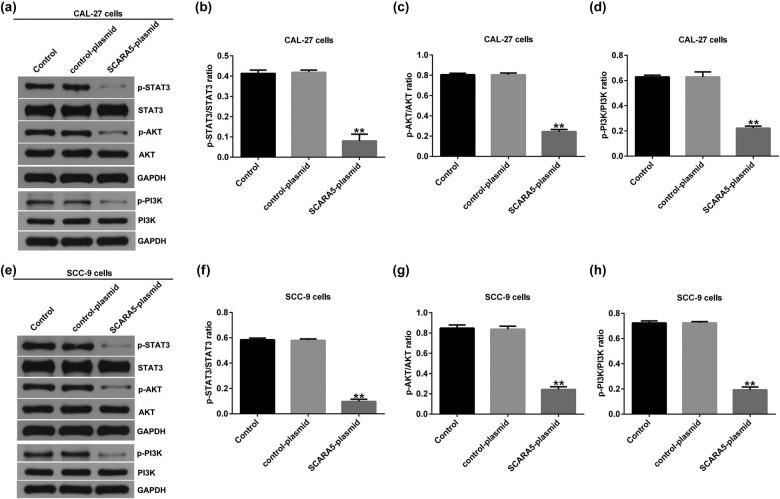
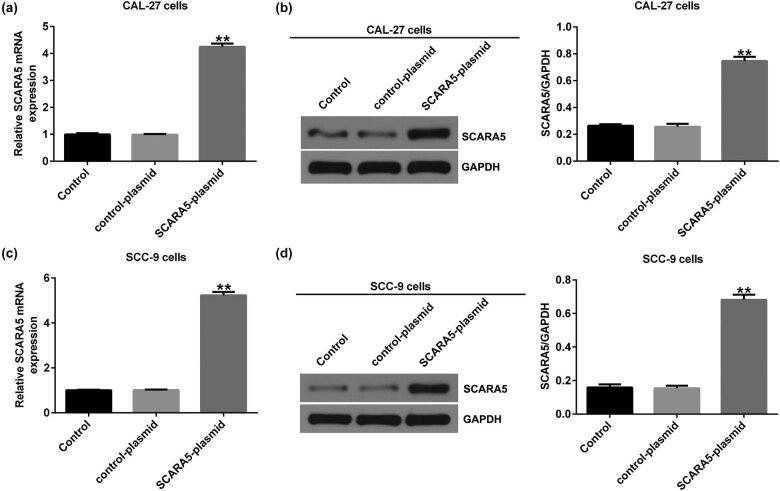
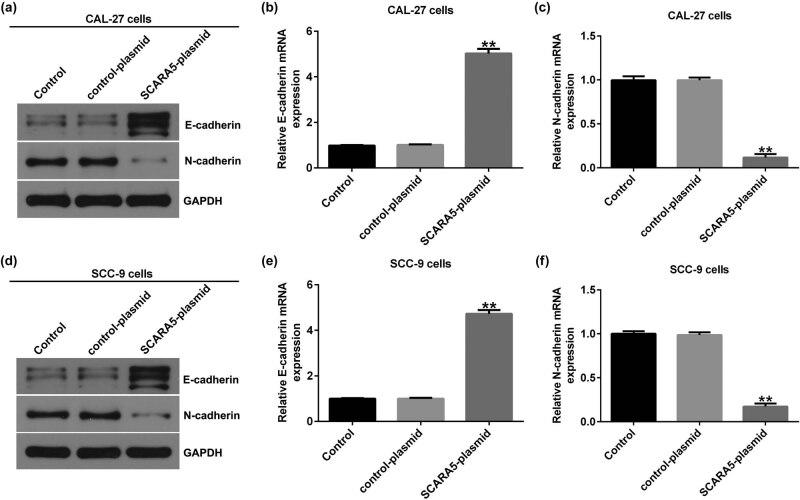
Oral squamous cell carcinoma (OSCC) is a common tumor in the world. Despite the rapid development of medical care, OSCC is also accompanied by high incidence and mortality every year. Therefore, it is still necessary to continuously develop new methods or find new targets to treat OSCC. Previous research showed that scavenger receptor class A member 5 (SCARA5) was one of the potential biomarkers of OSCC, and its expression is significantly low in OSCC. This study aimed to explore the role and related molecular mechanisms of SCARA5 in OSCC. In this study, we found that the SCARA5 expression was lower in CAL-27 and SCC-9 cells than that in human normal oral epithelial keratinocytes. SCARA5 overexpression significantly inhibited cell proliferation and induced apoptosis of CAL-27 and SCC-9 cells. In addition, SCARA5 repressed OSCC cell epithelial-mesenchymal transformation (EMT), evidenced by increased E-cadherin expression and reduced N-cadherin expression. Finally, we found that SCARA5 could suppress STAT3, PI3K, and AKT phosphorylation. Therefore, SCARA5 was related to STAT3 and PI3K/AKT signaling pathways in OSCC. In conclusion, SCARA5 inhibited the proliferation and EMT and induced the apoptosis of OSCC cells through the inhibition of STAT3 and PI3K/AKT signaling pathways, thereby exerting a tumor suppressor effect.
口腔鳞状细胞癌(OSCC)是一种常见的世界性肿瘤。尽管医疗保健迅速发展,但OSCC每年仍伴随着高发病率和高死亡率。因此,持续开发新方法或寻找新靶点来治疗OSCC仍然很有必要。先前的研究表明,A类清道夫受体成员5(SCARA5)是OSCC的潜在生物标志物之一,其在OSCC中的表达显著降低。本研究旨在探讨SCARA5在OSCC中的作用及相关分子机制。在本研究中,我们发现CAL-27和SCC-9细胞中的SCARA5表达低于人正常口腔上皮角质形成细胞。SCARA5过表达显著抑制CAL-27和SCC-9细胞的增殖并诱导其凋亡。此外,SCARA5抑制OSCC细胞上皮-间质转化(EMT),表现为E-钙黏蛋白表达增加和N-钙黏蛋白表达降低。最后,我们发现SCARA5可抑制STAT3、PI3K和AKT的磷酸化。因此,SCARA5与OSCC中的STAT3和PI3K/AKT信号通路相关。总之,SCARA5通过抑制STAT3和PI3K/AKT信号通路抑制OSCC细胞的增殖和EMT并诱导其凋亡,从而发挥肿瘤抑制作用。


 Zotero 插件