
与妊娠并发症相关的镉从母体向胎儿转移中的胎盘屏障
Placental Barrier on Cadmium Transfer from Mother to Fetus in Related to Pregnancy Complications.
作者信息
Dong Xudong, Ding Ailing, Hu Hong, Xu Fanping, Liu Lingyan, Wu Min
机构信息
The Obstetrical Department of the First People's Hospital of Yunnan Province, The Affiliated Hospital of Kunming University of Science and Technology, Kunming, 650500, People's Republic of China.
Faculty of Life Science and Technology, Kunming University of Science & Technology, Kunming, 650500, People's Republic of China.
出版信息
Int J Womens Health. 2023 Feb 10;15:179-190. doi: 10.2147/IJWH.S393067. eCollection 2023.
PURPOSE
As two of the most severe and common medical disorders during pregnancy, gestational diabetes mellitus (GDM) and hypertensive disorder complicating pregnancy (HDCP) cause adverse effects on placental barrier function and thus may lead to a high risk of intrauterine exposure to toxic metals from mother to fetus. This study investigates the impact of the placental barrier on the transfer of cadmium (Cd) from mother to fetus and the relationship between pregnancy complications.
METHODS
A total of 107 pairs of samples were collected in Kunming, China; 29 were from healthy pregnant women, and 78 were from patients with pregnancy complications. Cd was measured in each mother's placenta and maternal and umbilical cord blood. The expressions of MT and Cd-MT complex in blood and placental tissue samples were determined by enzyme-linked immunosorbent assay (ELISA).
RESULTS
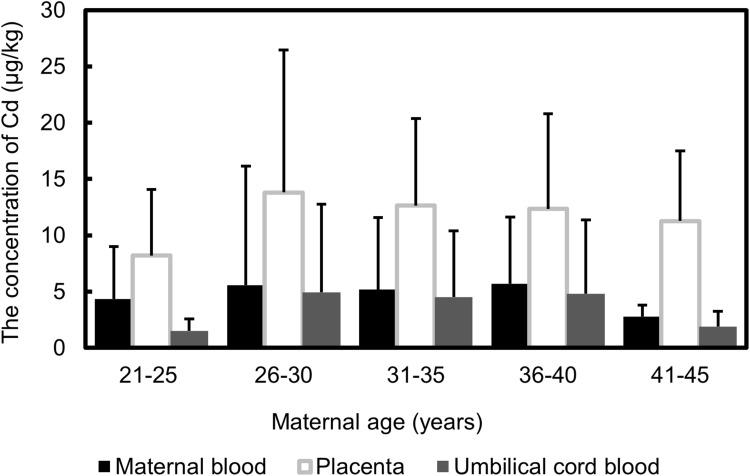
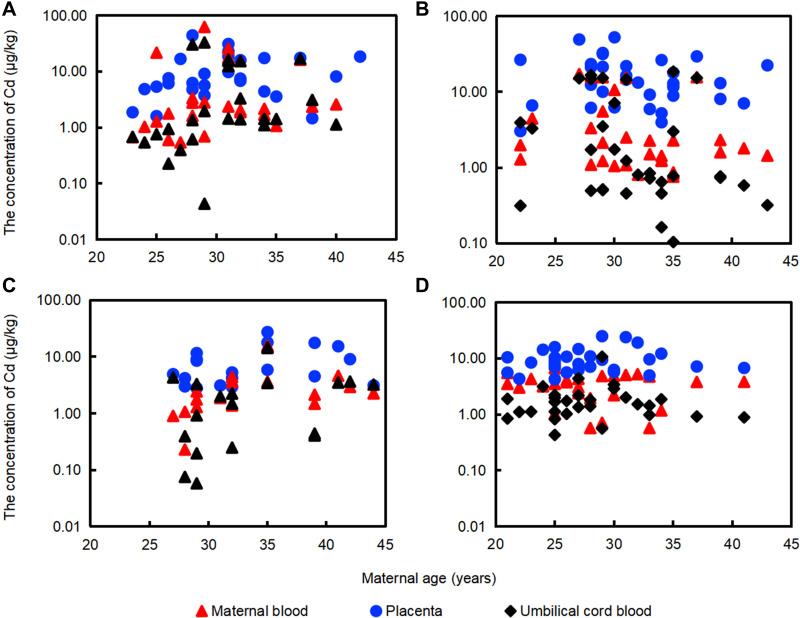
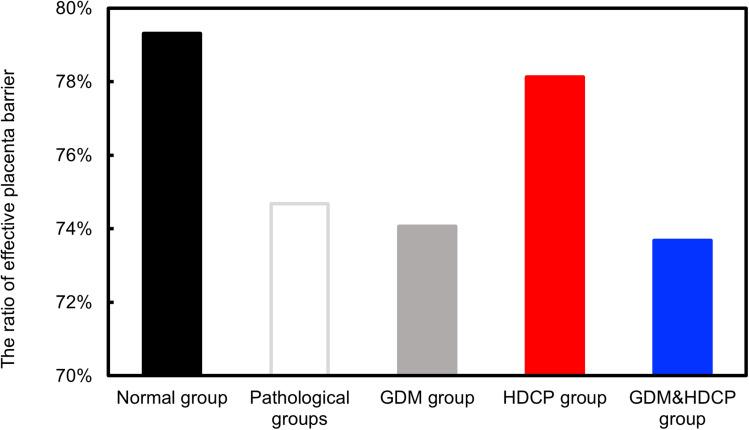
The cesarean section rate in the whole pathological group (60.7%) was higher than that in the normal group (20.7%), and the ratio of the effective barrier (ratio of maternal blood to umbilical cord blood>1) in the pathological group (74%) was lower than that in the normal group (79%). In addition, the proportion of practical placental barriers in women aged 20-25 years was 83.3%, 76.3% in women aged 26-30 years, 74.3% in women aged 31-35 years, 70% in women aged 36-40 years, and 71% in women aged 40-45 years. The Cd content in the placenta of the three pathological groups was significantly higher than that in maternal and umbilical cord blood (<0.05), and the distribution of Cd was the same as that in the normal group. However, there was no significant difference between maternal and umbilical cord blood Cd concentrations in the pathological group. The Cd concentration in the normal group's maternal blood was significantly higher than that in cord blood (<0.05). In addition, the expression levels of both metallothionein (MT) and Cd-MT complex in placenta is much higher than in maternal and umbilical blood, and which in normal group are significantly higher than those in pathological group.
CONCLUSION
Both mothers and fetuses are at increased health risk for pregnancy disorders when maternal age, BMI, or body weight increases. Increased maternal age increases the likelihood of Cd transfer from the mother to the fetus. Pregnancy complications may induce lower expression of MT, thus reducing the Cd-MT complex in the placenta, weakening the placental barrier, and increasing the risk of Cd transfer and exposure to the fetus.
目的
妊娠糖尿病(GDM)和妊娠期高血压疾病(HDCP)是妊娠期最严重且常见的两种医学病症,它们会对胎盘屏障功能产生不利影响,进而可能导致胎儿在子宫内接触母体有毒金属的风险升高。本研究旨在探究胎盘屏障对镉(Cd)从母体向胎儿转移的影响以及妊娠并发症之间的关系。
方法
在中国昆明共收集了107对样本;其中29对来自健康孕妇,78对来自患有妊娠并发症的患者。对每位母亲的胎盘以及母血和脐血中的镉进行了测量。通过酶联免疫吸附测定(ELISA)法测定血液和胎盘组织样本中金属硫蛋白(MT)和镉 - 金属硫蛋白复合物的表达。
结果
整个病理组的剖宫产率(60.7%)高于正常组(20.7%),病理组中有效屏障的比例(母血与脐血比值>1)(74%)低于正常组(79%)。此外,20 - 25岁女性中实际胎盘屏障的比例为83.3%,26 - 30岁女性中为76.3%,31 - 35岁女性中为74.3%,36 - 40岁女性中为70%,40 - 45岁女性中为71%。三个病理组胎盘中的镉含量显著高于母血和脐血中的镉含量(<0.05),且镉的分布与正常组相同。然而,病理组中母血和脐血镉浓度之间无显著差异。正常组母血中的镉浓度显著高于脐血中的镉浓度(<0.05)。此外,胎盘中金属硫蛋白(MT)和镉 - 金属硫蛋白复合物的表达水平均远高于母血和脐血中的表达水平,且正常组中的表达水平显著高于病理组。
结论
当母亲年龄、体重指数(BMI)或体重增加时,母亲和胎儿患妊娠疾病的健康风险都会增加。母亲年龄的增加会增加镉从母亲向胎儿转移的可能性。妊娠并发症可能会导致MT表达降低,从而减少胎盘中镉 - 金属硫蛋白复合物的含量,削弱胎盘屏障,增加镉转移至胎儿并使其暴露的风险。


 Zotero 插件