
T1 加权磁共振成像能否显著提高基于简易精神状态检查的轻度认知障碍与早期阿尔茨海默病的鉴别诊断能力?
Can T1-Weighted Magnetic Resonance Imaging Significantly Improve Mini-Mental State Examination-Based Distinguishing Between Mild Cognitive Impairment and Early-Stage Alzheimer's Disease?
机构信息
Department of Data Science and Engineering, The Silesian University of Technology, Gliwice, Poland.
出版信息
J Alzheimers Dis. 2023;92(3):941-957. doi: 10.3233/JAD-220806.
BACKGROUND
Detecting early-stage Alzheimer's disease (AD) is still problematic in clinical practice. This work aimed to find T1-weighted MRI-based markers for AD and mild cognitive impairment (MCI) to improve the screening process.
OBJECTIVE
Our assumption was to build a screening model that would be accessible and easy to use for physicians in their daily clinical routine.
METHODS
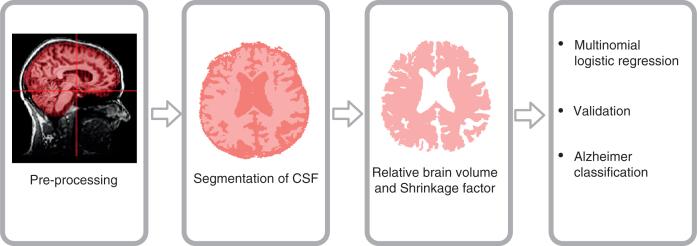
The multinomial logistic regression was used to detect status: AD, MCI, and normal control (NC) combined with the Bayesian information criterion for model selection. Several T1-weighted MRI-based radiomic features were considered explanatory variables in the prediction model.
RESULTS
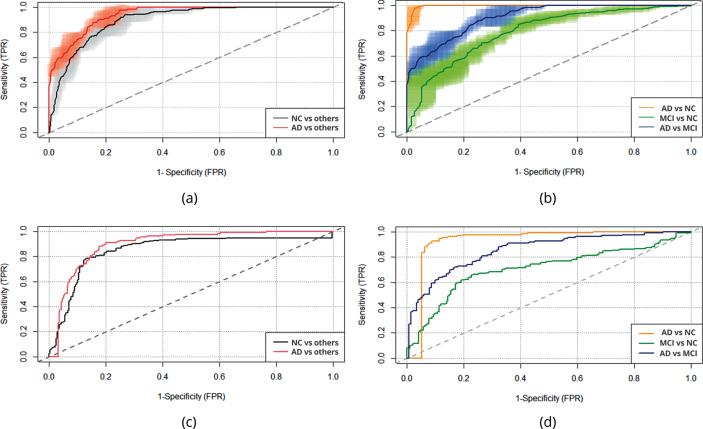
The best radiomic predictor was the relative brain volume. The proposed method confirmed its quality by achieving a balanced accuracy of 95.18%, AUC of 93.25%, NPV of 97.93%, and PPV of 90.48% for classifying AD versus NC for the European DTI Study on Dementia (EDSD). The comparison of the two models: with the MMSE score only as an independent variable and corrected for the relative brain value and age, shows that the addition of the T1-weighted MRI-based biomarker improves the quality of MCI detection (AUC: 67.04% versus 71.08%) while maintaining quality for AD (AUC: 93.35% versus 93.25%). Additionally, among MCI patients predicted as AD inconsistently with the original diagnosis, 60% from ADNI and 76.47% from EDSD were re-diagnosed as AD within a 48-month follow-up. It shows that our model can detect AD patients a few years earlier than a standard medical diagnosis.
CONCLUSION
The created method is non-invasive, inexpensive, clinically accessible, and efficiently supports AD/MCI screening.
背景
在临床实践中,早期阿尔茨海默病(AD)的检测仍然存在问题。本研究旨在寻找基于 T1 加权 MRI 的 AD 和轻度认知障碍(MCI)标志物,以改善筛查过程。
目的
我们假设构建一个易于医生在日常临床实践中使用的筛查模型。
方法
使用多项逻辑回归检测状态:AD、MCI 和正常对照(NC),并结合贝叶斯信息准则进行模型选择。在预测模型中考虑了几个基于 T1 加权 MRI 的放射组学特征作为解释变量。
结果
最佳放射组学预测因子是相对脑容量。所提出的方法通过实现 AD 与 NC 分类的平衡准确率为 95.18%、AUC 为 93.25%、NPV 为 97.93%和 PPV 为 90.48%,证明了其质量。将两种模型进行比较:一种是仅将 MMSE 评分作为独立变量,另一种是校正相对脑值和年龄后的模型,结果表明,添加基于 T1 加权 MRI 的生物标志物可提高 MCI 检测的质量(AUC:67.04%比 71.08%),同时保持 AD 的质量(AUC:93.35%比 93.25%)。此外,在与原始诊断不一致的被预测为 AD 的 MCI 患者中,ADNI 中有 60%和 EDSD 中有 76.47%在 48 个月的随访中被重新诊断为 AD。这表明我们的模型可以比标准医学诊断更早地检测到 AD 患者。
结论
所创建的方法是非侵入性的、廉价的、临床可行的,并且能够有效地支持 AD/MCI 筛查。

 Zotero 插件