
脂肪来源干细胞在血小板裂解液中培养的分泌组可提高角质形成细胞的迁移和活力。
Secretome of Adipose-Derived Stem Cells Cultured in Platelet Lysate Improves Migration and Viability of Keratinocytes.
机构信息
Laboratory of Tissue Engineering and Regenerative Medicine, Department of Plastic and Hand Surgery, University Hospital of Erlangen, Friedrich-Alexander-Universität Erlangen-Nürnberg, 91054 Erlangen, Germany.
Department of Plastic Surgery, Hand and Burn Surgery, University Hospital RWTH Aachen, 52074 Aachen, Germany.
出版信息
Int J Mol Sci. 2023 Feb 9;24(4):3522. doi: 10.3390/ijms24043522.
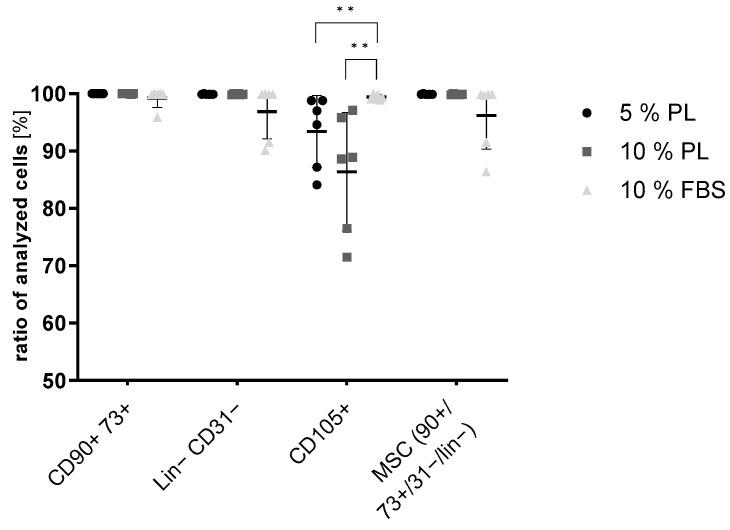
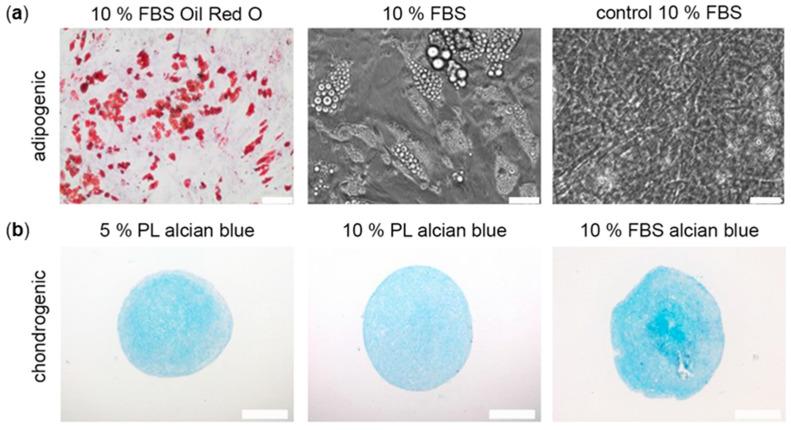
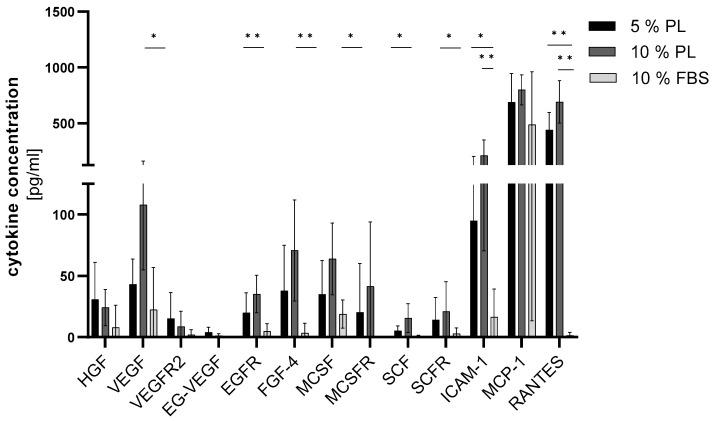
Chronic wounds depict a silent epidemic challenging medical professionals worldwide. Regenerative medicine uses adipose-derived stem cells (ADSC) in promising new therapies. In this study, platelet lysate (PL) as a xenogen-free substitute for foetal bovine serum (FBS) in ADSC culture was used to create an ADSC secretome containing cytokines for optimal wound healing conditions. The ADSC secretome was tested on keratinocytes for migrational behaviour and viability. Therefore, human ADSC were characterized under FBS (10%) and PL (5% and 10%) substitution, regarding morphology, differentiation, viability, gene and protein expression. ADSC were then cultured in 5% PL and their secretome was used for stimulation of keratinocyte migration and viability. To enhance the effect, ADSC were treated with Epithelial Growth Factor (EGF, 100 ng/mL) and hypoxia (1% O₂). In both PL and FBS groups, ADSC expressed typical stem cell markers. PL induced a significantly higher increase in cell viability compared to FBS substitution. ADSC secretome contained various beneficial proteins which enhance the wound healing capacity of keratinocytes. This could be optimized treating ADSC with hypoxia and EGF. In conclusion, the study shows that ADSC cultivated in 5% PL can effectively support wound healing conditions and can be considered as a promising new therapy for individual treatment of chronic wound disorders.
慢性伤口描绘了一个无声的全球医学挑战。再生医学使用脂肪来源的干细胞(ADSC)在有前途的新疗法中。在这项研究中,血小板裂解物(PL)作为胎牛血清(FBS)的无异种替代品在 ADSC 培养中用于产生含有细胞因子的 ADSC 分泌组,以创造最佳的伤口愈合条件。ADSC 分泌组用于测试角质形成细胞的迁移行为和活力。因此,在 FBS(10%)和 PL(5%和 10%)替代物下对人 ADSC 进行了形态、分化、活力、基因和蛋白表达的特征描述。然后将 ADSC 在 5% PL 中培养,并使用其分泌组刺激角质形成细胞的迁移和活力。为了增强效果,用表皮生长因子(EGF,100ng/mL)和缺氧(1%O₂)处理 ADSC。在 PL 和 FBS 组中,ADSC 均表达典型的干细胞标志物。与 FBS 替代物相比,PL 诱导细胞活力显著增加。ADSC 分泌组含有各种有益的蛋白质,可增强角质形成细胞的伤口愈合能力。通过用缺氧和 EGF 处理 ADSC 可以优化这种效果。总之,该研究表明,在 5% PL 中培养的 ADSC 可以有效支持伤口愈合条件,并可被视为慢性伤口疾病个体化治疗的一种有前途的新疗法。


 Zotero 插件