
生物抗 TNF-α 疗法的过去、现在及(可预见的)未来
Past, Present and (Foreseeable) Future of Biological Anti-TNF Alpha Therapy.
作者信息
Leone Gian Marco, Mangano Katia, Petralia Maria Cristina, Nicoletti Ferdinando, Fagone Paolo
机构信息
Department of Biomedical and Biotechnological Sciences, University of Catania, Via S. Sofia 97, 95123 Catania, Italy.
Department of Clinical and Experimental Medicine, University of Messina, 98122 Messina, Italy.
出版信息
J Clin Med. 2023 Feb 17;12(4):1630. doi: 10.3390/jcm12041630.
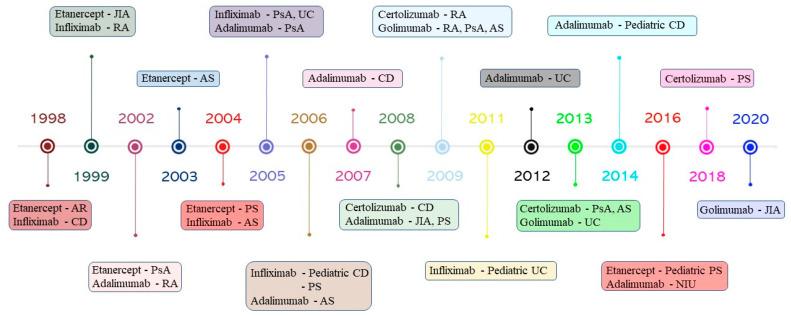
Due to the key role of tumor necrosis factor-alpha (TNF-α) in the pathogenesis of immunoinflammatory diseases, TNF-α inhibitors have been successfully developed and used in the clinical treatment of autoimmune disorders. Currently, five anti-TNF-α drugs have been approved: infliximab, adalimumab, golimumab, certolizumab pegol and etanercept. Anti-TNF-α biosimilars are also available for clinical use. Here, we will review the historical development as well as the present and potential future applications of anti-TNF-α therapies, which have led to major improvements for patients with several autoimmune diseases, such as rheumatoid arthritis (RA), ankylosing spondylitis (AS), Crohn's disease (CD), ulcerative colitis (UC), psoriasis (PS) and chronic endogenous uveitis. Other therapeutic areas are under evaluation, including viral infections, e.g., COVID-19, as well as chronic neuropsychiatric disorders and certain forms of cancer. The search for biomarkers able to predict responsiveness to anti-TNF-α drugs is also discussed.
由于肿瘤坏死因子-α(TNF-α)在免疫炎症性疾病发病机制中起关键作用,TNF-α抑制剂已成功研发并用于自身免疫性疾病的临床治疗。目前,已有五种抗TNF-α药物获批:英夫利昔单抗、阿达木单抗、戈利木单抗、赛妥珠单抗聚乙二醇化修饰物和依那西普。抗TNF-α生物类似药也可用于临床。在此,我们将回顾抗TNF-α疗法的历史发展以及当前和潜在的未来应用,这些疗法已给类风湿关节炎(RA)、强直性脊柱炎(AS)、克罗恩病(CD)、溃疡性结肠炎(UC)、银屑病(PS)和慢性内源性葡萄膜炎等多种自身免疫性疾病患者带来了重大改善。其他治疗领域正在评估中,包括病毒感染,如2019冠状病毒病(COVID-19),以及慢性神经精神疾病和某些癌症。本文还讨论了寻找能够预测对抗TNF-α药物反应性的生物标志物。

 Zotero 插件