
糖尿病肾病中高血糖诱导肾细胞损伤的机制:最新进展
The Mechanism of Hyperglycemia-Induced Renal Cell Injury in Diabetic Nephropathy Disease: An Update.
作者信息
Wu Tong, Ding Lei, Andoh Vivian, Zhang Jiaxin, Chen Liang
机构信息
School of Life Sciences, Jiangsu University, Zhenjiang 212013, China.
School of Food Science and Biological Engineering, Jiangsu University, Zhenjiang 212013, China.
出版信息
Life (Basel). 2023 Feb 15;13(2):539. doi: 10.3390/life13020539.
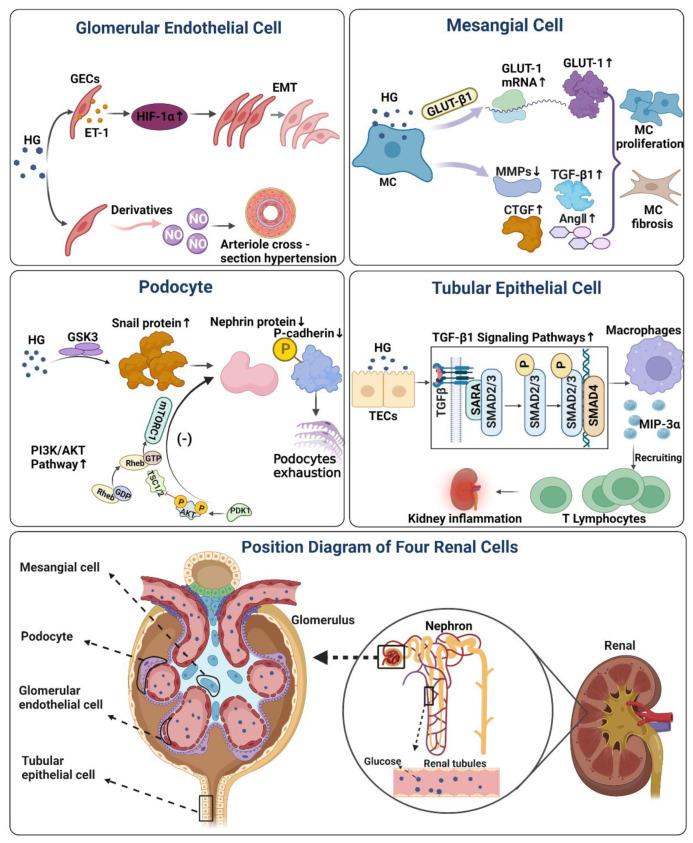
Diabetic Nephropathy (DN) is a serious complication of type I and II diabetes. It develops from the initial microproteinuria to end-stage renal failure. The main initiator for DN is chronic hyperglycemia. Hyperglycemia (HG) can stimulate the resident and non-resident renal cells to produce humoral mediators and cytokines that can lead to functional and phenotypic changes in renal cells and tissues, interference with cell growth, interacting proteins, advanced glycation end products (AGEs), etc., ultimately resulting in glomerular and tubular damage and the onset of kidney disease. Therefore, poor blood glucose control is a particularly important risk factor for the development of DN. In this paper, the types and mechanisms of DN cell damage are classified and summarized by reviewing the related literature concerning the effect of hyperglycemia on the development of DN. At the cellular level, we summarize the mechanisms and effects of renal damage by hyperglycemia. This is expected to provide therapeutic ideas and inspiration for further studies on the treatment of patients with DN.
糖尿病肾病(DN)是I型和II型糖尿病的一种严重并发症。它从最初的微量蛋白尿发展至终末期肾衰竭。DN的主要引发因素是慢性高血糖。高血糖(HG)可刺激肾脏固有细胞和非固有细胞产生体液介质和细胞因子,这些物质可导致肾细胞和组织发生功能及表型变化、干扰细胞生长、相互作用蛋白、晚期糖基化终产物(AGEs)等,最终导致肾小球和肾小管损伤以及肾病的发生。因此,血糖控制不佳是DN发生发展的一个特别重要的危险因素。本文通过回顾高血糖对DN发生发展影响的相关文献,对DN细胞损伤的类型和机制进行分类总结。在细胞水平上,我们总结了高血糖导致肾脏损伤的机制和影响。这有望为进一步研究DN患者的治疗提供治疗思路和启示。

 Zotero 插件