
天然黄酮类衍生物具有抗全冠状病毒活性。
Natural Flavonoid Derivatives Have Pan-Coronavirus Antiviral Activity.
作者信息
Mori Mattia, Quaglio Deborah, Calcaterra Andrea, Ghirga Francesca, Sorrentino Leonardo, Cammarone Silvia, Fracella Matteo, D'Auria Alessandra, Frasca Federica, Criscuolo Elena, Clementi Nicola, Mancini Nicasio, Botta Bruno, Antonelli Guido, Pierangeli Alessandra, Scagnolari Carolina
机构信息
Department of Biotechnology, Chemistry and Pharmacy, University of Siena, 53100 Siena, Italy.
Department of Chemistry and Technologies of Drugs, Sapienza University of Rome, 00185 Rome, Italy.
出版信息
Microorganisms. 2023 Jan 25;11(2):314. doi: 10.3390/microorganisms11020314.
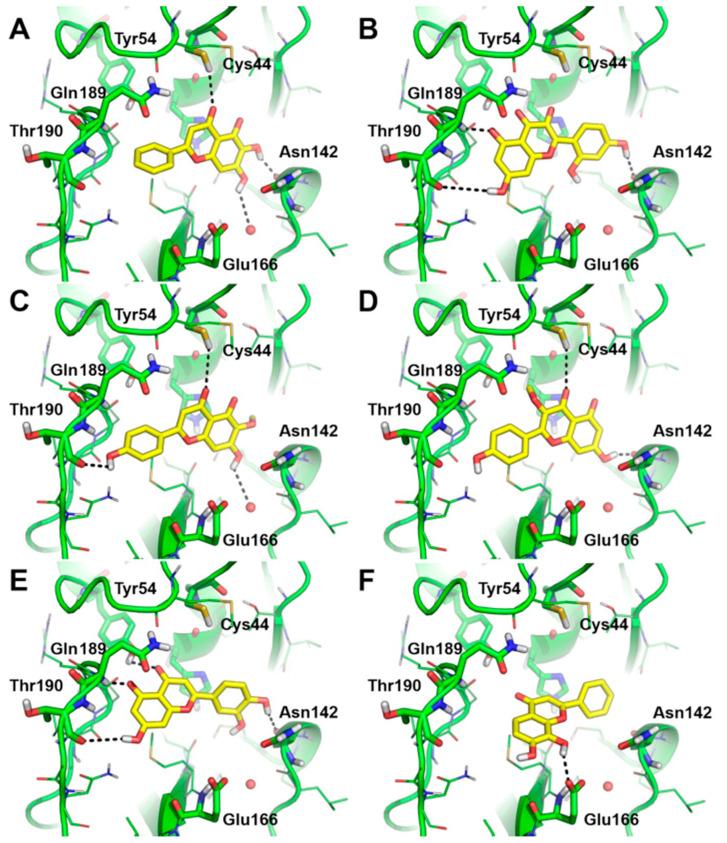
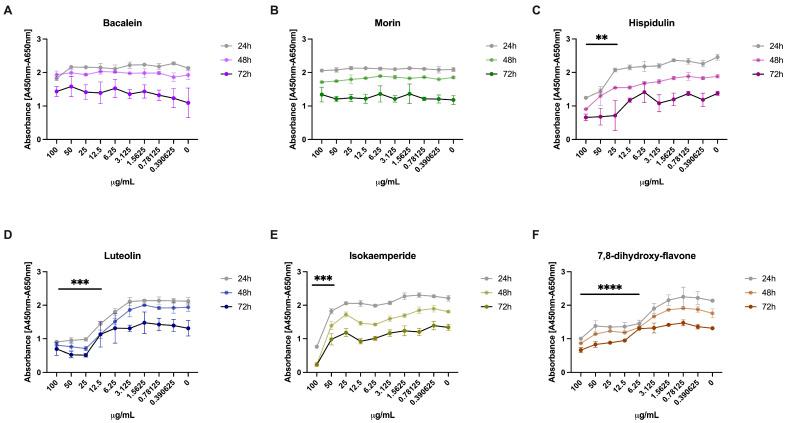
The SARS-CoV-2 protease (3CLpro) is one of the key targets for the development of efficacious drugs for COVID-19 treatment due to its essential role in the life cycle of the virus and exhibits high conservation among coronaviruses. Recent studies have shown that flavonoids, which are small natural molecules, have antiviral activity against coronaviruses (CoVs), including SARS-CoV-2. In this study, we identified the docking sites and binding affinity of several natural compounds, similar to flavonoids, and investigated their inhibitory activity towards 3CLpro enzymatic activity. The selected compounds were then tested in vitro for their cytotoxicity, for antiviral activity against SARS-CoV-2, and the replication of other coronaviruses in different cell lines. Our results showed that Baicalein (100 μg/mL) exerted strong 3CLpro activity inhibition (>90%), whereas Hispidulin and Morin displayed partial inhibition. Moreover, Baicalein, up to 25 μg/mL, hindered >50% of SARS-CoV-2 replication in Vero E6 cultures. Lastly, Baicalein displayed antiviral activity against alphacoronavirus (Feline-CoV) and betacoronavirus (Bovine-CoV and HCoV-OC43) in the cell lines. Our study confirmed the antiviral activity of Baicalein against SARS-CoV-2 and demonstrated clear evidence of its pan-coronaviral activity.
严重急性呼吸综合征冠状病毒2型蛋白酶(3CLpro)因其在病毒生命周期中的关键作用,成为开发治疗新冠肺炎有效药物的关键靶点之一,且在冠状病毒中具有高度保守性。最近的研究表明,黄酮类化合物作为一类天然小分子,对包括严重急性呼吸综合征冠状病毒2型(SARS-CoV-2)在内的冠状病毒具有抗病毒活性。在本研究中,我们确定了几种类似于黄酮类化合物的天然化合物的对接位点和结合亲和力,并研究了它们对3CLpro酶活性的抑制活性。随后,对所选化合物进行了体外细胞毒性测试、针对SARS-CoV-2的抗病毒活性测试以及它们在不同细胞系中对其他冠状病毒复制的影响。我们的结果表明,黄芩苷(100μg/mL)对3CLpro活性具有强烈抑制作用(>90%),而滨蓟黄素和桑色素表现出部分抑制作用。此外,在Vero E6细胞培养物中,高达25μg/mL的黄芩苷可抑制>50%的SARS-CoV-2复制。最后,黄芩苷在细胞系中对甲型冠状病毒(猫冠状病毒)和乙型冠状病毒(牛冠状病毒和人冠状病毒OC43)均表现出抗病毒活性。我们的研究证实了黄芩苷对SARS-CoV-2的抗病毒活性,并明确证明了其泛冠状病毒活性。

 Zotero 插件