
宿主对……表面S层蛋白(SLPs)的免疫反应
Host Immune Responses to Surface S-Layer Proteins (SLPs) of .
作者信息
Chandra Harish, Kovall Rhett A, Yadav Jagjit S, Sun Xingmin
机构信息
Department of Environmental Microbiology, School of Earth and Environmental Sciences, Babasaheb Bhimrao Ambedkar University, Lucknow 226025, UP, India.
Department of Molecular and Cellular Biosciences, University of Cincinnati College of Medicine, Cincinnati, OH 45267, USA.
出版信息
Microorganisms. 2023 Feb 2;11(2):380. doi: 10.3390/microorganisms11020380.
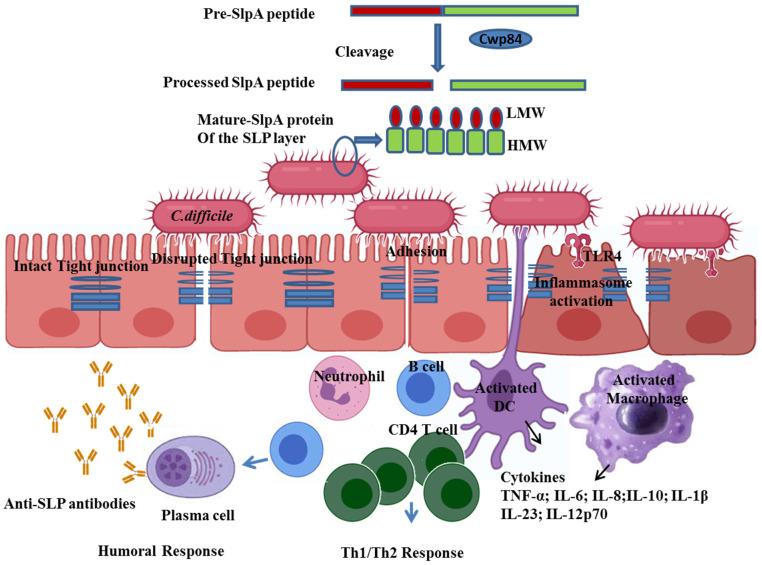
, a nosocomial pathogen, is an emerging gut pathobiont causing antibiotic-associated diarrhea. infection involves gut colonization and disruption of the gut epithelial barrier, leading to the induction of inflammatory/immune responses. The expression of two major exotoxins, TcdA and TcdB is the major cause of pathogenicity. Attachment of bacterial abundant cell wall proteins or surface S-layer proteins (SLPs) such as SlpA with host epithelial cells is critical for virulence. In addition to being toxins, these surface components have been shown to be highly immunogenic. Recent studies indicate that SLPs play important roles in the adhesion of the bacteria to the intestinal epithelial cells, disruption of tight junctions, and modulation of the immune response of the host cells. These proteins might serve as new targets for vaccines and new therapeutic agents. This review summarizes our current understanding of the immunological role of SLPs in inducing host immunity and their use in the development of vaccines and novel therapeutics to combat infection.
艰难梭菌是一种医院病原体,是一种新兴的肠道致病共生菌,可导致抗生素相关性腹泻。艰难梭菌感染涉及肠道定植和肠道上皮屏障的破坏,从而引发炎症/免疫反应。两种主要外毒素TcdA和TcdB的表达是艰难梭菌致病性的主要原因。细菌丰富的细胞壁蛋白或表面S层蛋白(SLP)如SlpA与宿主上皮细胞的附着对毒力至关重要。除了作为毒素外,这些表面成分已被证明具有高度免疫原性。最近的研究表明,艰难梭菌SLP在细菌与肠上皮细胞的黏附、紧密连接的破坏以及宿主细胞免疫反应的调节中起重要作用。这些蛋白质可能成为疫苗和新治疗剂的新靶点。本综述总结了我们目前对SLP在诱导宿主免疫中的免疫作用及其在开发对抗艰难梭菌感染的疫苗和新型治疗方法中的应用的理解。
 Zotero 插件