
铂催化剂上聚烯烃的构象控制塑料回收中的产物分布。
Conformations of polyolefins on platinum catalysts control product distribution in plastics recycling.
作者信息
Zare Mehdi, Kots Pavel A, Caratzoulas Stavros, Vlachos Dionisios G
机构信息
Center for Plastics Innovation, University of Delaware 221 Academy Street Newark Delaware 19716 USA
Department of Chemical and Biomolecular Engineering, University of Delaware 150 Academy Street Newark Delaware 19716 USA.
出版信息
Chem Sci. 2023 Jan 3;14(8):1966-1977. doi: 10.1039/d2sc04772a. eCollection 2023 Feb 22.
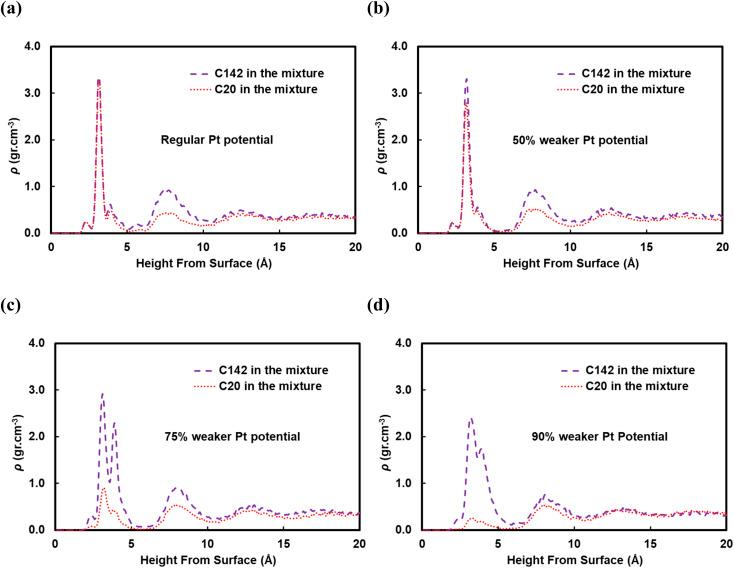
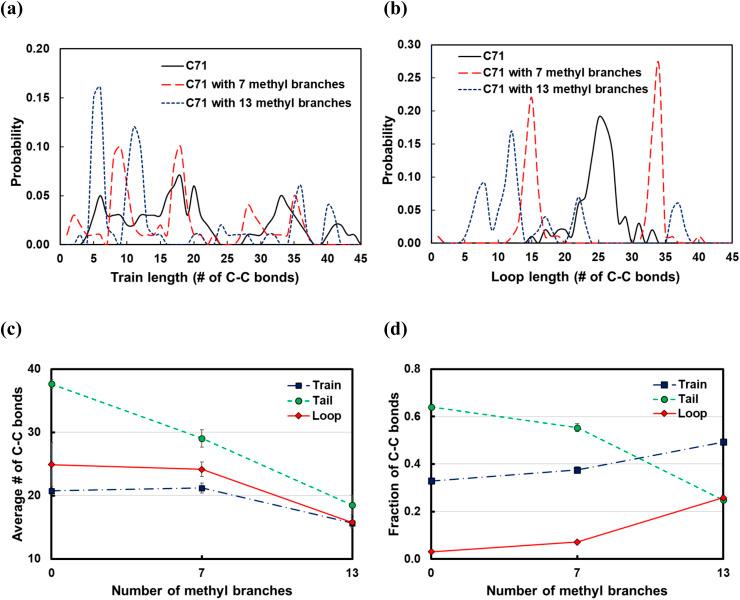
The design of catalysts for the chemical recycling of plastic waste will benefit greatly from an intimate knowledge of the interfacial polymer-catalyst interactions that determine reactant and product distributions. Here, we investigate backbone chain length, side chain length, and concentration effects on the density and conformation of polyethylene surrogates at the interface with Pt(111) and relate them to experimental product distributions resulting from carbon-carbon bond cleavage. Using replica-exchange molecular dynamics simulations, we characterize the polymer conformations at the interface by the distributions of trains, loops, and tails and their first moments. We find that the preponderance of short chains, in the range of 20 carbon atoms, lies entirely on the Pt surface, whereas longer chains exhibit much broader distributions of conformational features. Remarkably, the average length of trains is independent of the chain length but can be tuned the polymer-surface interaction. Branching profoundly impacts the conformations of long chains at the interface as the distributions of trains become less dispersed and more structured, localized around short trains, with the immediate implication of a wider carbon product distribution upon C-C bond cleavage. The degree of localization increases with the number and size of the side chains. Long chains can adsorb from the melt onto the Pt surface even in melt mixtures containing shorter polymer chains at high concentrations. We confirm experimentally key computational findings and demonstrate that blends may provide a strategy to reduce the selectivity for undesired light gases.
塑料废弃物化学循环催化剂的设计将极大地受益于对决定反应物和产物分布的聚合物 - 催化剂界面相互作用的深入了解。在此,我们研究了主链长度、侧链长度以及浓度对聚乙烯替代物在与Pt(111)界面处的密度和构象的影响,并将它们与碳 - 碳键断裂产生的实验产物分布相关联。使用副本交换分子动力学模拟,我们通过链段、链环和链尾的分布及其一阶矩来表征界面处的聚合物构象。我们发现,20个碳原子范围内的短链大多完全位于Pt表面,而较长的链则表现出更广泛的构象特征分布。值得注意的是,链段的平均长度与链长无关,但可以通过聚合物 - 表面相互作用进行调节。支化对界面处长链的构象有深远影响,因为链段的分布变得不那么分散且更具结构性,集中在短链段周围,这直接意味着碳 - 碳键断裂后碳产物分布更宽。定位程度随着侧链的数量和大小而增加。即使在含有高浓度较短聚合物链的熔体混合物中,长链也可以从熔体吸附到Pt表面。我们通过实验证实了关键的计算结果,并证明共混物可能提供一种策略来降低对不需要的轻质气体的选择性。



 Zotero 插件