
超加工食品消费与 2 型糖尿病风险:三项大型前瞻性美国队列研究。
Ultra-Processed Food Consumption and Risk of Type 2 Diabetes: Three Large Prospective U.S. Cohort Studies.
机构信息
1Department of Nutrition, Harvard T.H. Chan School of Public Health, Boston, MA.
2Department of Epidemiology, Erasmus MC, University Medical Center Rotterdam, Rotterdam, the Netherlands.
出版信息
Diabetes Care. 2023 Jul 1;46(7):1335-1344. doi: 10.2337/dc22-1993.
OBJECTIVE
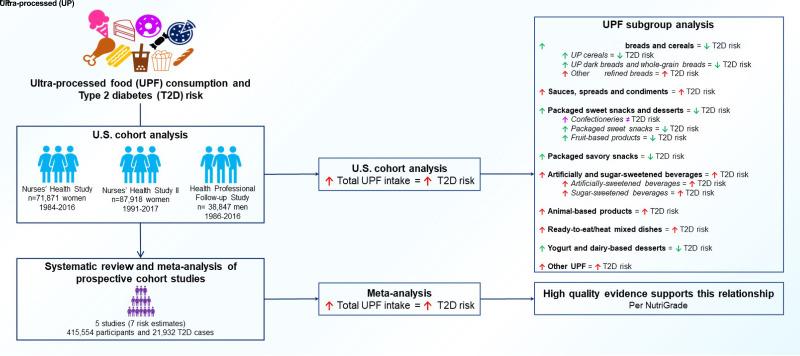
We examined the relationship between ultra-processed food (UPF) intake and type 2 diabetes (T2D) risk among 3 large U.S. cohorts, conducted a meta-analysis of prospective cohort studies, and assessed meta-evidence quality.
RESEARCH DESIGN AND METHODS
We included 71,871 women from the Nurses' Health Study, 87,918 women from the Nurses' Health Study II, and 38,847 men from the Health Professional Follow-Up Study. Diet was assessed using food frequency questionnaires and UPF was categorized per the NOVA classification. Associations of total and subgroups of UPF with T2D were assessed using Cox proportional hazards models. We subsequently conducted a meta-analysis of prospective cohort studies on total UPF and T2D risk, and assessed meta-evidence quality using the NutriGrade scoring system.
RESULTS
Among the U.S. cohorts (5,187,678 person-years; n = 19,503 T2D cases), the hazard ratio for T2D comparing extreme quintiles of total UPF intake (percentage of grams per day) was 1.46 (95% CI 1.39-1.54). Among subgroups, refined breads; sauces, spreads, and condiments; artificially and sugar-sweetened beverages; animal-based products; and ready-to-eat mixed dishes were associated with higher T2D risk. Cereals; dark and whole-grain breads; packaged sweet and savory snacks; fruit-based products; and yogurt and dairy-based desserts were associated with lower T2D risk. In the meta-analysis (n = 415,554 participants; n = 21,932 T2D cases), each 10% increment in total UPF was associated with a 12% (95% CI 10%-13%) higher risk. Per NutriGrade, high-quality evidence supports this relationship.
CONCLUSIONS
High-quality meta-evidence shows that total UPF consumption is associated with higher T2D risk. However, some UPF subgroups were associated with lower risk in the U.S. cohorts.
目的
我们在美国的 3 个大型队列中研究了超加工食品(UPF)的摄入量与 2 型糖尿病(T2D)风险之间的关系,对前瞻性队列研究进行了荟萃分析,并评估了荟萃分析证据的质量。
研究设计和方法
我们纳入了护士健康研究中的 71871 名女性、护士健康研究 II 中的 87918 名女性和健康专业人员随访研究中的 38847 名男性。通过食物频率问卷评估饮食情况,并根据 NOVA 分类对 UPF 进行分类。使用 Cox 比例风险模型评估总 UPF 和 UPF 亚组与 T2D 的关联。随后,我们对总 UPF 和 T2D 风险的前瞻性队列研究进行了荟萃分析,并使用 NutriGrade 评分系统评估了荟萃分析证据的质量。
结果
在美国队列中(5187678 人年;n=19503 例 T2D),总 UPF 摄入量(每天克数)极端五分位数比较的 T2D 风险比为 1.46(95%CI 1.39-1.54)。在亚组中,精制面包、酱汁、涂抹酱和调味料、人工和加糖饮料、动物制品和即食混合菜肴与更高的 T2D 风险相关。谷物、深色和全麦面包、包装的甜咸小吃、水果制品以及酸奶和奶制品甜点与更低的 T2D 风险相关。在荟萃分析中(n=41554 名参与者;n=21932 例 T2D),总 UPF 每增加 10%,风险增加 12%(95%CI 10%-13%)。根据 NutriGrade,高质量的证据支持这种关系。
结论
高质量的荟萃分析证据表明,总 UPF 的摄入量与更高的 T2D 风险相关。然而,在美国队列中,一些 UPF 亚组与更低的风险相关。
 Zotero 插件