
小鼠终纹床核外侧与内侧前背侧的全脑输入图谱
Whole-brain input mapping of the lateral versus medial anterodorsal bed nucleus of the stria terminalis in the mouse.
作者信息
Sun Yanjun, Zweifel Larry S, Holmes Todd C, Xu Xiangmin
机构信息
Department of Anatomy and Neurobiology, School of Medicine, University of California, Irvine, CA, 92697-1275, USA.
Department of Psychiatry and Behavioral Sciences and Department of Pharmacology, University of Washington, Seattle, WA, 98195, USA.
出版信息
Neurobiol Stress. 2023 Feb 15;23:100527. doi: 10.1016/j.ynstr.2023.100527. eCollection 2023 Mar.
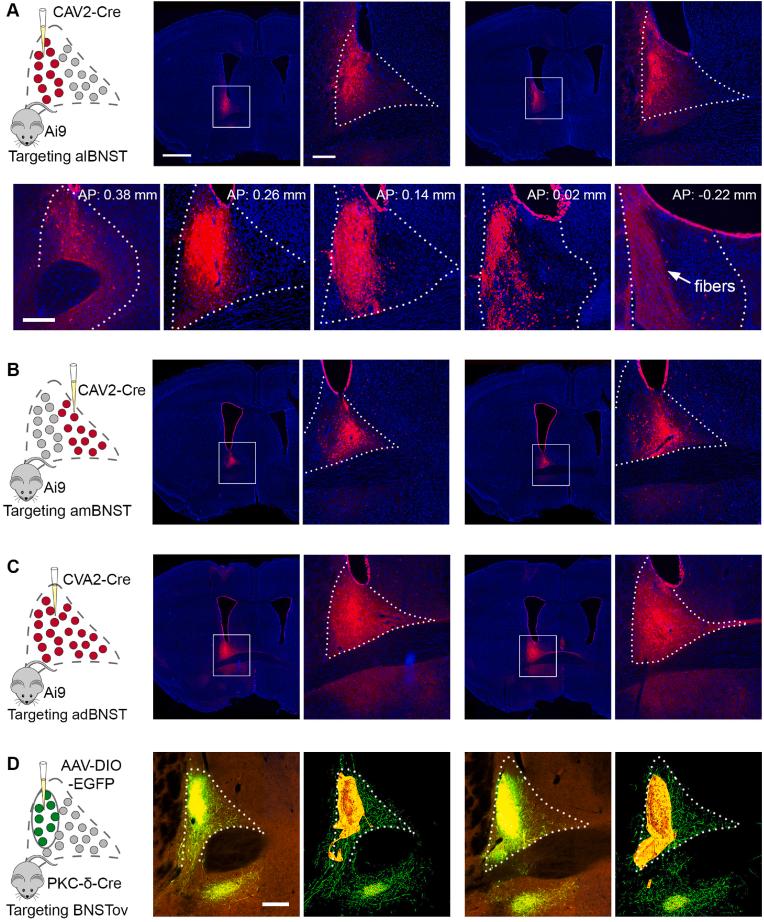
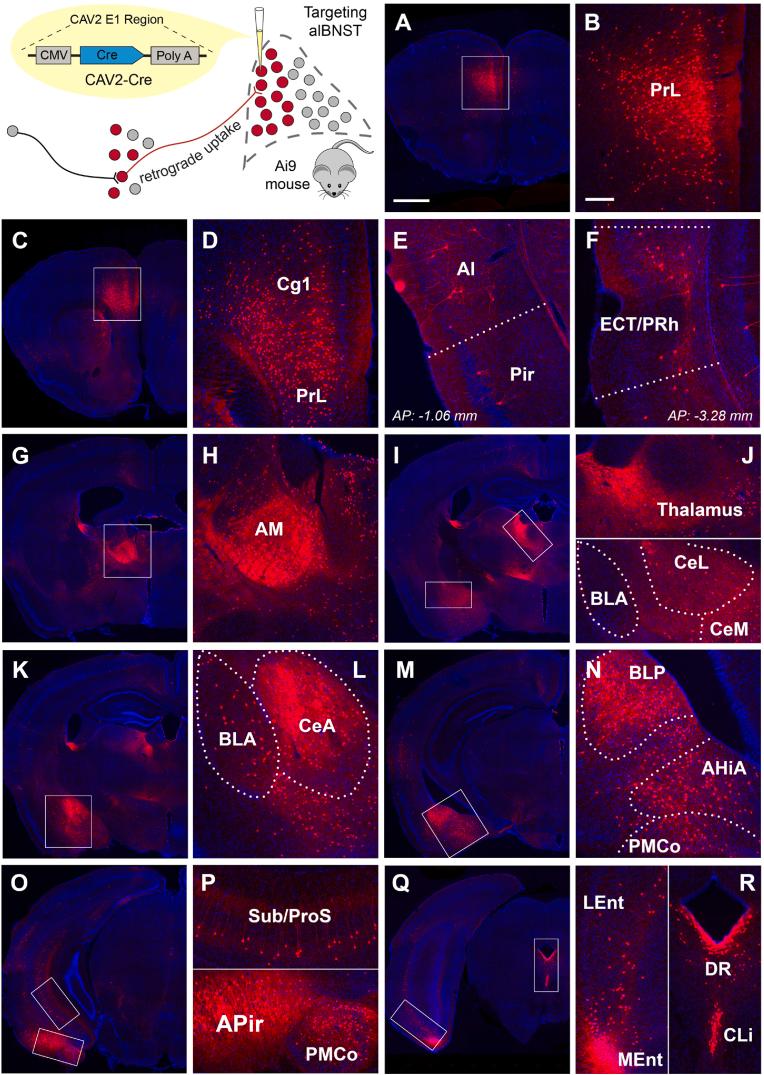
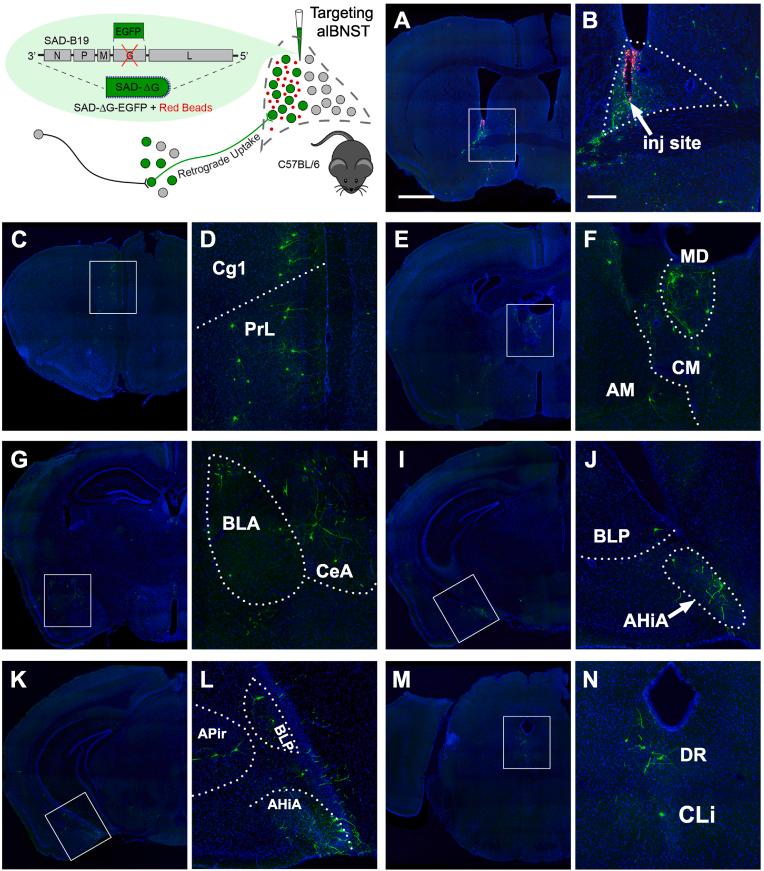
The anterior portion of the bed nucleus of the stria terminalis (BNST) modulates fear and stress responses. The anterodorsal BNST (adBNST) can be anatomically subdivided further into the lateral and medial divisions. Although output projections of BNST subregions have been studied, the local and global input connections to these subregions remain poorly understood. To further understand BNST-centered circuit operations, we have applied new viral-genetic tracing and functional circuit mapping to determine detailed synaptic circuit inputs to lateral and medial subregions of adBNST in the mouse. Monosynaptic canine adenovirus type 2 (CAV2) and rabies virus-based retrograde tracers were injected in the adBNST subregions. The amygdalar complex, hypothalamus and hippocampal formation account for the majority of overall inputs to adBNST. However, lateral versus medial adBNST subregions have distinct patterns of long-range cortical and limbic brain inputs. The lateral adBNST has more input connections from prefrontal (prelimbic, infralimbic, cingulate) and insular cortices, anterior thalamus and ectorhinal/perirhinal cortices. In contrast, the medial adBNST received biased inputs from the medial amygdala, lateral septum, hypothalamus nuclei and ventral subiculum. We confirmed long-range functional inputs from the amydalohippocampal area and basolateral amygdala to the adBNST using ChR2-assisted circuit mapping. Selected novel BNST inputs are also validated with the AAV axonal tracing data from the Allen Institute Mouse Brain Connectivity Atlas. Together, these results provide a comprehensive map of the differential afferent inputs to lateral and medial adBNST subregions, and offer new insight into the functional operations of BNST circuitry for stress and anxiety-related behaviors.
终纹床核(BNST)的前部调节恐惧和应激反应。前背侧BNST(adBNST)在解剖学上可进一步细分为外侧和内侧部分。尽管已经对BNST亚区的输出投射进行了研究,但对这些亚区的局部和整体输入连接仍知之甚少。为了进一步了解以BNST为中心的神经回路运作,我们应用了新的病毒基因追踪和功能回路映射技术,以确定小鼠adBNST外侧和内侧亚区的详细突触回路输入。将单突触2型犬腺病毒(CAV2)和基于狂犬病病毒的逆行示踪剂注射到adBNST亚区。杏仁复合体、下丘脑和海马结构占adBNST总体输入的大部分。然而,adBNST外侧与内侧亚区具有不同的长程皮质和边缘脑输入模式。外侧adBNST有更多来自前额叶(前边缘、边缘下、扣带回)和岛叶皮质、丘脑前部以及嗅外/嗅周皮质的输入连接。相比之下,内侧adBNST接收来自内侧杏仁核、外侧隔、下丘脑核和腹侧海马下托的偏向性输入。我们使用ChR2辅助回路映射技术证实了从杏仁海马区和基底外侧杏仁核到adBNST的长程功能输入。选定的新型BNST输入也通过来自艾伦脑科学研究所小鼠脑连接图谱的AAV轴突追踪数据得到了验证。总之,这些结果提供了adBNST外侧和内侧亚区差异传入输入的综合图谱,并为BNST神经回路在应激和焦虑相关行为中的功能运作提供了新的见解。





 Zotero 插件