
ACSL1、CH25H、GPCPD1 和 PLA2G12A 作为急性心肌梗死潜在的脂质相关诊断生物标志物。
ACSL1, CH25H, GPCPD1, and PLA2G12A as the potential lipid-related diagnostic biomarkers of acute myocardial infarction.
机构信息
Department of Cardiology, Hunan Provincial People's Hospital, Changsha 410000, China.
Department of Epidemiology, Hunan Provincial People's Hospital (The First Affiliated Hospital of Hunan Normal University), Changsha 410000, China.
出版信息
Aging (Albany NY). 2023 Feb 24;15(5):1394-1411. doi: 10.18632/aging.204542.
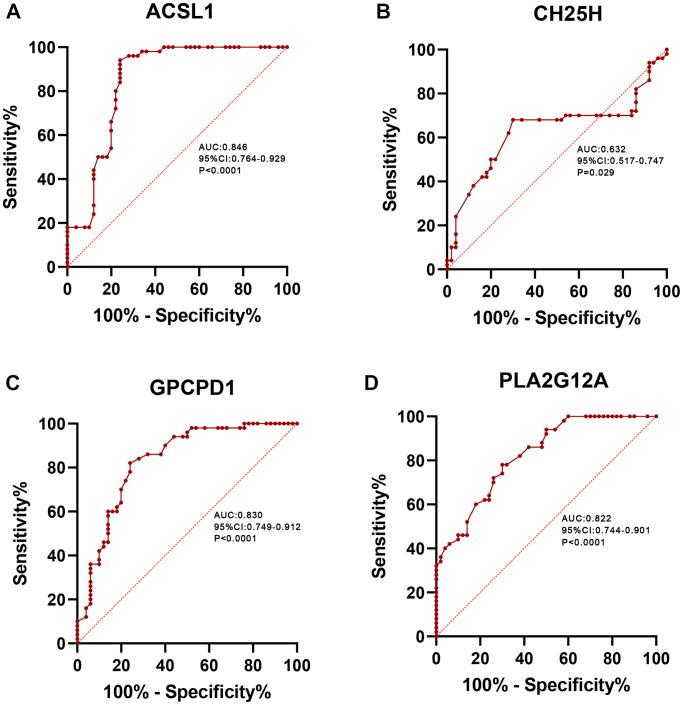
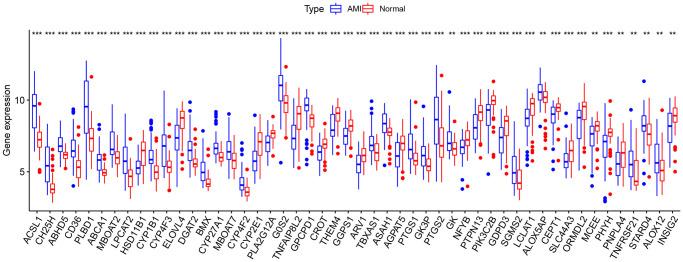
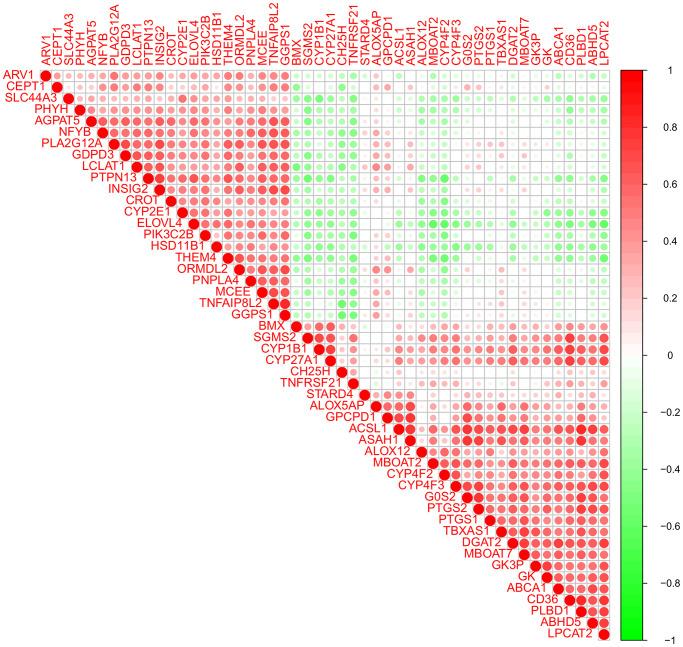
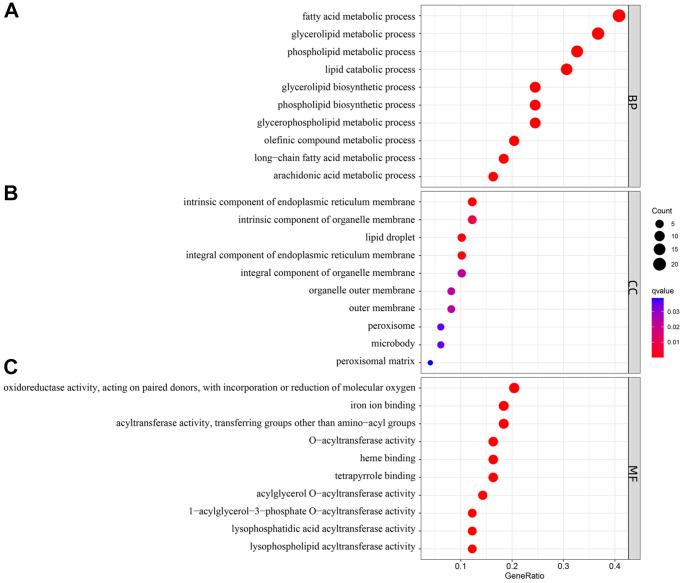
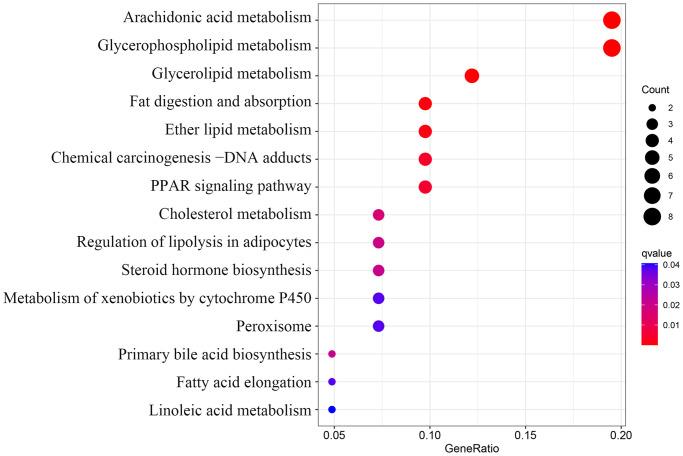
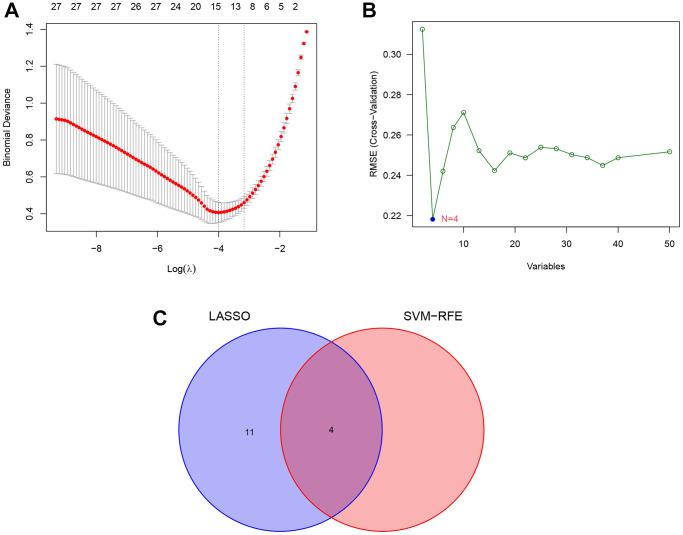
Lipid metabolism plays an essential role in the genesis and progress of acute myocardial infarction (AMI). Herein, we identified and verified latent lipid-related genes involved in AMI by bioinformatic analysis. Lipid-related differentially expressed genes (DEGs) involved in AMI were identified using the GSE66360 dataset from the Gene Expression Omnibus (GEO) database and R software packages. Gene ontology (GO) and Kyoto Encyclopedia of Genes and Genomes (KEGG) pathway enrichment analyses were conducted to analyze lipid-related DEGs. Lipid-related genes were identified by two machine learning techniques: least absolute shrinkage and selection operator (LASSO) regression and support vector machine recursive feature elimination (SVM-RFE). The receiver operating characteristic (ROC) curves were used to descript diagnostic accuracy. Furthermore, blood samples were collected from AMI patients and healthy individuals, and real-time quantitative polymerase chain reaction (RT-qPCR) was used to determine the RNA levels of four lipid-related DEGs. Fifty lipid-related DEGs were identified, 28 upregulated and 22 downregulated. Several enrichment terms related to lipid metabolism were found by GO and KEGG enrichment analyses. After LASSO and SVM-RFE screening, four genes (, and ) were identified as potential diagnostic biomarkers for AMI. Moreover, the RT-qPCR analysis indicated that the expression levels of four DEGs in AMI patients and healthy individuals were consistent with bioinformatics analysis results. The validation of clinical samples suggested that 4 lipid-related DEGs are expected to be diagnostic markers for AMI and provide new targets for lipid therapy of AMI.
脂质代谢在急性心肌梗死(AMI)的发生和进展中起着至关重要的作用。在此,我们通过生物信息学分析鉴定和验证了与 AMI 相关的潜在脂质相关基因。使用 GEO 数据库中的 GSE66360 数据集和 R 软件包鉴定与 AMI 相关的脂质差异表达基因(DEGs)。通过基因本体论(GO)和京都基因与基因组百科全书(KEGG)通路富集分析对脂质相关 DEGs 进行分析。通过两种机器学习技术:最小绝对值收缩和选择算子(LASSO)回归和支持向量机递归特征消除(SVM-RFE)来鉴定脂质相关基因。使用接收者操作特征(ROC)曲线描述诊断准确性。此外,从 AMI 患者和健康个体采集血液样本,并使用实时定量聚合酶链反应(RT-qPCR)测定四个脂质相关 DEG 的 RNA 水平。鉴定出 50 个与脂质相关的 DEG,其中 28 个上调,22 个下调。通过 GO 和 KEGG 富集分析发现了几个与脂质代谢相关的富集术语。经过 LASSO 和 SVM-RFE 筛选,鉴定出四个可能作为 AMI 潜在诊断生物标志物的基因(、和)。此外,RT-qPCR 分析表明,AMI 患者和健康个体中四个 DEG 的表达水平与生物信息学分析结果一致。临床样本的验证表明,4 个脂质相关 DEG 有望成为 AMI 的诊断标志物,并为 AMI 的脂质治疗提供新的靶点。



 Zotero 插件