
功能性食品和膳食补充剂在非酒精性脂肪性肝病管理中的应用:一项系统评价和荟萃分析。
Functional foods and dietary supplements in the management of non-alcoholic fatty liver disease: A systematic review and meta-analysis.
作者信息
Wang Lei-Lei, Zhang Pian-Hong, Yan Hui-Hui
机构信息
Department of Clinical Nutrition, The Second Affiliated Hospital, College of Medicine, Zhejiang University, Hangzhou, Zhejiang, China.
Department of Gastroenterology, The Second Affiliated Hospital, College of Medicine, Zhejiang University, Hangzhou, Zhejiang, China.
出版信息
Front Nutr. 2023 Feb 14;10:1014010. doi: 10.3389/fnut.2023.1014010. eCollection 2023.
OBJECTIVE
In this systematic review and meta-analysis, we aimed to clarify the overall effects of functional foods and dietary supplements in non-alcoholic fatty liver disease (NAFLD) patients.
METHODS
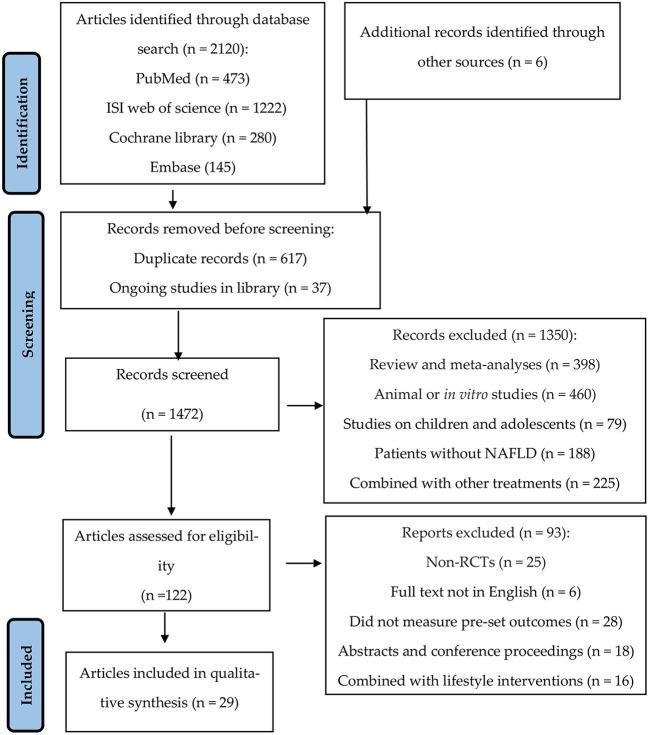
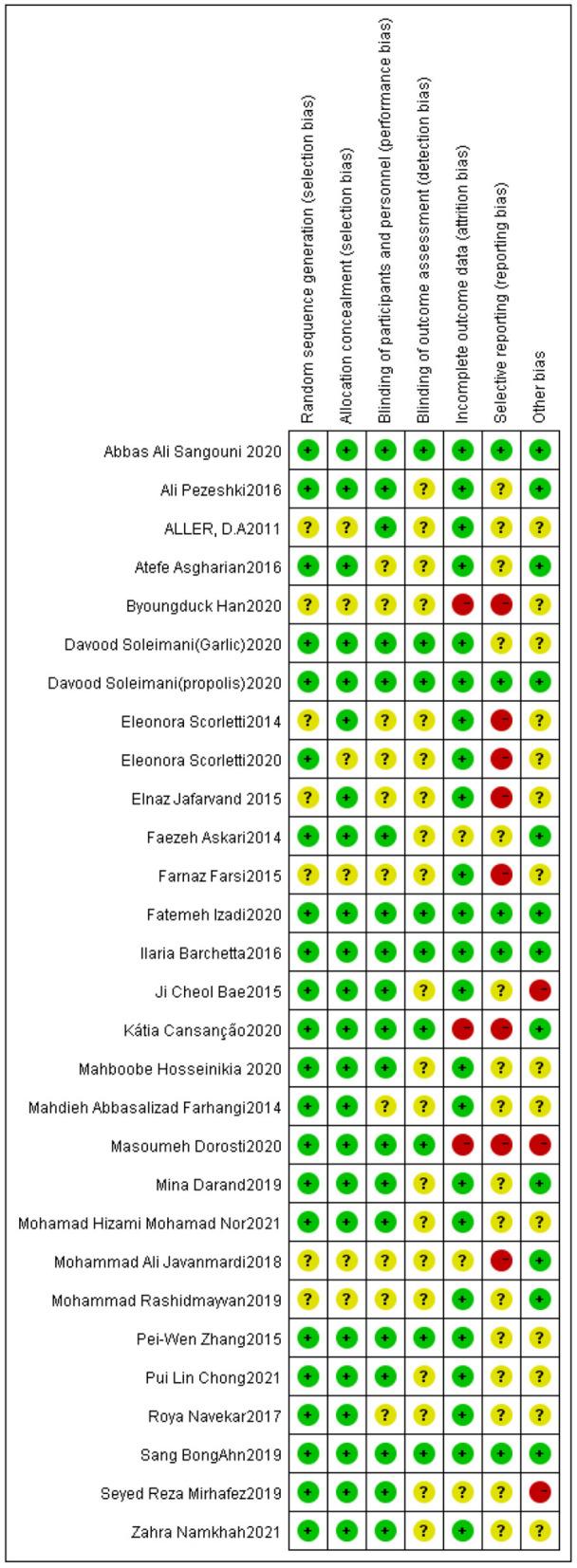
Randomized controlled trials (RCTs) published in PubMed, ISI Web of Science, Cochrane library, and Embase from January 1, 2000 to January 31, 2022 were systematically searched to assess the effects of functional foods and dietary supplements in patients with NAFLD. The primary outcomes were liver-related measures, such as alanine aminotransferase (ALT), aspartate aminotransferase (AST), and hepatic fibrosis and steatosis, while the secondary outcomes included body mass index (BMI), waist circumference (WC), triacylglyceride (TG), total cholesterol (TC), low-density lipoprotein cholesterol (LDL-C), and high-density lipoprotein cholesterol (HDL-C). These indexes were all continuous variables, so the mean difference (MD) was used for calculating the effect size. Random-effects or fixed-effects models were used to estimate the mean difference (MD). The risk of bias in all studies was assessed with guidance provided in the Cochrane Handbook for Systematic Reviews of Interventions.
RESULTS
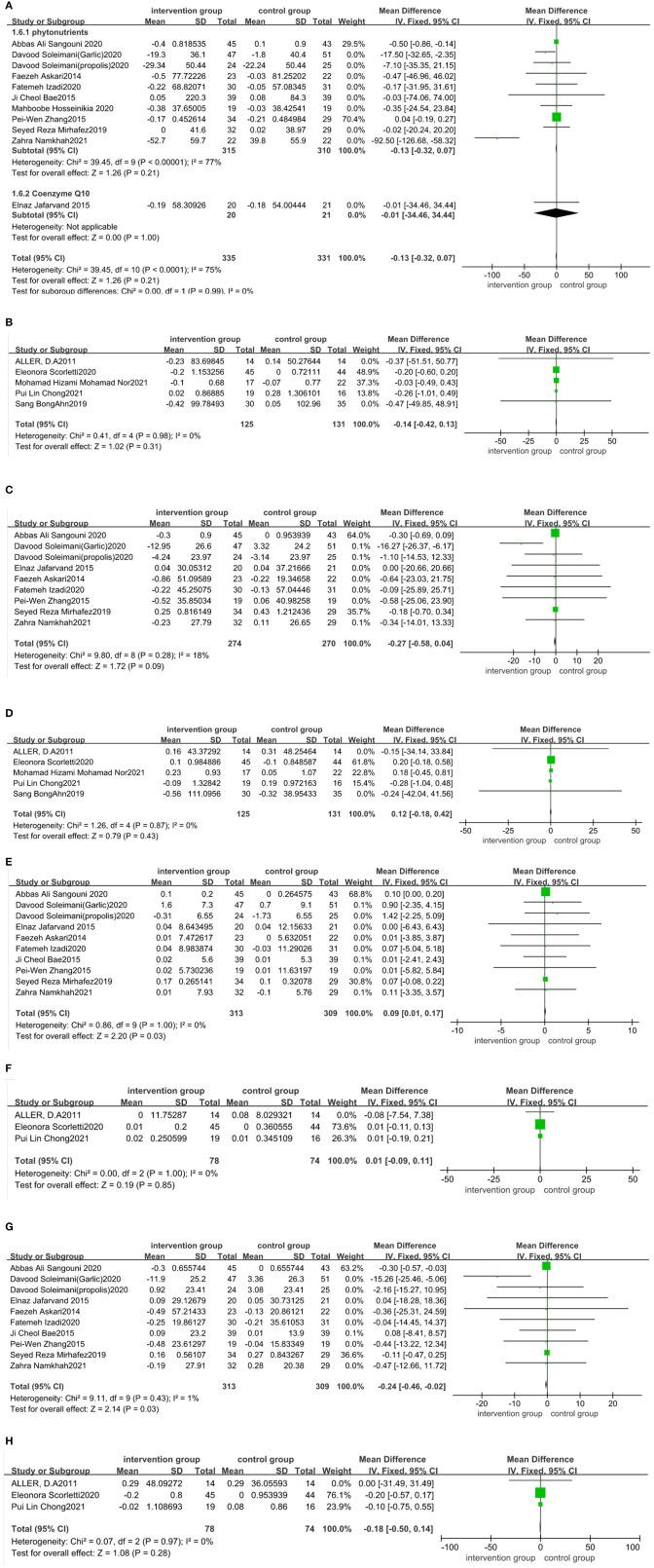
Twenty-nine articles investigating functional foods and dietary supplements [antioxidants (phytonutrients and coenzyme Q10) = 18, probiotics/symbiotic/prebiotic = 6, fatty acids = 3, vitamin D = 1, and whole grain = 1] met the eligibility criteria. Our results showed that antioxidants could significantly reduce WC (MD: -1.28 cm; 95% CI: -1.58, -0.99, < 0.05), ALT (MD: -7.65 IU/L; 95% CI: -11.14, -4.16, < 0.001), AST (MD: -4.26 IU/L; 95% CI: -5.76, -2.76, < 0.001), and LDL-C (MD: -0.24 mg/dL; 95% CI: -0.46, -0.02, < 0.05) increased in patients with NAFLD but had no effect on BMI, TG, and TC. Probiotic/symbiotic/prebiotic supplementation could decrease BMI (MD: -0.57 kg/m; 95% CI: -0.72, -0.42, < 0.05), ALT (MD: -3.96 IU/L; 95% CI: -5.24, -2.69, < 0.001), and AST (MD: -2.76; 95% CI: -3.97, -1.56, < 0.0001) levels but did not have beneficial effects on serum lipid levels compared to the control group. Moreover, the efficacy of fatty acids for treating NAFLD was full of discrepancies. Additionally, vitamin D had no significant effect on BMI, liver transaminase, and serum lipids, while whole grain could reduce ALT and AST but did not affect serum lipid levels.
CONCLUSION
The current study suggests that antioxidant and probiotic/symbiotic/prebiotic supplements may be a promising regimen for NAFLD patients. However, the usage of fatty acids, vitamin D, and whole grain in clinical treatment is uncertain. Further exploration of the efficacy ranks of functional foods and dietary supplements is needed to provide a reliable basis for clinical application.
SYSTEMATIC REVIEW REGISTRATION
https://www.crd.york.ac.uk/prospero, identifier: CRD42022351763.
目的
在本系统评价和荟萃分析中,我们旨在阐明功能性食品和膳食补充剂对非酒精性脂肪性肝病(NAFLD)患者的总体影响。
方法
系统检索了2000年1月1日至2022年1月31日发表在PubMed、ISI Web of Science、Cochrane图书馆和Embase上的随机对照试验(RCT),以评估功能性食品和膳食补充剂对NAFLD患者的影响。主要结局是与肝脏相关的指标,如丙氨酸氨基转移酶(ALT)、天冬氨酸氨基转移酶(AST)以及肝纤维化和脂肪变性,而次要结局包括体重指数(BMI)、腰围(WC)、甘油三酯(TG)、总胆固醇(TC)、低密度脂蛋白胆固醇(LDL-C)和高密度脂蛋白胆固醇(HDL-C)。这些指标均为连续变量,因此采用平均差(MD)来计算效应量。采用随机效应或固定效应模型估计平均差(MD)。根据《Cochrane系统评价干预措施手册》提供的指南评估所有研究的偏倚风险。
结果
29篇研究功能性食品和膳食补充剂的文章[抗氧化剂(植物营养素和辅酶Q10)=18篇、益生菌/共生菌/益生元=6篇、脂肪酸=3篇、维生素D=1篇、全谷物=1篇]符合纳入标准。我们的结果表明,抗氧化剂可显著降低NAFLD患者的WC(MD:-1.28cm;95%CI:-1.58,-0.99,P<0.05)、ALT(MD:-7.65IU/L;95%CI:-11.14,-4.16,P<0.001)、AST(MD:-4.26IU/L;95%CI:-5.76,-2.76,P<0.001)以及升高的LDL-C(MD:-0.24mg/dL;95%CI:-0.46,-0.02,P<0.05),但对BMI、TG和TC无影响。补充益生菌/共生菌/益生元可降低BMI(MD:-0.57kg/m²;95%CI:-0.72,-0.42,P<0.05)、ALT(MD:-3.96IU/L;95%CI:-5.24,-2.69,P<0.001)和AST(MD:-2.76;95%CI:-3.97,-1.56,P<0.0001)水平,但与对照组相比对血脂水平无有益影响。此外,脂肪酸治疗NAFLD的疗效存在差异。另外,维生素D对BMI、肝转氨酶和血脂无显著影响,而全谷物可降低ALT和AST,但不影响血脂水平。
结论
目前的研究表明,抗氧化剂和益生菌/共生菌/益生元补充剂可能是NAFLD患者的一种有前景的治疗方案。然而,脂肪酸、维生素D和全谷物在临床治疗中的应用尚不确定。需要进一步探索功能性食品和膳食补充剂的疗效排序,为临床应用提供可靠依据。
系统评价注册



 Zotero 插件