
蛋白质与 RNA 的相互作用:从质谱分析到药物研发。
Protein-RNA interactions: from mass spectrometry to drug discovery.
机构信息
Department of Biology, Institute of Molecular Systems Biology, ETH Zürich, 8093 Zurich, Switzerland.
RNA Biology PhD Program, University of Zurich and ETH Zürich, Zurich, Switzerland.
出版信息
Essays Biochem. 2023 Mar 29;67(2):175-186. doi: 10.1042/EBC20220177.
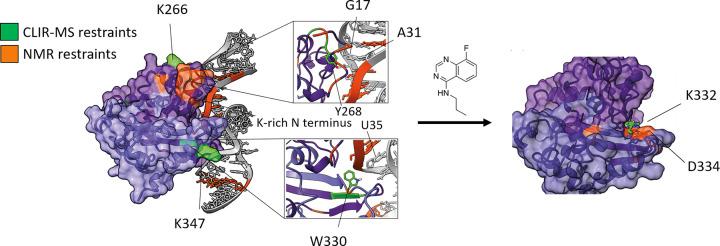
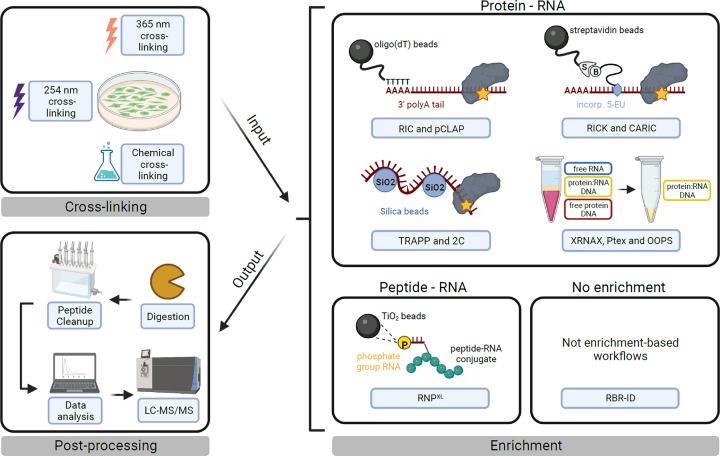
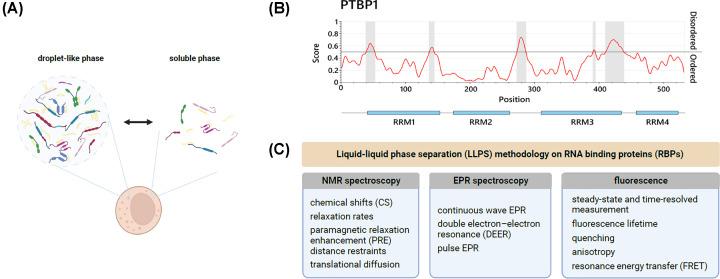
Proteins and RNAs are fundamental parts of biological systems, and their interactions affect many essential cellular processes. Therefore, it is crucial to understand at a molecular and at a systems level how proteins and RNAs form complexes and mutually affect their functions. In the present mini-review, we will first provide an overview of different mass spectrometry (MS)-based methods to study the RNA-binding proteome (RBPome), most of which are based on photochemical cross-linking. As we will show, some of these methods are also able to provide higher-resolution information about binding sites, which are important for the structural characterisation of protein-RNA interactions. In addition, classical structural biology techniques such as nuclear magnetic resonance (NMR) spectroscopy and biophysical methods such as electron paramagnetic resonance (EPR) spectroscopy and fluorescence-based methods contribute to a detailed understanding of the interactions between these two classes of biomolecules. We will discuss the relevance of such interactions in the context of the formation of membrane-less organelles (MLOs) by liquid-liquid phase separation (LLPS) processes and their emerging importance as targets for drug discovery.
蛋白质和 RNA 是生物系统的基本组成部分,它们的相互作用影响许多重要的细胞过程。因此,从分子和系统水平上了解蛋白质和 RNA 如何形成复合物以及相互影响它们的功能至关重要。在本次迷你综述中,我们将首先概述几种基于质谱(MS)的方法来研究 RNA 结合蛋白组(RBPome),其中大多数方法基于光化学交联。正如我们将展示的那样,其中一些方法还能够提供有关结合位点的更高分辨率信息,这对于蛋白质-RNA 相互作用的结构特征至关重要。此外,经典的结构生物学技术,如核磁共振(NMR)光谱学,以及生物物理方法,如电子顺磁共振(EPR)光谱学和荧光方法,有助于深入了解这两类生物分子之间的相互作用。我们将讨论这些相互作用在通过液-液相分离(LLPS)过程形成无膜细胞器(MLO)的背景下的相关性,以及它们作为药物发现靶点的新兴重要性。

 Zotero 插件