
三种毛细支气管炎临床评分工具对预测三个月龄及以下新生儿和婴儿呼吸支持需求及住院时间的比较。
Comparison of three clinical scoring tools for bronchiolitis to predict the need for respiratory support and length of stay in neonates and infants up to three months of age.
作者信息
De Rose Domenico Umberto, Maddaloni Chiara, Martini Ludovica, Braguglia Annabella, Dotta Andrea, Auriti Cinzia
机构信息
Neonatal Intensive Care Unit, Bambino Gesù Children's Hospital IRCCS, Rome, Italy.
Neonatal Sub-Intensive Care Unit and Follow-up, Bambino Gesù Children's Hospital IRCCS, Rome, Italy.
出版信息
Front Pediatr. 2023 Feb 17;11:1040354. doi: 10.3389/fped.2023.1040354. eCollection 2023.
BACKGROUND
Bronchiolitis severity can be assessed using different clinical scores. Some of the most used are the Wang Bronchiolitis Severity Score (WBSS), the Kristjansson Respiratory Score (KRS), and the Global Respiratory Severity Score (GRSS), calculated on the vital parameters and the clinical conditions.
OBJECTIVE
To assess which of the three clinical scores better predicts the need for respiratory support and length of hospital stay in neonates and infants younger than three months, admitted to neonatal units for bronchiolitis.
METHODS
Neonates and infants younger than three months admitted to neonatal units from October 2021 to March 2022 were included in this retrospective study. The scores were calculated in all patients soon after admission.
RESULTS
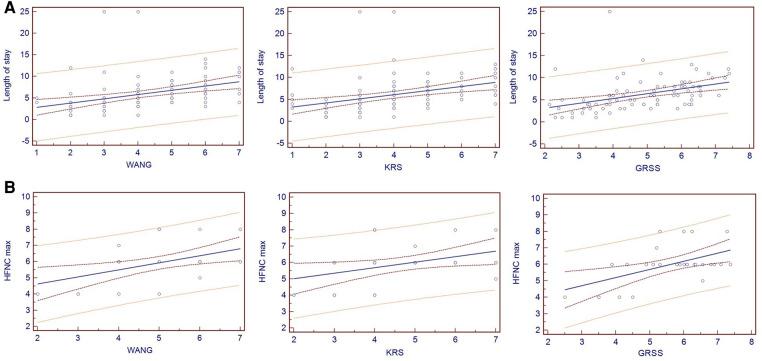
Ninety-six patients (of whom 61 neonates) admitted for bronchiolitis were included in the analysis. Median WBSS at admission was 4.00 (interquartile range, IQR 3.00-6.00), median KRS was 4.00 (IQR 3.00-5.00), and median GRSS 4.90 (IQR 3.89-6.10). We found significant differences in all three scores between infants who needed respiratory support (72.9%) and those who did not (27.1%) ( < 0.001). A value >3 for WBSS, > 3 for KRS, and >3.8 for GRSS were accurate in predicting the need for respiratory support, with a sensitivity of 85.71%, 75.71%, and 93.75% and a specificity of 80.77%, 92.31%, and 88.24%, respectively. The three infants who required mechanical ventilation had a median WBSS of 6.00 (IQR 5.00-6.50), a KRS of 7.00 (IQR 5.00-7.00), and a GRSS of 7.38 (IQR 5.59-7.39). The median length of stay was 5 days (IQR 4-8). All three scores were significantly correlated with the length of stay, although with a low correlation coefficient: WBSS with an r of 0.139 ( < 0.001), KRS with an r of 0.137 ( < 0.001), and GRSS with an r of 0.170 ( < 0.001).
CONCLUSION
Clinical scores WBSS, KRS, and GRSS calculated on admission accurately predict the need for respiratory support and the length of hospital stay in neonates and infants younger than three months with bronchiolitis. The GRSS score seems to better discriminate the need for respiratory support than the others.
背景
可使用不同的临床评分来评估细支气管炎的严重程度。一些最常用的评分包括王细支气管炎严重程度评分(WBSS)、克里斯蒂安松呼吸评分(KRS)和全球呼吸严重程度评分(GRSS),这些评分是根据生命体征参数和临床状况计算得出的。
目的
评估这三种临床评分中哪一种能更好地预测入住新生儿病房的3个月以下新生儿和婴儿因细支气管炎而需要呼吸支持的情况以及住院时间。
方法
本回顾性研究纳入了2021年10月至2022年3月入住新生儿病房的3个月以下新生儿和婴儿。所有患者入院后不久即计算评分。
结果
分析纳入了96例因细支气管炎入院的患者(其中61例为新生儿)。入院时WBSS的中位数为4.00(四分位间距,IQR 3.00 - 6.00),KRS的中位数为4.00(IQR 3.00 - 5.00),GRSS的中位数为4.90(IQR 3.89 - 6.10)。我们发现需要呼吸支持的婴儿(72.9%)和不需要呼吸支持的婴儿(27.1%)在所有这三种评分上均存在显著差异(<0.001)。WBSS >3、KRS >3和GRSS >3.8在预测呼吸支持需求方面较为准确,敏感性分别为85.71%、75.71%和93.75%,特异性分别为80.77%、92.31%和88.24%。三名需要机械通气的婴儿,其WBSS的中位数为6.00(IQR 5.00 - 6.50),KRS为7.00(IQR 5.00 - 7.00),GRSS为7.38(IQR 5.59 - 7.39)。住院时间的中位数为5天(IQR 4 - 8)。所有这三种评分均与住院时间显著相关,尽管相关系数较低:WBSS的r为0.139(<0.001),KRS的r为0.137(<0.001),GRSS的r为0.170(<0.001)。
结论
入院时计算的临床评分WBSS、KRS和GRSS能够准确预测3个月以下患有细支气管炎的新生儿和婴儿对呼吸支持的需求以及住院时间。GRSS评分在区分呼吸支持需求方面似乎比其他评分更好。

 Zotero 插件