
评价肠超声在炎症性肠病患者疾病活动评估中的应用:马来西亚一家三级中心的横断面研究。
Evaluation of intestinal ultrasound for disease activity assessment in patients with inflammatory bowel disease: A cross-sectional study at a tertiary centre in Malaysia.
机构信息
Gastroenterology Unit, Department of Medicine, Faculty of Medicine, Universiti Kebangsaan Malaysia, Cheras, Kuala Lumpur, Malaysia.
Gastroenterology Unit, Department of Medicine, Faculty of Medicine, Universiti Kebangsaan Malaysia; GUT Research Group, Faculty of Medicine, Universiti Kebangsaan Malaysia, Cheras, Kuala Lumpur, Malaysia.
出版信息
Saudi J Gastroenterol. 2023 Sep-Oct;29(5):300-308. doi: 10.4103/sjg.sjg_531_22.
BACKGROUND
The use of intestinal ultrasound (IUS) in the management of inflammatory bowel disease (IBD) is emerging. We aim to determine the performance of IUS in the assessment of disease activity in IBD.
METHODS
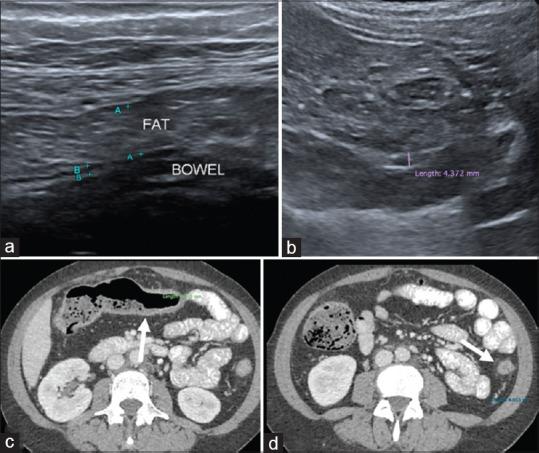
This is a prospective cross-sectional study of IUS performed on IBD patients in a tertiary centre. IUS parameters including intestinal wall thickness, loss of wall stratification, mesenteric fibrofatty proliferation, and increased vascularity were compared with endoscopic and clinical activity indices.
RESULTS
Among the 51 patients, 58.8% were male, with a mean age of 41 years. Fifty-seven percent had underlying ulcerative colitis with mean disease duration of 8.4 years. Against ileocolonoscopy, IUS had a sensitivity of 67% (95% confidence interval (CI): 41-86) for detecting endoscopically active disease. It had high specificity of 97% (95% CI: 82-99) with positive and negative predictive values of 92% and 84%, respectively. Against clinical activity index, IUS had a sensitivity of 70% (95% CI: 35-92) and specificity of 85% (95% CI: 70-94) for detecting moderate to severe disease. Among individual IUS parameters, presence of bowel wall thickening (>3 mm) had the highest sensitivity (72%) for detecting endoscopically active disease. For per-bowel segment analysis, IUS (bowel wall thickening) was able to achieve 100% sensitivity and 95% specificity when examining the transverse colon.
CONCLUSIONS
IUS has moderate sensitivity with excellent specificity in detecting active disease in IBD. IUS is most sensitive in detecting a disease at transverse colon. IUS can be employed as an adjunct in the assessment of IBD.
背景
肠超声(IUS)在炎症性肠病(IBD)的治疗中逐渐得到应用。本研究旨在评估 IUS 在评估 IBD 疾病活动中的表现。
方法
这是一项在三级中心进行的 IBD 患者前瞻性横断面研究。将肠壁厚度、壁分层丧失、肠系膜纤维脂肪增生和血管增多等 IUS 参数与内镜和临床活动指数进行比较。
结果
在 51 例患者中,58.8%为男性,平均年龄为 41 岁。57%患有溃疡性结肠炎,平均病程为 8.4 年。与结肠镜相比,IUS 诊断内镜下活动性病变更敏感,敏感性为 67%(95%可信区间:41-86)。特异性为 97%(95%可信区间:82-99),阳性预测值和阴性预测值分别为 92%和 84%。与临床活动指数相比,IUS 诊断中重度疾病的敏感性为 70%(95%可信区间:35-92),特异性为 85%(95%可信区间:70-94)。在单独的 IUS 参数中,肠壁增厚(>3mm)的检测活动性病变更敏感,敏感性为 72%。对于每段肠管的分析,当检查横结肠时,IUS(肠壁增厚)可达到 100%的敏感性和 95%的特异性。
结论
IUS 检测 IBD 活动性病变更敏感,特异性较高。IUS 在检测横结肠疾病方面最敏感。IUS 可作为 IBD 评估的辅助手段。

 Zotero 插件