
晚期肺癌炎症指数是接受手术治疗的胃肠道癌症患者的预后因素:系统评价和荟萃分析。
The advanced lung cancer inflammation index is a prognostic factor for gastrointestinal cancer patients undergoing surgery: a systematic review and meta-analysis.
机构信息
Department of Gastrointestinal Surgery, The First Affiliated Hospital of Chongqing Medical University, Chongqing, 400016, China.
Department of Clinical Nutrition, the First Affiliated Hospital of Chongqing Medical University, Chongqing, 400016, China.
出版信息
World J Surg Oncol. 2023 Mar 6;21(1):81. doi: 10.1186/s12957-023-02972-4.
BACKGROUND
The advanced lung cancer inflammation index (ALI) is a comprehensive assessment indicator that can reflect inflammation and nutrition conditions. However, there are some controversies about whether ALI is an independent prognostic factor for gastrointestinal cancer patients undergoing surgical resection. Thus, we aimed to clarify its prognostic value and explore the potential mechanisms.
METHODS
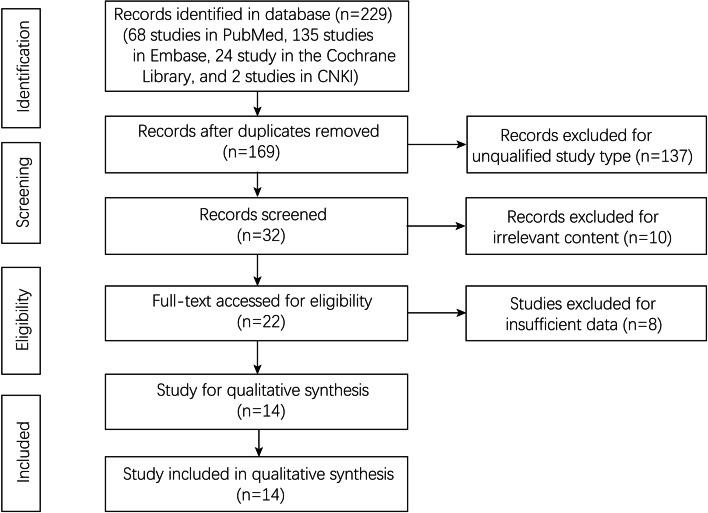
Four databases including PubMed, Embase, the Cochrane Library, and CNKI were used for searching eligible studies from inception to June 28, 2022. All gastrointestinal cancers, including colorectal cancer (CRC), gastric cancer (GC), esophageal cancer (EC), liver cancer, cholangiocarcinoma, and pancreatic cancer were enrolled for analysis. We focused on prognosis most in the current meta-analysis. Survival indicators, including overall survival (OS), disease-free survival (DFS), and cancer-special survival (CSS) were compared between the high ALI group and the low ALI group. The Preferred Reporting Items for Systematic Reviews and Meta-Analyses (PRISMA) checklist was submitted as a supplementary document.
RESULTS
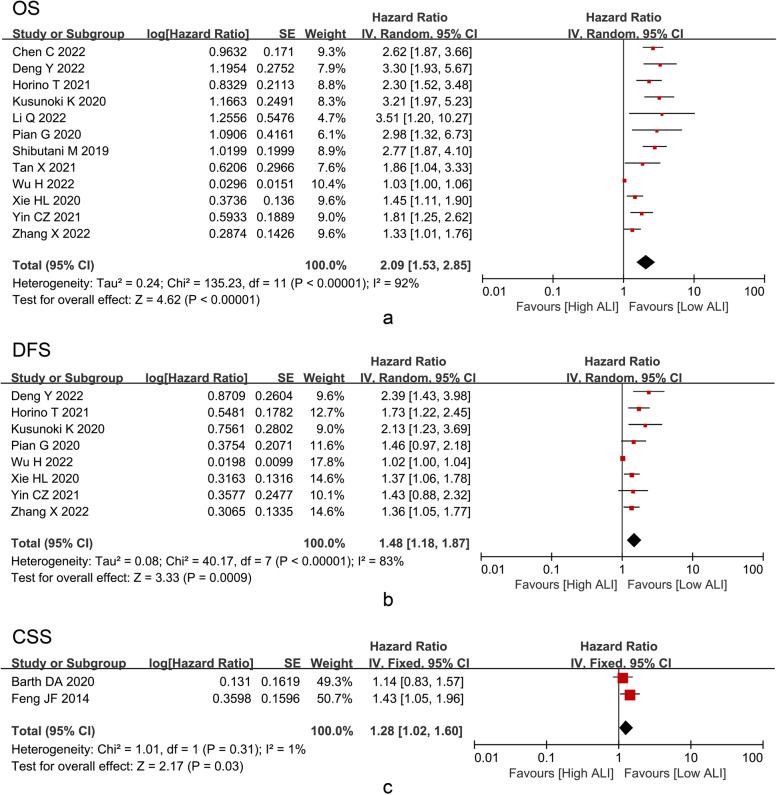
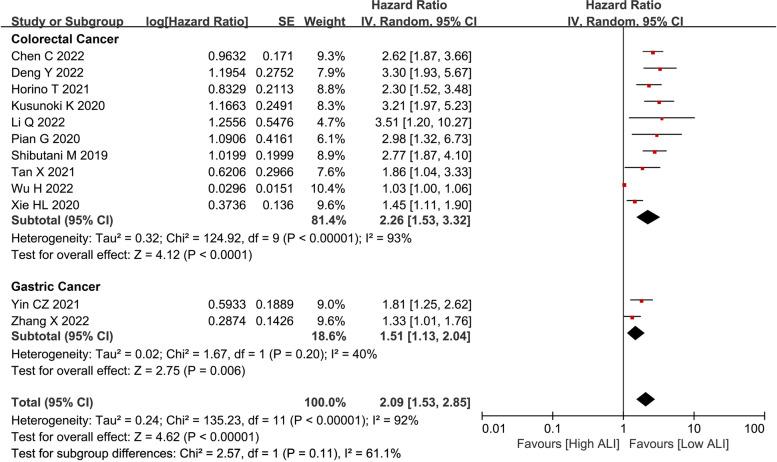
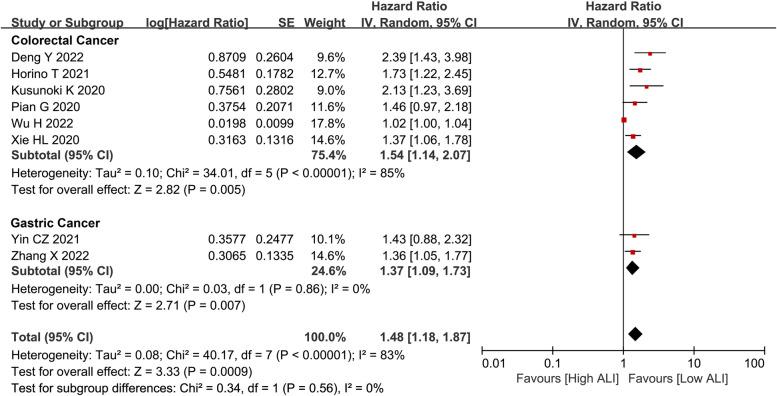
We finally included fourteen studies involving 5091 patients in this meta-analysis. After pooling the hazard ratios (HRs) and 95% confidence intervals (CIs), ALI was found to be an independent prognostic factor for both OS (HR = 2.09, I = 92%, 95% CI = 1.53 to 2.85, P < 0.01), DFS (HR = 1.48, I = 83%, 95% CI = 1.18 to 1.87, P < 0.01), and CSS (HR = 1.28, I = 1%, 95% CI = 1.02 to 1.60, P = 0.03) in gastrointestinal cancer. After subgroup analysis, we found that ALI was still closely related to OS for CRC (HR = 2.26, I = 93%, 95% CI = 1.53 to 3.32, P < 0.01) and GC (HR = 1.51, I = 40%, 95% CI = 1.13 to 2.04, P = 0.006) patients. As for DFS, ALI also has a predictive value on the prognosis of CRC (HR = 1.54, I = 85%, 95% CI = 1.14 to 2.07, P = 0.005) and GC (HR = 1.37, I = 0%, 95% CI = 1.09 to 1.73, P = 0.007) patients.
CONCLUSION
ALI affected gastrointestinal cancer patients in terms of OS, DFS, and CSS. Meanwhile, ALI was a prognostic factor both for CRC and GC patients after subgroup analysis. Patients with low ALI had poorer prognoses. We recommended that surgeons should perform aggressive interventions in patients with low ALI before the operation.
背景
高级肺癌炎症指数(ALI)是一种综合评估指标,可反映炎症和营养状况。然而,ALI 是否是接受手术切除的胃肠道癌症患者的独立预后因素仍存在一些争议。因此,我们旨在阐明其预后价值并探讨其潜在机制。
方法
我们使用 PubMed、Embase、Cochrane 图书馆和中国知网这四个数据库,从成立到 2022 年 6 月 28 日,对符合条件的研究进行了搜索。所有胃肠道癌症,包括结直肠癌(CRC)、胃癌(GC)、食管癌(EC)、肝癌、胆管癌和胰腺癌,均纳入分析。我们在当前的荟萃分析中最关注预后。在生存指标方面,比较了高 ALI 组和低 ALI 组之间的总生存期(OS)、无病生存期(DFS)和癌症特异性生存期(CSS)。提交了循证医学系统评价和荟萃分析的首选报告项目(PRISMA)清单作为补充文件。
结果
我们最终纳入了这项荟萃分析中的 14 项研究,共涉及 5091 名患者。合并风险比(HR)和 95%置信区间(CI)后,ALI 被发现是 OS(HR=2.09,I=92%,95%CI=1.53 至 2.85,P<0.01)、DFS(HR=1.48,I=83%,95%CI=1.18 至 1.87,P<0.01)和 CSS(HR=1.28,I=1%,95%CI=1.02 至 1.60,P=0.03)的独立预后因素。亚组分析后,我们发现 ALI 与 CRC(HR=2.26,I=93%,95%CI=1.53 至 3.32,P<0.01)和 GC(HR=1.51,I=40%,95%CI=1.13 至 2.04,P=0.006)患者的 OS 也密切相关。对于 DFS,ALI 对 CRC(HR=1.54,I=85%,95%CI=1.14 至 2.07,P=0.005)和 GC(HR=1.37,I=0%,95%CI=1.09 至 1.73,P=0.007)患者的预后也具有预测价值。
结论
ALI 影响胃肠道癌症患者的 OS、DFS 和 CSS。同时,ALI 是亚组分析后 CRC 和 GC 患者的预后因素。低 ALI 患者的预后较差。我们建议外科医生在手术前对低 ALI 患者进行积极的干预。
 Zotero 插件