
美国燃煤电厂相关的不公平暴露:22 年及以后。
Inequitable Exposures to U.S. Coal Power Plant-Related : 22 Years and Counting.
机构信息
Department of Civil, Environmental, and Infrastructure Engineering; George Mason University, Fairfax, Virginia, USA.
Swiss Data Science Center, ETH Zürich and EPFL, Lausanne, Switzerland.
出版信息
Environ Health Perspect. 2023 Mar;131(3):37005. doi: 10.1289/EHP11605. Epub 2023 Mar 8.
BACKGROUND
Emissions from coal power plants have decreased over recent decades due to regulations and economics affecting costs of providing electricity generated by coal vis-à-vis its alternatives. These changes have improved regional air quality, but questions remain about whether benefits have accrued equitably across population groups.
OBJECTIVES
We aimed to quantify nationwide long-term changes in exposure to particulate matter (PM) with an aerodynamic diameter () associated with coal power plant emissions. We linked exposure reductions with three specific actions taken at individual power plants: scrubber installations, reduced operations, and retirements. We assessed how emissions changes in different locations have influenced exposure inequities, extending previous source-specific environmental justice analyses by accounting for location-specific differences in racial/ethnic population distributions.
METHODS
We developed a data set of annual source impacts ("coal ") associated with emissions at each of 1,237 U.S. coal-fired power plants across 1999-2020. We linked population-weighted exposure with information about each coal unit's operational and emissions-control status. We calculate changes in both relative and absolute exposure differences across demographic groups.
RESULTS
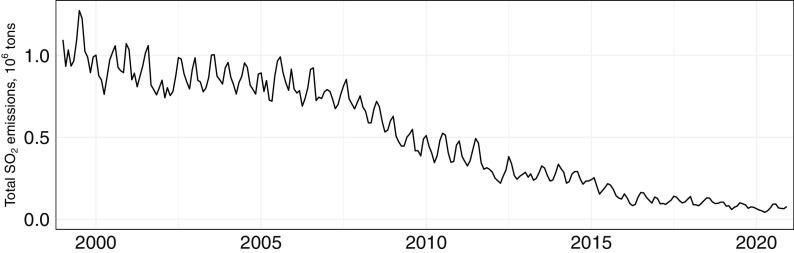
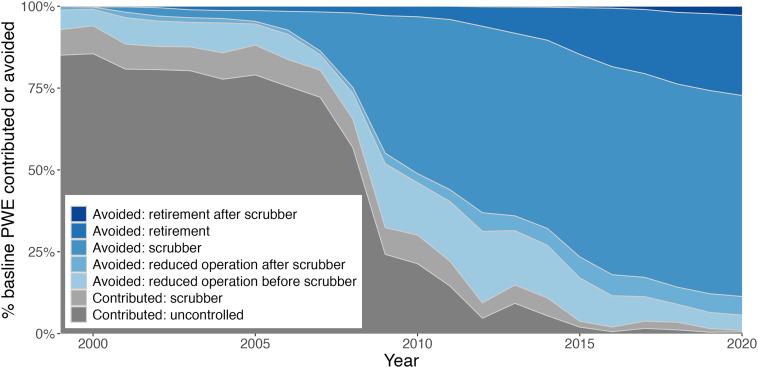
Nationwide population-weighted coal declined from in 1999 to in 2020. Between 2007 and 2010, most of the exposure reduction is attributable to scrubber installations, and after 2010 most of the decrease is attributable to retirements. Black populations in the South and North Central United States and Native American populations in the western United States were inequitably exposed early in the study period. Although inequities decreased with falling emissions, facilities in states across the North Central United States continue to inequitably expose Black populations, and Native populations are inequitably exposed to emissions from facilities in the West.
DISCUSSION
We show that air quality controls, operational adjustments, and retirements since 1999 led to reduced exposure to coal power plant related . Reduced exposure improved equity overall, but some populations continue to be inequitably exposed to associated with facilities in the North Central and western United States. https://doi.org/10.1289/EHP11605.
背景
由于法规和经济因素影响了燃煤发电相对于替代能源的成本,近几十年来,燃煤电厂的排放量有所减少。这些变化改善了区域空气质量,但仍存在疑问,即这些效益是否在人群中公平分配。
目的
我们旨在量化与燃煤电厂排放相关的空气动力学直径为 的颗粒物(PM)暴露量的全国性长期变化。我们将暴露量的减少与个别电厂采取的三项具体行动联系起来:安装洗涤器、减少运行和退役。我们评估了不同地点的排放变化如何影响了不公平的暴露情况,通过考虑种族/族裔人口分布的特定位置差异,扩展了以前基于特定来源的环境正义分析。
方法
我们开发了一个数据集,其中包含了 1999 年至 2020 年期间,美国 1237 个燃煤电厂的每年 源影响(“煤”),这些影响与 排放有关。我们将人口加权暴露与每个煤机组的运行和排放控制状况的信息联系起来。我们计算了不同人群的相对和绝对暴露差异的变化。
结果
全国人口加权的煤 排放量从 1999 年的 下降到 2020 年的 。在 2007 年至 2010 年期间,大部分暴露量的减少归因于 洗涤器的安装,而在 2010 年之后,大部分的减少归因于退役。在研究早期,美国南部和中北部的黑人群体以及美国西部的美洲原住民群体受到了不公平的暴露。尽管随着排放的减少,不公平性有所降低,但美国中北部各州的工厂仍继续不公平地暴露黑人群体,而美洲原住民则受到来自美国西部工厂排放的不公平暴露。
讨论
我们表明,自 1999 年以来的空气质量控制、运行调整和退役导致了与燃煤电厂相关的 暴露量的减少。暴露量的减少总体上改善了公平性,但一些人群仍然受到美国中北部和西部工厂与 相关的不公平暴露。https://doi.org/10.1289/EHP11605.




 Zotero 插件