
非药物干预措施降低了 COVID-19 传染病发病率:一项基于对照的中断时间序列研究。
Non-pharmaceutical interventions for COVID-19 reduced the incidence of infectious diseases: a controlled interrupted time-series study.
机构信息
Division of Disease Surveillance, Chinese PLA Center for Disease Control and Prevention, Beijing, 100071, China.
School of Public Health and Preventive Medicine, Monash University, Level 2, 553 St Kilda Road, Melbourne, VIC, 3004, Australia.
出版信息
Infect Dis Poverty. 2023 Mar 9;12(1):15. doi: 10.1186/s40249-023-01066-3.
BACKGROUND
Non-pharmaceutical interventions (NPIs) have been implemented worldwide to suppress the spread of coronavirus disease 2019 (COVID-19). However, few studies have evaluated the effect of NPIs on other infectious diseases and none has assessed the avoided disease burden associated with NPIs. We aimed to assess the effect of NPIs on the incidence of infectious diseases during the COVID-19 pandemic in 2020 and evaluate the health economic benefits related to the reduction in the incidence of infectious diseases.
METHODS
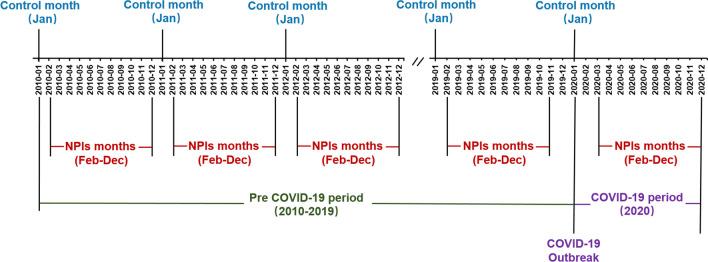
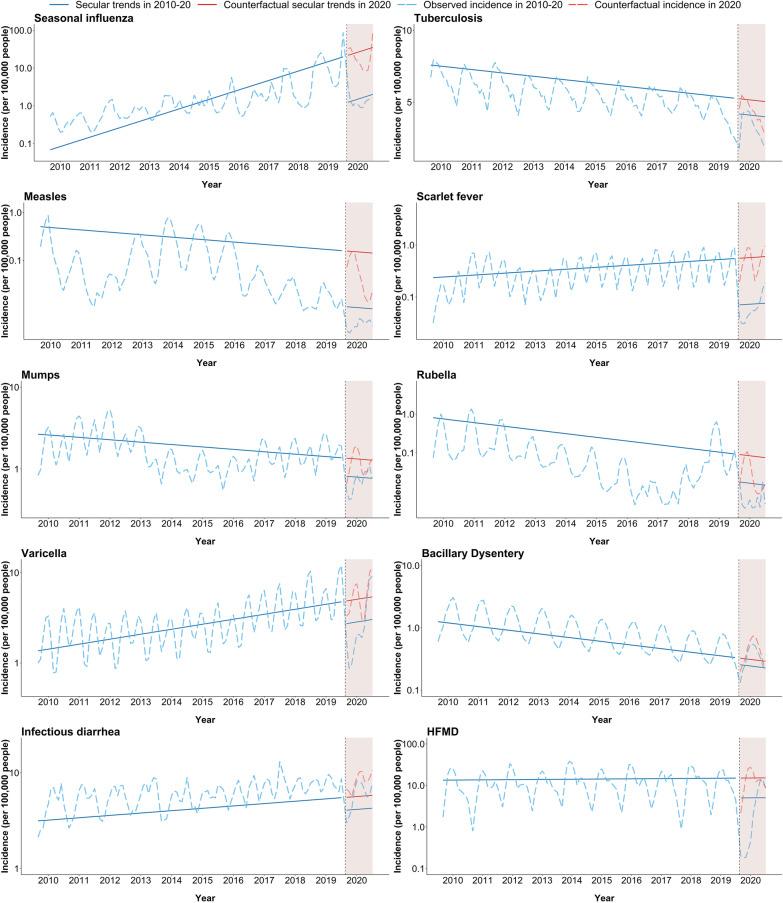
Data on 10 notifiable infectious diseases across China during 2010-2020 were extracted from the China Information System for Disease Control and Prevention. A two-stage controlled interrupted time-series design with a quasi-Poisson regression model was used to examine the impact of NPIs on the incidence of infectious diseases. The analysis was first performed at the provincial-level administrative divisions (PLADs) level in China, then the PLAD-specific estimates were pooled using a random-effect meta-analysis.
RESULTS
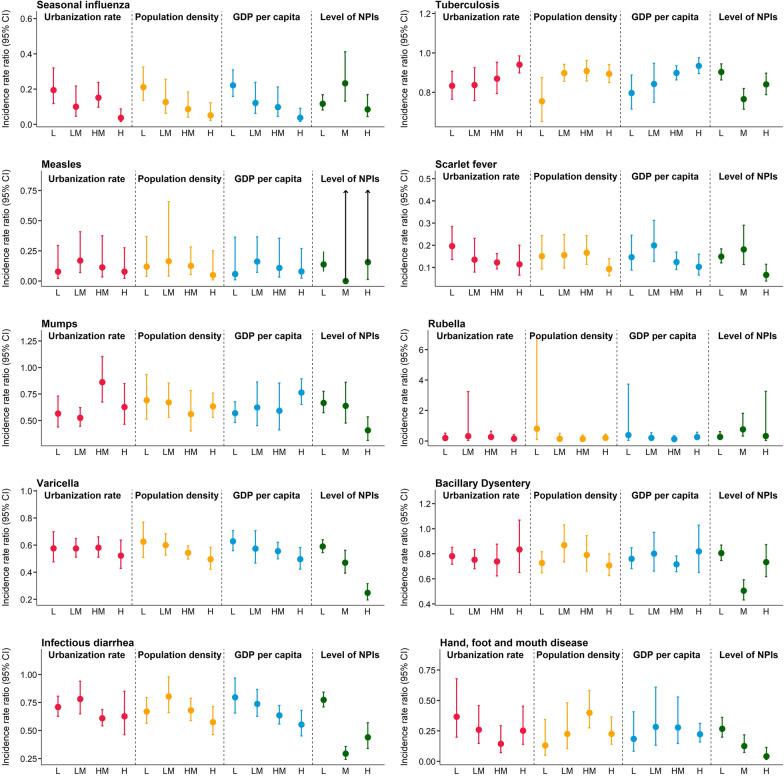
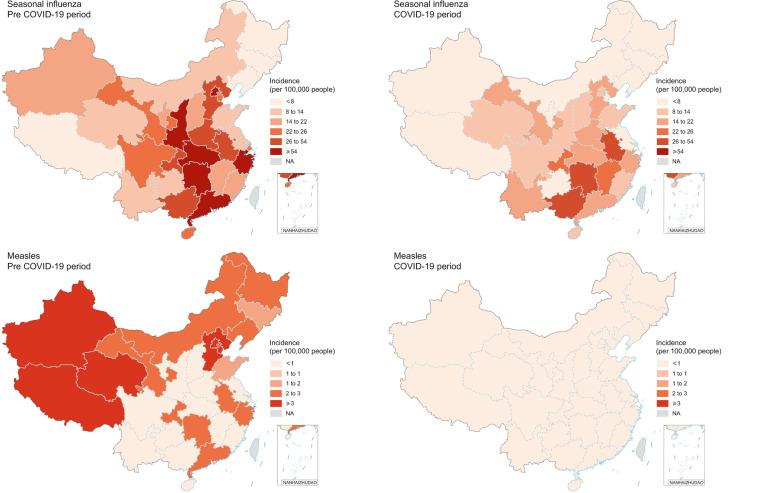
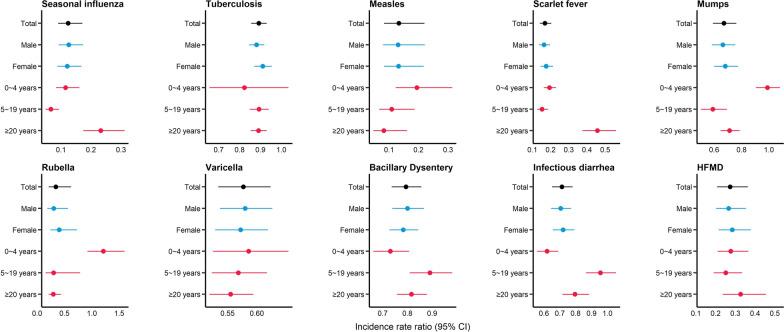
A total of 61,393,737 cases of 10 infectious diseases were identified. The implementation of NPIs was associated with 5.13 million (95% confidence interval [CI] 3.45‒7.42) avoided cases and USD 1.77 billion (95% CI 1.18‒2.57) avoided hospital expenditures in 2020. There were 4.52 million (95% CI 3.00‒6.63) avoided cases for children and adolescents, corresponding to 88.2% of total avoided cases. The top leading cause of avoided burden attributable to NPIs was influenza [avoided percentage (AP): 89.3%; 95% CI 84.5‒92.6]. Socioeconomic status and population density were effect modifiers.
CONCLUSIONS
NPIs for COVID-19 could effectively control the prevalence of infectious diseases, with patterns of risk varying by socioeconomic status. These findings have important implications for informing targeted strategies to prevent infectious diseases.
背景
为了抑制 2019 年冠状病毒病(COVID-19)的传播,全球已实施非药物干预(NPIs)。然而,很少有研究评估 NPIs 对其他传染病的影响,也没有研究评估与传染病发病率降低相关的健康经济效益。我们旨在评估 2020 年 COVID-19 大流行期间 NPIs 对传染病发病率的影响,并评估与传染病发病率降低相关的健康经济效益。
方法
从中国疾病预防控制信息系统中提取了 2010-2020 年期间中国 10 种法定传染病的数据。采用两阶段控制中断时间序列设计和准泊松回归模型,研究 NPIs 对传染病发病率的影响。首先在省级行政单位(PLADs)水平上进行分析,然后使用随机效应荟萃分析对特定 PLAD 的估计值进行汇总。
结果
共确定了 10 种传染病的 61393737 例病例。实施 NPIs 可避免 513 万例(95%置信区间 [CI] 345-742)病例,避免 2020 年 17.7 亿美元(95% CI 11.8-25.7)的医院支出。其中,儿童和青少年可避免 452 万例(95% CI 300-663),占总可避免病例的 88.2%。NPIs 避免负担的主要原因是流感[避免率(AP):89.3%;95% CI 84.5-92.6]。社会经济地位和人口密度是影响因素。
结论
针对 COVID-19 的 NPIs 可有效控制传染病的流行,其风险模式因社会经济地位而异。这些发现对于制定有针对性的传染病预防策略具有重要意义。

 Zotero 插件