
注意缺陷多动障碍与寿命之间存在共享的遗传结构。
Shared genetic architecture between attention-deficit/hyperactivity disorder and lifespan.
机构信息
Psychiatric Genetics Unit, Group of Psychiatry, Mental Health and Addiction, Vall d'Hebron Research Institute (VHIR), Universitat Autònoma de Barcelona, Barcelona, Spain.
Department of Mental Health, Hospital Universitari Vall d'Hebron, Barcelona, Spain.
出版信息
Neuropsychopharmacology. 2023 Jun;48(7):981-990. doi: 10.1038/s41386-023-01555-x. Epub 2023 Mar 11.
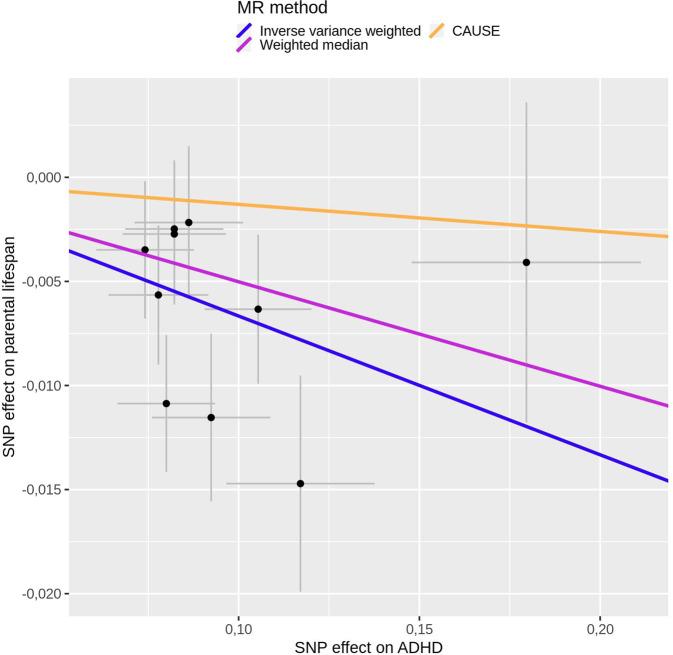
There is evidence linking ADHD to a reduced life expectancy. The mortality rate in individuals with ADHD is twice that of the general population and it is associated with several factors, such as unhealthy lifestyle behaviors, social adversity, and mental health problems that may in turn increase mortality rates. Since ADHD and lifespan are heritable, we used data from genome-wide association studies (GWAS) of ADHD and parental lifespan, as proxy of individual lifespan, to estimate their genetic correlation, identify genetic loci jointly associated with both phenotypes and assess causality. We confirmed a negative genetic correlation between ADHD and parental lifespan (rg = -0.36, P = 1.41e-16). Nineteen independent loci were jointly associated with both ADHD and parental lifespan, with most of the alleles that increased the risk for ADHD being associated with shorter lifespan. Fifteen loci were novel for ADHD and two were already present in the original GWAS on parental lifespan. Mendelian randomization analyses pointed towards a negative causal effect of ADHD liability on lifespan (P = 1.54e-06; Beta = -0.07), although these results were not confirmed by all sensitivity analyses performed, and further evidence is required. The present study provides the first evidence of a common genetic background between ADHD and lifespan, which may play a role in the reported effect of ADHD on premature mortality risk. These results are consistent with previous epidemiological data describing reduced lifespan in mental disorders and support that ADHD is an important health condition that could negatively affect future life outcomes.
有证据表明注意力缺陷多动障碍(ADHD)与预期寿命缩短有关。ADHD 患者的死亡率是普通人群的两倍,这与多种因素有关,如不健康的生活方式行为、社会逆境和心理健康问题,这些因素反过来又可能增加死亡率。由于 ADHD 和寿命是可遗传的,我们使用 ADHD 的全基因组关联研究(GWAS)和父母寿命的数据(作为个体寿命的替代指标)来估计它们的遗传相关性,确定与两种表型都相关的遗传位点,并评估因果关系。我们证实 ADHD 与父母寿命之间存在负遗传相关性(rg=-0.36,P=1.41e-16)。有 19 个独立的位点与 ADHD 和父母寿命都有关联,大多数增加 ADHD 风险的等位基因与更短的寿命有关。有 15 个位点是 ADHD 的新发现,有 2 个位点已经存在于父母寿命的原始 GWAS 中。孟德尔随机化分析表明 ADHD 易感性对寿命有负向因果效应(P=1.54e-06;Beta=-0.07),尽管这些结果并未被所有进行的敏感性分析所证实,还需要进一步的证据。本研究首次提供了 ADHD 和寿命之间存在共同遗传背景的证据,这可能在 ADHD 对过早死亡风险的报告影响中起作用。这些结果与描述精神障碍寿命缩短的先前流行病学数据一致,并支持 ADHD 是一种重要的健康状况,可能对未来的生活结果产生负面影响。


 Zotero 插件