
用于培养和分子生物学分析 IBD 患者来源结肠上皮类器官的综合方案。
Comprehensive protocols for culturing and molecular biological analysis of IBD patient-derived colon epithelial organoids.
机构信息
Department of Clinical and Molecular Medicine (IKOM), Faculty of Medicine and Health Sciences, NTNU- Norwegian University of Science and Technology, Trondheim, Norway.
Clinic of Laboratory Medicine, St. Olav's University Hospital, Trondheim, Norway.
出版信息
Front Immunol. 2023 Feb 23;14:1097383. doi: 10.3389/fimmu.2023.1097383. eCollection 2023.
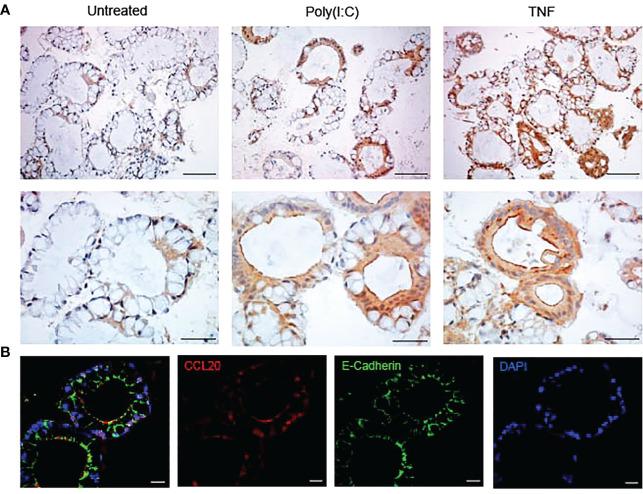
There are many unanswered questions regarding responses to proinflammatory signals in intestinal epithelial cells (IECs). For example, chemokines secreted by IECs upon external stimuli play multifunctional roles in both homeostasis and during inflammation. Several chemokines are upregulated during active inflammatory bowel disease (IBD), which is associated with an increased influx of immune cells into the gut mucosa. Therefore, studies on how chemokines are regulated in the intestinal epithelium may identify putative treatment targets in IBD. More recently, patient-derived models such as intestinal organoids have facilitated molecular analysis of epithelial alterations in IBD patients own cells. Here, we describe refined experimental protocols and methods for the generation and maintenance of IBD patient-derived colonic organoids (colonoids) culture. We also give detailed description of medium, and supplements needed for colonoid establishment, growth, and differentiation, including production of Wnt-3A and Rspondin1 enriched media. Further, we present protocols for RNA and protein isolation from human colonoids, and subsequent gene expression analysis and Western blotting for e.g., signal transduction studies. We also describe how to process colonoids for chemokine protein expression analysis such as immunostaining, confocal imaging, and detection of secreted chemokines by e.g., enzyme-linked immunosorbent assay (ELISA). As proof of principle, we give examples of how the chemoattractant CCL20 can be regulated and expressed in colonoids derived from IBD-patients and healthy controls upon ligands-driven inflammation.
关于肠道上皮细胞 (IEC) 对促炎信号的反应,仍有许多悬而未决的问题。例如,IEC 在受到外部刺激时分泌的趋化因子在稳态和炎症期间具有多功能作用。几种趋化因子在活性炎症性肠病 (IBD) 期间上调,这与免疫细胞大量涌入肠道黏膜有关。因此,研究趋化因子在肠道上皮细胞中的调节方式可能有助于确定 IBD 的潜在治疗靶点。最近,患者来源的模型,如肠类器官,促进了对 IBD 患者自身细胞上皮改变的分子分析。在这里,我们描述了生成和维持 IBD 患者衍生结肠类器官(类器官)培养物的改良实验方案和方法。我们还详细描述了类器官建立、生长和分化所需的培养基和补充剂,包括 Wnt-3A 和 Rspondin1 富集培养基的生产。此外,我们还介绍了从人源类器官中分离 RNA 和蛋白质的方案,以及随后的基因表达分析和 Western blot 分析,例如信号转导研究。我们还描述了如何处理类器官以进行趋化因子蛋白表达分析,例如免疫染色、共聚焦成像和通过例如酶联免疫吸附测定 (ELISA) 检测分泌的趋化因子。作为原理验证,我们举例说明了在配体驱动的炎症下,源自 IBD 患者和健康对照的类器官中趋化因子 CCL20 如何被调节和表达。



 Zotero 插件