
美国注意缺陷多动障碍伴发焦虑和/或抑郁患者的治疗模式:一项回顾性理赔分析。
Treatment Patterns Among Patients with Attention-Deficit/Hyperactivity Disorder and Comorbid Anxiety and/or Depression in the United States: A Retrospective Claims Analysis.
机构信息
Otsuka Pharmaceutical Development & Commercialization, Inc., 508 Carnegie Center Dr, Princeton, NJ, 08540, USA.
Center for Psychiatry and Behavioral Medicine, Inc., 7351 Prairie Falcon Rd STE 160, Las Vegas, NV, 89128, USA.
出版信息
Adv Ther. 2023 May;40(5):2265-2281. doi: 10.1007/s12325-023-02458-5. Epub 2023 Mar 13.
INTRODUCTION
Patients with attention-deficit/hyperactivity disorder (ADHD) often have psychiatric comorbidities that may confound diagnosis and affect treatment outcomes and costs. The current study described treatment patterns and healthcare costs among patients with ADHD and comorbid anxiety and/or depression in the United States (USA).
METHODS
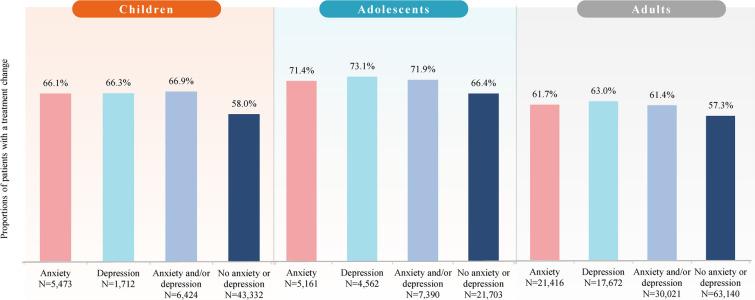
Patients with ADHD initiating pharmacological treatments were identified from IBM MarketScan Data (2014-2018). The index date was the first observed ADHD treatment. Comorbidity profiles (anxiety and/or depression) were assessed during the 6-month baseline period. Treatment changes (discontinuation, switch, add-on, drop) were examined during the 12-month study period. Adjusted odds ratios (ORs) of experiencing a treatment change were estimated. Adjusted annual healthcare costs were compared between patients with and without treatment changes.
RESULTS
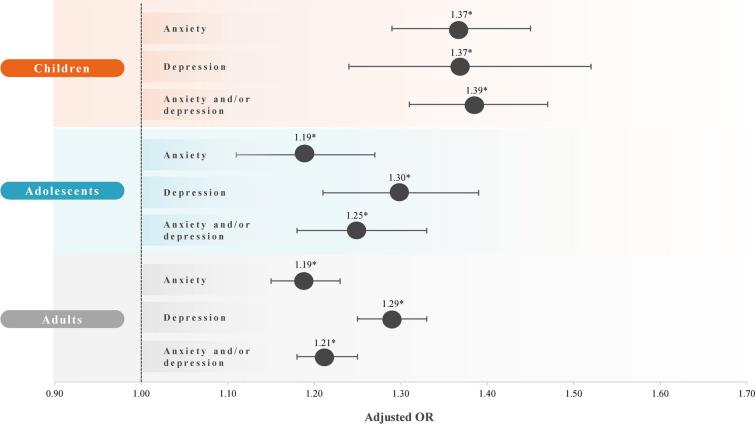
Among 172,010 patients with ADHD (children [aged 6-12] N = 49,756; adolescents [aged 13-17] N = 29,093; adults [aged 18 +] N = 93,161), the proportion of patients with anxiety and depression increased from childhood to adulthood (anxiety 11.0%, 17.7%, 23.0%; depression 3.4%, 15.7%, 19.0%; anxiety and/or depression 12.9%, 25.4%, 32.2%). Compared with patients without the comorbidity profile, those with the comorbidity profile experienced a significantly higher odds of a treatment change (ORs [children, adolescents, adults] 1.37, 1.19, 1.19 for those with anxiety; 1.37, 1.30, 1.29 for those with depression; and 1.39, 1.25, 1.21 for those with anxiety and/or depression). Excess costs associated with a treatment change were generally higher with more treatment changes. Among patients with three or more treatment changes, annual excess costs per child, adolescent, and adult were $2234, $6557, and $3891 for those with anxiety; $4595, $3966, and $4997 for those with depression; and $2733, $5082, and $3483 for those with anxiety and/or depression.
CONCLUSIONS
Over 12 months, patients with ADHD and comorbid anxiety and/or depression were significantly more likely to experience a treatment change than those without these psychiatric comorbidities and incurred higher excess costs with additional treatment changes.
简介
患有注意缺陷多动障碍(ADHD)的患者通常存在精神共病,这可能会使诊断复杂化,并影响治疗结果和成本。本研究描述了美国(美国)患有 ADHD 且伴有焦虑和/或抑郁的患者的治疗模式和医疗保健成本。
方法
从 IBM MarketScan 数据(2014-2018 年)中确定了开始药物治疗的 ADHD 患者。索引日期为首次观察到的 ADHD 治疗日期。在 6 个月的基线期内评估合并症(焦虑和/或抑郁)。在 12 个月的研究期间检查治疗变化(停药、换药、附加、停药)。估计经历治疗变化的调整优势比(OR)。比较有和没有治疗变化的患者的调整后年度医疗保健费用。
结果
在 172,010 名患有 ADHD 的患者中(儿童[6-12 岁] N = 49,756;青少年[13-17 岁] N = 29,093;成年人[18 岁及以上] N = 93,161),焦虑和抑郁的患者比例从儿童期到成年期逐渐增加(焦虑 11.0%、17.7%、23.0%;抑郁 3.4%、15.7%、19.0%;焦虑和/或抑郁 12.9%、25.4%、32.2%)。与没有合并症的患者相比,有合并症的患者经历治疗变化的可能性明显更高(儿童、青少年、成人的 OR [有焦虑的患者] 1.37、1.19、1.19;有抑郁的患者] 1.37、1.30、1.29;有焦虑和/或抑郁的患者] 1.39、1.25、1.21)。治疗变化相关的额外成本通常随着治疗变化的增加而增加。在有 3 次或更多次治疗变化的患者中,有焦虑的儿童、青少年和成年人的每年额外费用为 2234 美元、6557 美元和 3891 美元;有抑郁的患者为 4595 美元、3966 美元和 4997 美元;有焦虑和/或抑郁的患者为 2733 美元、5082 美元和 3483 美元。
结论
在 12 个月内,患有 ADHD 且伴有焦虑和/或抑郁的患者经历治疗变化的可能性明显高于无这些精神共病的患者,并且随着治疗变化的增加,他们的额外费用也会增加。

 Zotero 插件