
贝类消费与尿中邻苯二甲酸酯代谢物之间的关系:韩国国家环境卫生调查(KoNEHS)第3周期(2015 - 2017年)
Relationship between shellfish consumption and urinary phthalate metabolites: Korean National Environmental Health Survey (KoNEHS) cycle 3 (2015-2017).
作者信息
Kang Jisoo, Cho Seong-Yong, Kim Jinseok, Yoon Seongyong, An Jong-Min, Kim Gayoung, Kim Si Young
机构信息
Department of Occupational and Environmental Medicine, Soonchunhyang University Hospital, Gumi, Korea.
出版信息
Ann Occup Environ Med. 2023 Feb 6;35:e2. doi: 10.35371/aoem.2023.35.e2. eCollection 2023.
BACKGROUND
Phthalates are endocrine disrupting chemicals that are widely used in the production of items of daily life such as in polyvinylchloride plastics, insecticides, and medical devices. This study aimed to determine the association between phthalate exposure and shellfish consumption using data from the Korean National Environmental Health Survey (KoNEHS) cycle 3 (2015-2017), which is a nationally representative survey.
METHODS
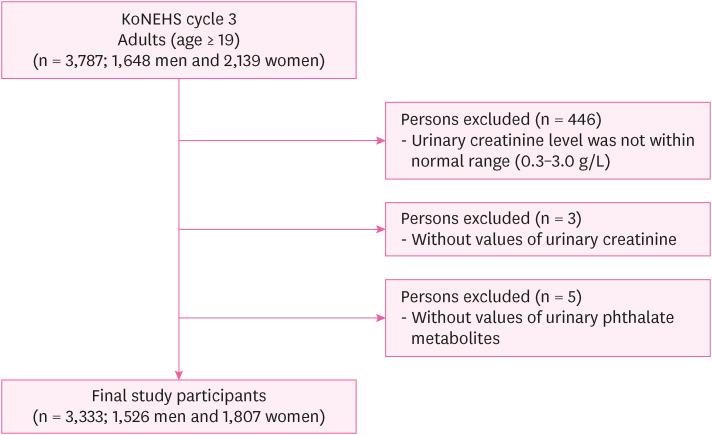
In this study, we analyzed the KoNEHS cycle 3 data of 3,333 (1,526 men and 1,807 women) adults aged more than 19 years. Data related to the variables of sociodemographic factors, health-related behaviors, dietary factors, seafood consumption frequency, and urinary phthalate metabolites concentrations were collected. The concentrations of urinary phthalate metabolites of all the participants were divided into quartiles to define high and low concentration groups based on the 75th percentile concentration. A χ test was conducted to analyze the distribution of independent variables. To analyze the relationship between shellfish consumption and phthalate exposure, the odds ratios (ORs) were calculated using logistic regression analysis.
RESULTS
Total adults with shellfish consumption frequency of over once a week showed the following adjusted ORs for high concentrations of the following metabolites compared with the group that consumed shellfish once a week or less: 1.43 (95% confidence interval [CI]: 1.01-2.06) for mono-(2-ethyl-5-oxohexyl) phthalate (MEOHP), 1.43 (95% CI: 1.01-2.03) for mono-(2-ethyl-5-carboxypentyl) phthalate (MECPP), 1.57 (95% CI: 1.10-2.24) for ∑di-2-ethylhexyl phthalate (∑DEHP), 2.01 (95% CI: 1.46-2.77) for mono-carboxyoctyl phthalate (MCOP), 1.56 (95% CI: 1.11-2.18) for mono-carboxy-isononly phthalate (MCNP), and 2.57 (95% CI: 1.85-3.56) for mono (3-carboxypropyl) phthalate (MCPP).
CONCLUSIONS
The concentrations of urinary phthalate metabolites (MEOHP, MECPP, ∑DEHP, MCOP, MCNP, and MCPP) were higher in adults with a higher frequency of shellfish consumption.
背景
邻苯二甲酸酯是一类内分泌干扰化学物质,广泛应用于日常生活用品的生产,如聚氯乙烯塑料、杀虫剂和医疗设备。本研究旨在利用韩国国家环境卫生调查(KoNEHS)第三轮(2015 - 2017年)的数据确定邻苯二甲酸酯暴露与贝类消费之间的关联,该调查具有全国代表性。
方法
在本研究中,我们分析了3333名(1526名男性和1807名女性)19岁以上成年人的KoNEHS第三轮数据。收集了与社会人口学因素、健康相关行为、饮食因素、海鲜消费频率和尿邻苯二甲酸酯代谢物浓度等变量相关的数据。根据第75百分位数浓度将所有参与者的尿邻苯二甲酸酯代谢物浓度分为四分位数,以定义高浓度组和低浓度组。进行χ检验以分析自变量的分布。为了分析贝类消费与邻苯二甲酸酯暴露之间的关系,使用逻辑回归分析计算优势比(OR)。
结果
与每周食用贝类一次或更少的组相比,每周食用贝类频率超过一次的成年人中,以下代谢物高浓度的调整后OR如下:单(2 - 乙基 - 5 - 氧代己基)邻苯二甲酸酯(MEOHP)为1.43(95%置信区间[CI]:1.01 - 2.06),单(2 - 乙基 - 5 - 羧基戊基)邻苯二甲酸酯(MECPP)为1.43(95% CI:1.01 - 2.03),总和二(2 - 乙基己基)邻苯二甲酸酯(∑DEHP)为1.57(95% CI:1.10 - 2.24),单羧基辛基邻苯二甲酸酯(MCOP)为2.01(95% CI:1.46 - 2.77),单羧基异壬基邻苯二甲酸酯(MCNP)为1.56(95% CI:1.11 - 2.18),单(3 - 羧基丙基)邻苯二甲酸酯(MCPP)为2.57(95% CI:1.85 - 3.56)。
结论
贝类消费频率较高的成年人尿邻苯二甲酸酯代谢物(MEOHP、MECPP、∑DEHP、MCOP、MCNP和MCPP)浓度更高。
 Zotero 插件